
Volume 0: Foundation
Volume 0, The IS–HAS–DOES Modelling System
Section titled “Volume 0, The IS–HAS–DOES Modelling System”The formal ground on which every other volume stands. Eight terms, three closure rules, three theorems, and the deeper kernel/surface architecture that proves the eight primitives desugar to a kernel with only entities, transitions, and composition.
This is the academic foundation. Volume I chapter 2 (Subjects) operationalizes this system as Primmel’s subject anatomy; this volume proves why that anatomy is exhaustive rather than heuristic, and how it relates to the broader landscape of modelling methodologies.
Why this volume exists
Section titled “Why this volume exists”Most modelling systems are notations, UML, BPMN, EXPRESS, OPM, RDF/OWL, each with its own vocabulary, its own diagram conventions, its own meta-model, its own escape hatches where the notation stops and code begins. None of them prove themselves closed under their own operations.
This volume does. It defines a minimal algebra 𝓜, proves the algebra is closed, complete (relative to a stated axiom), and extensible, and then shows that the algebra can be reduced further, to a kernel with only entities, transitions, and composition, while the eight primitives remain useful as a surface vocabulary that desugars to the kernel. That two-tier architecture, arrived at independently by SysML v2 / KerML for different reasons, is the load-bearing result.
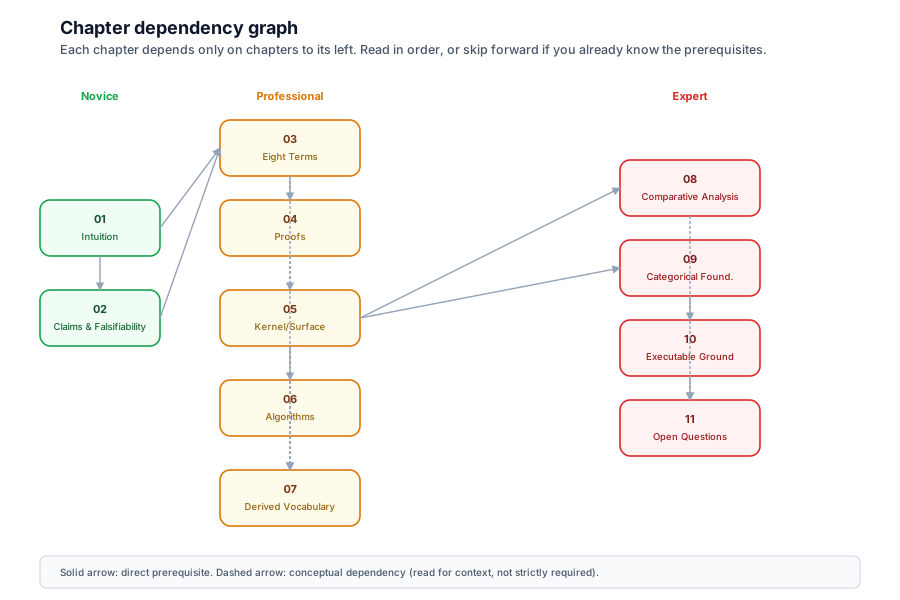
If you only read one chapter, read Chapter 1 (Intuition). If you read three, add Chapter 3 (Eight Terms and Closure Rules) and Chapter 4 (Proofs).
Reading tracks
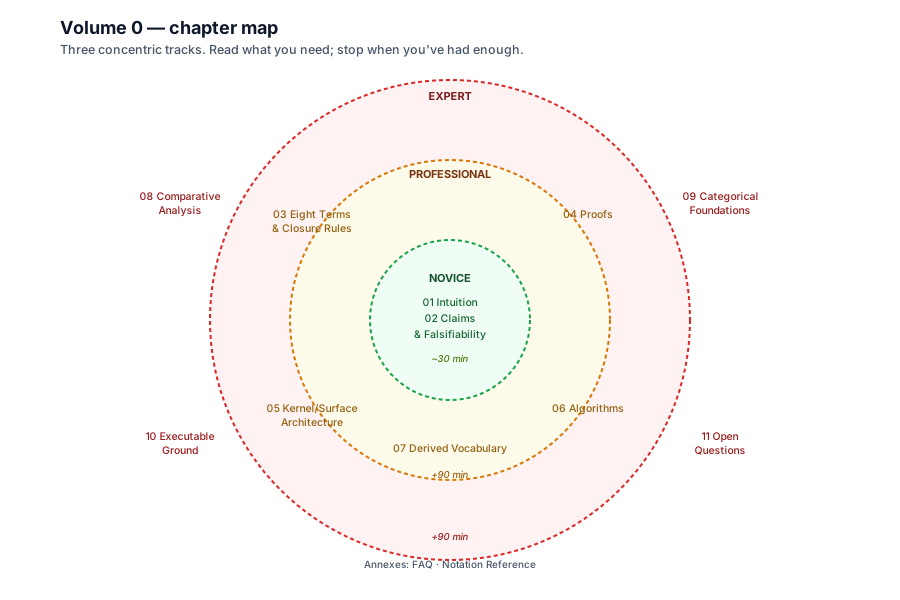
Section titled “Reading tracks”The volume is layered by depth. Read what you need; stop when you’ve had enough.
Novice track, chapters 1–2 (~30 minutes)
Section titled “Novice track, chapters 1–2 (~30 minutes)”Goal: understand what IS/HAS/DOES is, why it’s three buckets and not seven, what it claims, and what would refute it.
- Chapter 1, Intuition, the three natural questions, the layers at a glance, the dialectic that killed off candidate primitives (STATE, CAN, RECEIVES, RELATES-TO, BECOMES).
- Chapter 2, Claims and Falsifiability , the Claim-Form Axiom stated upfront; what we claim; what would refute us.
Professional track, chapters 3–7 (+90 minutes)
Section titled “Professional track, chapters 3–7 (+90 minutes)”Goal: model with the system, argue for it, recognize when something is being passed off as a new primitive that is actually a composite.
- Chapter 3, Eight Terms and Closure Rules , the formal algebra 𝓜.
- Chapter 4, Proofs, closure, completeness, extensibility, full rigor.
- Chapter 5, Kernel/Surface Architecture , Tier 0 (entities + transitions + composition) and Tier 1 (the eight primitives) with the desugaring map.
- Chapter 6, Algorithms, elaboration, resugaring, reification, evaluation, state-location.
- Chapter 7, Derived Vocabulary Proofs , six retired terms (STATE, STEP, CAN, RECEIVES, RELATES-TO, BECOMES), each with a full derivation.
Expert track, chapters 8–11 (+90 minutes)
Section titled “Expert track, chapters 8–11 (+90 minutes)”Goal: defend the system against methodological comparison, contribute to its extension, locate the seams where it could break.
- Chapter 8, Comparative Analysis , vs OPM, OOP, UML/fUML, SysML v2/KerML, BPMN, EXPRESS, RDF/OWL, Petri nets; the positioning matrix; the adoption-via-executability thesis.
- Chapter 9, Categorical Foundations , arrows-only category; identity morphisms; Curry–Howard–Lambek; KerML as independent precedent.
- Chapter 10, The Executable Ground, no escape hatch; reification; scale invariance; model=program; adoption lesson.
- Chapter 11, Open Questions, what is not proven; falsifiability; future work.
Annexes
Section titled “Annexes”- FAQ, anticipated objections, Q&A format.
- Notation Reference, every math symbol and LaTeX equivalent used in the volume.
The one-sentence summary
Section titled “The one-sentence summary”Read the layers outward: IS individuates; objects bear; properties and values describe; transitions transform; processes fold transformation back into objecthood. Three closure rules seal the seams. Eight terms, not because eight is a lucky count, but because type and instance were finally separated on both axes, and once that joint is cut correctly, the list stops growing.
Conventions
Section titled “Conventions”This volume follows the documentation tree’s conventions
(docs/README.md §Conventions), with two extensions
specific to formal/math content.
Math notation
Section titled “Math notation”Phases 1–2 of this volume use Unicode math symbols (⊆, →, ∘, ⇀, ↪,
×, ∈, ⊂, ι, ρ, σ). Phase 3 (chapters 8–11) introduces LaTeX-style
rendering via KaTeX for diagrams that demand it (commutative diagrams,
proof-rule inference bars, fractions). The Unicode symbols continue
to render in raw markdown views; KaTeX only kicks in inside $…$ /
$$…$$ delimiters.
See Notation Reference for the full symbol list with LaTeX equivalents.
Status markers
Section titled “Status markers”Following the tree convention:
- ● exists in the running system
- ◐ partial
- ○ planned
Most claims in this volume are mathematical, not implementation, claims; status markers apply only where a claim depends on the runtime actually existing (Chapter 10).
Diagram palette
Section titled “Diagram palette”The volume extends the tree’s standard palette (indigo/green/amber/red/slate/violet for IS/HAS/DOES-specific content) with a formal/math palette for kernel-and-category diagrams:
| Use | Color tokens |
|---|---|
| Kernel / Tier 0 constructs | teal #0d9488, dark #115e59, light #f0fdfa |
| Surface / Tier 1 constructs | gray #475569, dark #1e293b, light #f8fafc |
| Elaboration / desugaring arrows | dashed lines (1.6px stroke) |
Reification (ρ) | double-stroke lines |
| Math notation | monospace font (system stack) |
All diagrams are hand-authored SVG, 900×600 viewBox default, system
font stack (ui-sans-serif, system-ui, sans-serif).
How to cite this volume
Section titled “How to cite this volume”When extending or critiquing the modelling system in another volume, cite specific chapters and sections. For example:
“Volume I chapter 2 §2.2’s IS/HAS/DOES trichotomy is exhaustive under the Claim-Form Axiom (Volume 0 chapter 2 §2.2); the closure of the algebra under composition, reification, and embedding is proven in Volume 0 chapter 4 §4.2.”
If a chapter in Volumes I–III ever seems to introduce a ninth modelling term, treat it as a materialized view (Volume 0 chapter 7) and check what composite it is shorthand for.
Source
Section titled “Source”This volume is the formal reconstruction of the design dialogue that produced the IS–HAS–DOES system through dialectic. The dialogue is the negotiation record; this volume is the developed form. Where prose here and the dialogue disagree, this volume is canonical.
Next: Chapter 1, Intuition.