
FAQ, Anticipated Objections
FAQ, Anticipated Objections
Section titled “FAQ, Anticipated Objections”A Q&A annex. Each question links to the chapter that answers it in depth. If your question isn’t here, consult the chapter dependency graph or the open questions.
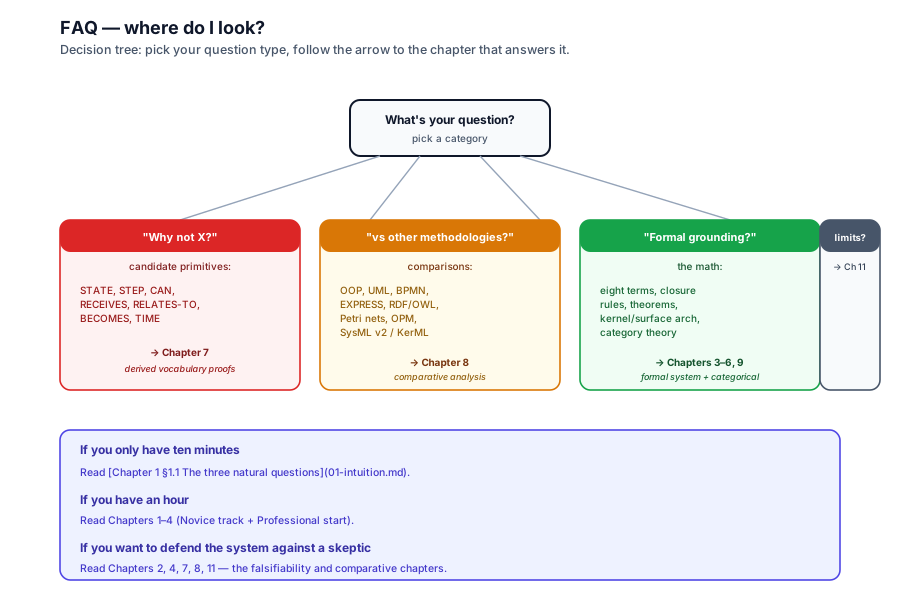
Q1. Why not STATE as a fourth primitive?
Section titled “Q1. Why not STATE as a fourth primitive?”Because STATE is a positional identifier for an execution, not a property of an entity. The word conflates two things:
- Data state (the current value of a property, e.g. temperature 100°C), covered by HAS, no new primitive.
- Control state (which node in the transition graph is active
for a particular run), a pointer pair
(ρ(t), t_i), derivable from the kernel.
Full derivation in Chapter 7 §7.2 STATE.
Q2. Why not CAN as a fourth primitive?
Section titled “Q2. Why not CAN as a fourth primitive?”CAN is a modal operator on DOES, it strips the actualization commitment. “A bird can fly” is “a bird flies” minus the tense. As a quantifier over reifications:
CAN without a condition is too coarse; CAN with a condition is just “DOES under condition C.” Either way, not a primitive. Full derivation in Chapter 7 §7.4 CAN.
Q3. Why not BECOMES? Things change over time
Section titled “Q3. Why not BECOMES? Things change over time”BECOMES is not a fact about an entity, it is a comparison across two facts. “The door becomes closed” is the diff of two timestamped value-readings:
No database has a “BECOMES” column. The verb is convenient; the ontology isn’t. Full derivation (including the caterpillar-butterfly case) in Chapter 7 §7.7 BECOMES.
Q4. What about relations? Things stand in relation to each other
Section titled “Q4. What about relations? Things stand in relation to each other”Relations are HAS with object-valued values. Closure Rule 2
(ι : O ↪ V) permits a value to be a reference to another object:
“owns,” “adjacent-to,” “depends-on,” “part-of,” “employed-by”, all reduce the same way. When the relation itself needs properties (e.g. start-date), reify it as its own object (the ER junction-entity move). Full derivation in Chapter 7 §7.6 RELATES-TO.
Q5. What about TIME?
Section titled “Q5. What about TIME?”Time is ordering from composition, plus timestamps as values. If is well-defined, happened before . No “Time” sort is needed. This is what physicists and process calculi both discovered independently. Full derivation in Chapter 7 §7.8 TIME.
Q6. How is this different from OOP?
Section titled “Q6. How is this different from OOP?”OOP’s escape hatch is the method body. A method signature is a label (name, parameter list, return type); the behavior lives in a separate language (Java, Python, C++) with separate grammar and semantics. The model documents intent; the code implements it; nothing formal ties them together.
The foundation has no escape hatch. A transition decomposes into smaller transitions by the same composition operator, terminating in atomic transitions the runtime provides. Behavior is inside the model all the way down. See Chapter 8 §8.5 OOP and Chapter 10 §10.1 No escape hatch.
Q7. How is this different from UML?
Section titled “Q7. How is this different from UML?”UML has roughly a dozen distinct diagram types (class, object, activity, sequence, state machine, communication, component, deployment, use case, package) because it never unifies structure and behavior under one recursive operator. Each diagram type has its own metaclass and its own semantics; alignment across diagrams is maintained by hand.
The foundation’s claim, composition of transitions is itself a transition, so “step,” “process,” and “system” are the same primitive at different scale, is precisely the unification UML never attempts. See Chapter 8 §8.4 UML/fUML.
Q8. How is this different from BPMN?
Section titled “Q8. How is this different from BPMN?”BPMN is widely adopted because engines exist (Camunda, Flowable, jBPM). But its semantics is defined by prose plus vendor behavior; token flow through inclusive gateways was famously ambiguous for years; conformance means “roughly what the major engines do.”
BPMN proves executability wins adoption; it also proves executability without a formal kernel accumulates semantic debt that can never be repaid. The foundation’s kernel is closed under composition by construction (Theorem 1, Chapter 4); the debt cannot accumulate. See Chapter 8 §8.6 BPMN.
Q9. How is this different from OPM?
Section titled “Q9. How is this different from OPM?”OPM (ISO/PAS 19450:2015) is the closest intellectual relative , unified object/process ontology, one diagram kind. But OPM postulates two irreducible sorts where the foundation derives one sort with object/process as roles. OPM has ~12 hard-coded link types where the foundation’s surface vocabulary desugars to a one-sort kernel. OPM is animated but not executable; the foundation’s kernel is execution.
See Chapter 8 §8.2 OPM for the full comparison.
Q10. What is the Claim-Form Axiom, and why does it matter?
Section titled “Q10. What is the Claim-Form Axiom, and why does it matter?”The axiom (stated in Chapter 2 §2.2):
Every atomic descriptive claim about an entity is one of three forms: an identity claim (what it is), an attribution claim (what it has), or a transformation claim (what it does).
It matters because the completeness theorem (Theorem 2, Chapter 4) is relative to this axiom. We cannot prove the axiom, that would be a Gödel-style impossibility. What we can do is state it explicitly so it can be examined.
If you can exhibit a fourth claim-form, an atomic claim that is neither identity, nor attribution, nor transformation, and cannot be reduced to any of them, the system breaks there.
Q11. Is the system falsifiable?
Section titled “Q11. Is the system falsifiable?”Yes, with four attack points (Chapter 11 §11.2):
- Find a genuine fourth claim-form (attacks Theorem 2).
- Show one of the three closure rules is inconsistent (attacks Theorem 1).
- Show the runtime implementation diverges from the algebra (attacks Chapter 10’s practical claims, not the algebra).
- Show the trichotomy isn’t actually MECE (attacks the system’s structural argument).
Anything else, “I prefer UML,” “the syntax is ugly”, is preference, not refutation.
Q12. Why eight terms, specifically?
Section titled “Q12. Why eight terms, specifically?”Because type and instance were finally separated on both axes. Once you separate:
- the static axis into PROPERTY (the slot) and VALUE (the content), and
- the dynamic axis into TRANSITION (the rule) and PROCESS (the reified transition, an object),
the list stops growing. Eight is not a lucky count; it is the consequence of cutting the type/instance joint correctly. See Chapter 1 §1.4 and Chapter 3.
Q13. Can I extend the system with my own primitives?
Section titled “Q13. Can I extend the system with my own primitives?”No, by design. Theorem 3 (extensibility, Chapter 4) says:
- Adding content (new kinds, properties, values, transitions) is always fine, the algebra grows monotonically.
- Adding primitives is not. A proposed ninth primitive is either reducible to the eight (in which case it’s a composite, not a primitive) or it violates the Claim-Form Axiom (in which case it changes what “modelling” means).
If you find yourself wanting a new primitive, write it as a materialized view (see Chapter 7 for six examples) instead.
Q14. Why a kernel/surface split?
Section titled “Q14. Why a kernel/surface split?”Because the eight primitives are useful for authoring but not irreducible. Pushing the reductions through (Chapter 5) yields a kernel with one sort and one operation, a category. The eight-term surface remains as syntactic sugar that elaborates into the kernel.
Two benefits:
- Minimality: the trusted base (what a conforming runtime implements) is tiny.
- Legibility: authors use the surface vocabulary that matches their mental model.
This is the same architecture SysML v2 / KerML arrived at independently. See Chapter 5 and Chapter 9 §9.6 KerML.
Q15. What does “executable” mean, concretely?
Section titled “Q15. What does “executable” mean, concretely?”A conforming runtime implements five algorithms (Chapter 6):
- Elaboration, desugar Tier 1 statements to kernel triples.
- Resugaring, project kernel triples back to Tier 1 for display.
- Reification (), turn a transition into an object.
- Evaluation, apply a transition to its input.
- State-location (), locate where an execution is.
Anything beyond these five is definition, not implementation. See Chapter 10 §10.5 Specification=implementation.
Q16. What’s not proven?
Section titled “Q16. What’s not proven?”- Decidability. No guarantee that reasoning over an arbitrary model terminates.
- Cartesian-closed verification. We believe the kernel is a CCC (which would give operational semantics via Curry–Howard–Lambek), but have not written the proof.
- Implementation conformance. The runtime contract is a spec; we need second and third implementations to test it.
- Adoption. The foundation’s adoption record is “to be earned.”
See Chapter 11 for the full honest list.
Q17. Where do I start reading?
Section titled “Q17. Where do I start reading?”- Novice, Chapter 1 alone.
- Professional, Chapters 1–7.
- Expert, the whole volume.
If you only have ten minutes, read Chapter 1 §1.1 The three natural questions.
Q18. How does this connect to Primmel (Volume I) and OIML SMART (Volumes II–III)?
Section titled “Q18. How does this connect to Primmel (Volume I) and OIML SMART (Volumes II–III)?”- Primmel operationalizes the eight primitives as a subject anatomy (Volume I, chapter 2).
- Processes in Primmel are reified transitions (Volume I, chapter 4, see Closure Rule 3).
- Mapping between reference and implementation models is HAS-with-reference (Volume I, chapter 5, Closure Rule 2).
- The OIML subject chain (Family → Group → Model → Sample) is the IS relation at four grains (Volume II, chapter 2, Closure Rule 1).
If a chapter in Volumes I–III ever seems to introduce a ninth modelling term, treat it as a materialized view (Chapter 7) and check what composite it is shorthand for.
Back to Volume 0 README.