
Chapter 5, Mappings
Chapter 5, Mappings
Section titled “Chapter 5, Mappings”In this chapter: the two model kinds (reference and implementation), the mapping relation between them, and the coverage calculus that turns “are we compliant?” into graph computation.
5.1 The voices in a mapping
Section titled “5.1 The voices in a mapping”Chapter 1 introduced the model kinds; this chapter makes them precise.
A reference model speaks for the standard: its processes read as “a process is required”, its provisions are the normative statements, its registries are the evidence the standard demands. A reference model is faithful (reviewed by professionals), machine-applicable, machine-readable, transferable.
An implementation model speaks for an organization: its processes are the organization’s actual operations, a digital twin of reality. It is not a “special case” of the reference model. It is a different model, of a different thing (the organization, not the standard), authored by different people, evolving on a different clock.
The twin direction adds a third speaker ● (task 36): the product reference model, a manufacturer’s model of their own product, a reference model in kind but speaking for the product, not the standard. It stands to the standards-reference model in exactly this chapter’s relation: mapped aspect by aspect, with description and justification (chapter 15).
Because the two models are different things, their relation cannot be inheritance or refinement. It is mapping.
5.2 The mapping relation
Section titled “5.2 The mapping relation”A mapping links one implementation-model component to one reference-model component with implication semantics:
A ⇒ B, fulfilling A fulfils B.
Two properties to internalize:
- Not equivalence. A ⇒ B does not give you B ⇒ A. The implementation may be stricter than the standard requires (an inventory list fulfils “equipment maintenance”, but maintenance is achievable without one).
- Not refinement. A mapping crosses models; nothing is inherited.
The implementation process keeps its own anatomy; the mapping is a
claim about it, with:
- description, how the fulfillment works;
- justification, why the claim holds (optional per pair, demanded by auditors).
Mappings attach at process granularity by default, but any typed component can be mapped: a registry to a required-evidence registry, an approval step to a required approval, a measurement test to a provision.
5.3 The coverage calculus
Section titled “5.3 The coverage calculus”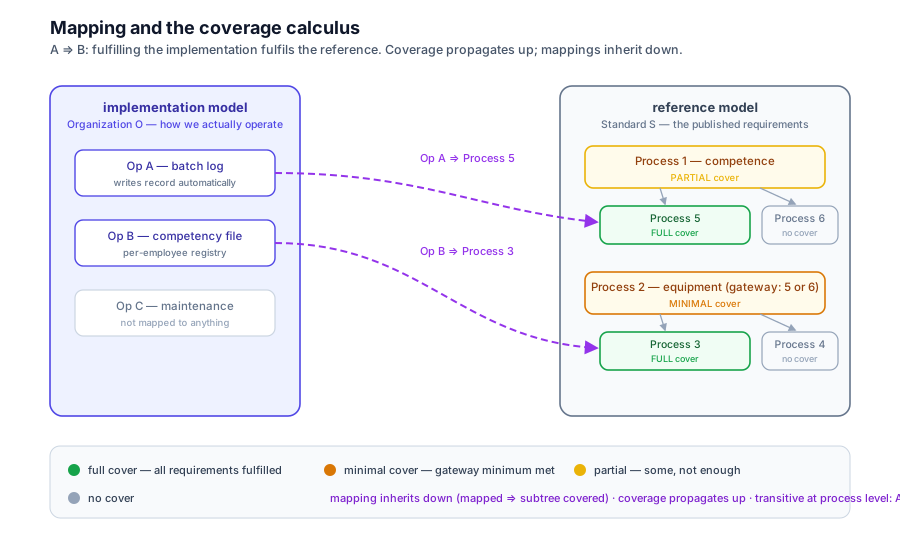
Coverage answers, per reference-model component: how much of this is fulfilled by mapped implementations? Four levels:
| Level | Meaning |
|---|---|
| full cover | all requirements of the component are fulfilled |
| minimal cover | the gateway minimum is met (e.g. “at least one of these options”), but not all branches |
| partial cover | something is mapped, not enough to claim the minimum |
| no cover | nothing mapped |
Three propagation rules make coverage a computation, not an opinion:
- Inheritance (downward). A mapped process covers its entire subprocess tree: mapping to the parent is a claim that the whole subtree is fulfilled.
- Aggregation (upward). A parent is covered when its children are: all children full ⇒ parent full; gateway children with the minimum met ⇒ parent minimal; otherwise partial or none.
- Transitivity (process level). A ⇒ B and B ⇒ C ⊢ A ⇒ C. At model level transitivity does not hold in general (two mappings with no common component carry no logical information).
A fourth rule, closure, all children mapped ⇒ parent covered without a direct mapping, is the standard discovery heuristic and is computed by tooling, flagged for confirmation rather than asserted.
Transitivity at process level is also what lets the calculus chain: user ⇒ product ⇒ standard. An instrument user’s implementation model maps to a manufacturer’s product reference model; that model maps to the Recommendation; together they carry user ⇒ standard through the mapped aspects, while model-level non-transitivity stands guard, so compliance flows only through shared components, and the coverage report says where it doesn’t. Chapter 15 develops this supply chain in full.
5.4 Discovery
Section titled “5.4 Discovery”Given existing mappings, the engine proposes new ones by transitivity and inheritance (the “auto-mapper”): seed the obvious pairs, then let the calculus enumerate candidates across a repository of models, and have a human confirm with justification. Discovery scales the audit question, which organizations have mapped to clause 4.4, and which haven’t?, from a document chase to a query.
5.5 Serialization
Section titled “5.5 Serialization”Two equivalent forms; pick per maintenance style:
In-model (map_profile in the .prl file):
map_profile StdS { mapping { OpA -> StdS#Process5 OpB -> StdS#Process3 }}Per-pair metadata blocks (description / justification / coverage)
extend any pair in v3: OpA -> StdS#Process5 { description "…" coverage full }.
Standalone .prm file (JSON), richer per-pair metadata, versioned
independently of the models:
{ "@type": "Primmel_MAP", "id": "OrgO-to-StandardS", "mapSet": { "StdS": { "id": "StdS", "mappings": { "OpA": { "StdS#Process5": { "description": "Automatic batch logging fulfils the record requirement.", "justification": "The roaster writes the batch record on batch completion." } } } } }}Cross-model references use the Namespace#ElementID aliasing
pattern: the implementation model declares local copies of the reference
elements it maps to (e.g. StdS#Process5), and provisions/references
resolve to the same clause in the source .prd extract.
5.6 The mapping space: layers, imports, multi-targets, views
Section titled “5.6 The mapping space: layers, imports, multi-targets, views”Four properties finish the theory. Each is simple; together they make the ecosystem legible.
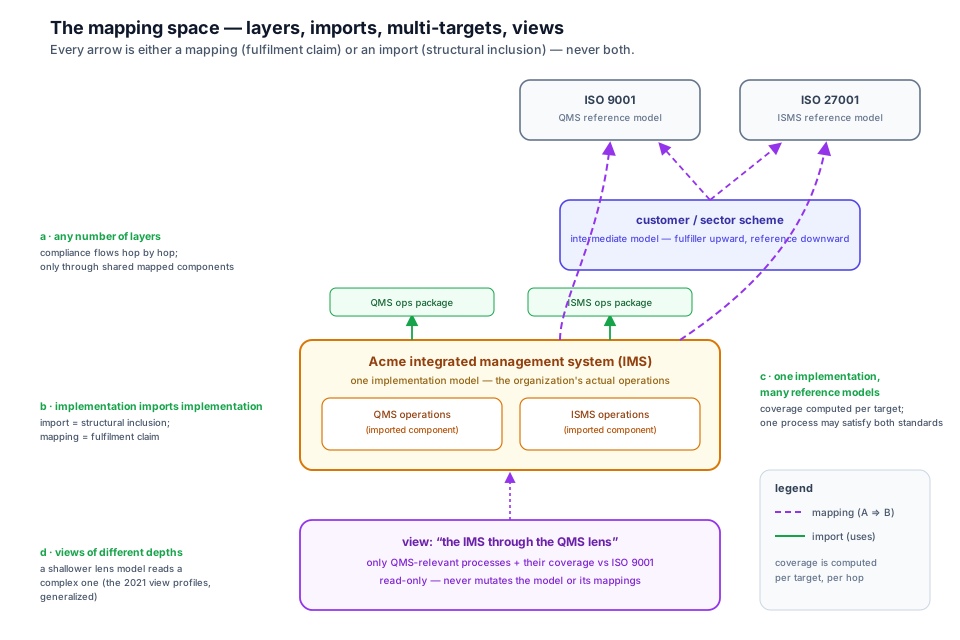
a · Any number of layers. Reference and implementation are roles at the ends of a chain, not a binary. An intermediate model, a sector scheme, a corporate policy manual, a manufacturer’s product model, is a fulfiller toward the layers above and a reference for the layers below. Compliance flows hop by hop; the model-level non-transitivity of §5.3 is the guardrail: nothing flows except through shared mapped components. (Chapter 15’s supply chain is this property’s home turf.)
b · Import ≠ mapping. Implementation models may import each other
(uses composition): an integrated management system includes its QMS
operations and its ISMS operations as components. Import is structural
inclusion, “my model contains yours”. Mapping is a fulfilment claim ,
“my process fulfils your requirement”. An integrated system does both:
it imports its components and maps to its standards. Confusing the
two is how compliance gets double-counted.
c · One implementation, many reference models. mapSet is per
target namespace for a reason: the same operations model maps to ISO
9001, to ISO 27001, to a customer scheme, with coverage computed per
target. And a single process may fulfil provisions in several standards
at once: that is the entire economic argument for integrated systems
(“write once, comply twice”), and the mapping set is what proves it
instead of asserting it.
d · Views of different depths. A complex model can be read through a shallower one. Viewing the integrated system through the QMS lens shows only the QMS-relevant processes and their coverage against ISO 9001, the organization sees one standard at a time while the model stays whole. A view is either a filtered rendering (a view profile, carrying no provisions of its own) or a deliberate lens model placed in the chain. Views never mutate the underlying model or its mappings. (The 2021 view profiles, generalized.)
5.7 Why the OIML-CS case matters
Section titled “5.7 Why the OIML-CS case matters”The running OIML SMART system already contains the pattern, unnamed:
the platform’s certification workflow (evaluation/) is an
implementation model of the OIML-CS process (PD-05), and the PD-05
clause references in its approvals are embryonic mappings. Naming it
gives the ecosystem a plan:
- PD-05 published as its own reference package (the certification scheme’s requirements);
- the platform workflow re-homed as an implementation package, mapped to PD-05, its coverage calculus then answers “how much of PD-05 does this platform fulfil?”;
- per-lab implementation models of R 60-2 test methods, each lab’s SOP mapped to the Recommendation’s required methods, its coverage answering “is this lab’s procedure a fulfilment of R 60-2?”;
, all in one relation, one calculus, one audit view.
5.8 Validation rules
Section titled “5.8 Validation rules”- both ends of a mapping resolve (implementation component and
Namespace#ElementIDreference element); - no mapping from a reference component to an implementation component (direction is fixed);
- an import (
uses) may not be expressed as a mapping, nor a mapping as an import, inclusion and fulfilment are different claims (§5.6 b); - a view never adds, removes, or edits mappings of the model it reads (§5.6 d);
- coverage claims are computed, not authored, an authored coverage assertion that disagrees with the calculus is an error;
- a mapping without description is a warning at audit strictness.
5.9 Summary
Section titled “5.9 Summary”- Reference speaks for the standard; implementation speaks for the organization; workspace speaks for the evidence.
- Mapping is implication (A ⇒ B), with description and justification , never equivalence, never refinement.
- Coverage is a calculus: inherit down, aggregate up, transitive at process level, closure by discovery.
- The mapping space: chains of any depth (compliance flows hop by hop through shared components); import ≠ mapping (inclusion ≠ fulfilment); one implementation may map to many references (coverage per target); views read complex models through shallower lenses without touching them.
- One relation serves publishers, implementers, operators and auditors alike.
Next: Chapter 6, Data and values: registries, variables, quantities, tables and time.