
Chapter 1, Philosophy and Tiers
Chapter 1, Philosophy and Tiers
Section titled “Chapter 1, Philosophy and Tiers”In this chapter: why Primmel exists, the design principles every language decision answers to, and the tier system, the single organizing fact about every model you will ever write.
1.1 The problem: standards are texts
Section titled “1.1 The problem: standards are texts”A standard, as published, is prose. A conformance requirement like
“The value of the largest load applied to a load cell during test […] shall not be greater than E_max.”, OIML R 60-1:2021, clause 5.2
carries, in one English sentence, at least five machine-relevant facts:
a subject (a load cell), an aspect of it under test (the largest
applied load, d_max), another aspect (its maximum capacity, E_max),
a constraint (d_max ≤ E_max), and a provenance (clause 5.2).
In prose, all five are fused. Every reader, manufacturer, test lab,
certification body, regulator, must re-derive them, and every pair of
readers can disagree about what was derived.
The document-centric industry answers (tag the paragraph as a “requirement” in a requirements database; classify it in an ontology) stop at the first of the five facts. They make the text findable. They do not make the semantics executable: you still cannot ask “does this instrument pass?” and get a computed answer.
Primmel’s claim: a standard can be modelled so that all five facts are first-class, typed, and related, and then the standard runs.
1.2 What “executable” means
Section titled “1.2 What “executable” means”A Primmel-modelled standard admits four machine operations:
- Validate, the model itself is checked: every reference resolves, every constraint’s inputs are bound, every test’s acceptance derives from a requirement, every form’s fields bind into the subject graph.
- Query, the model answers structural questions: which requirements apply to accuracy class C? Which tests verify this requirement? What evidence must this lab produce?
- Execute, the model runs: applicability expands per subject, calculations evaluate, state machines transition, gateways route, verdicts are re-computed from evidence.
- Reason, the model supports inference over its relations: mapping coverage (what of the standard is fulfilled?), traceability (why does this verdict exist?), coverage (which aspects are unconstrained?).
If a model cannot do all four, it is a document in a costume.
1.3 Design principles
Section titled “1.3 Design principles”Every construct in Primmel v3 answers to these principles. When two designs compete, the one that better satisfies this list wins.
Formal grounding. Each of these principles is grounded in , and partially follows from, the IS–HAS–DOES modelling system proven in Volume 0. Where a principle is a direct consequence of one of Volume 0’s theorems or closure rules, the grounding is noted inline. Where the principle is a pragmatic choice (not a theorem), it stands on its own.
-
The model is the source of truth. Domain content lives in models; tooling is a pure engine. Adding a requirement, attribute, or form is a model edit, never a code edit. Grounded in Volume 0 ch 10 §10.5: specification equals implementation.
-
Executable semantics, or it isn’t modelled. Every construct has a defined meaning to a machine, a validation rule, an evaluation, a transition, not just a rendering. Grounded in Volume 0 ch 10: the foundation has no escape hatch, behavior is inside the model all the way down.
-
MECE. Every concept has exactly one canonical definition point. If two constructs overlap, one is deleted or one becomes a facet of the other. Grounded in Volume 0 ch 4 §4.3 Theorem 2: completeness relative to the Claim-Form Axiom, every atomic claim falls into exactly one of IS/HAS/DOES.
-
OCP. Layers and packages are open for extension, closed for modification: a new Recommendation, capability, or aspect kind is added without editing existing models. Grounded in Volume 0 ch 4 §4.4 Theorem 3: extensibility, new content is absorbed without new primitives; extension is monotone.
-
Closed under reference. Every identifier used anywhere resolves to a declared element. No dangling references, no undefined variables. Grounded in Volume 0 ch 3 §3.8 Closure Rule 2: values hold references (ι : O ↪ V), every relation is a property-value pair whose value points at an object.
-
Traceability. Every element carries provenance to the source document; every judgment carries its evidence chain. Operational consequence of Volume 0 ch 6 §6.4 Reification: every process instance is an object ρ(t) ∈ O, individuated by IS and queryable by HAS, the trace is the model at instance grain.
-
One rule language. All computable statements, constraints, derivations, guards, conditions, are OCL. No second expression dialect anywhere. Pragmatic choice (not a theorem): Primmel’s surface picks OCL as the canonical transition-decomposition language. The algebra itself is neutral on which expression language fills the kernel’s atomic transitions; see Volume 0 ch 5 §5.2.
1.4 The tier system
Section titled “1.4 The tier system”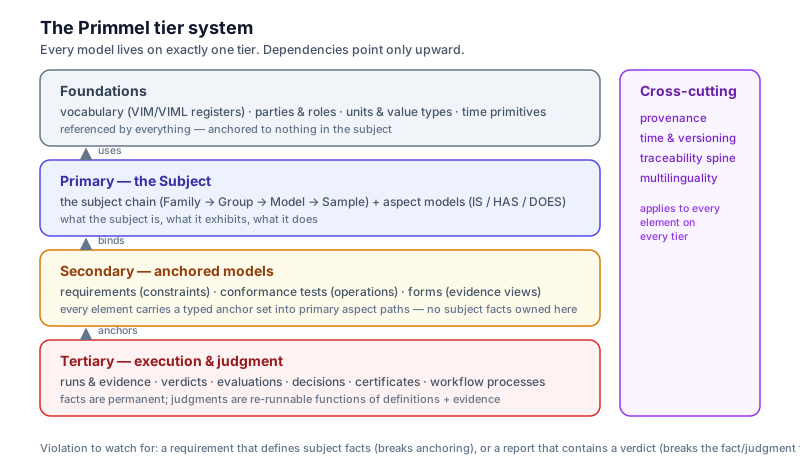
Every model element in Primmel lives on exactly one tier:
| Tier | What lives there | Examples |
|---|---|---|
| Foundations | what everything references and nothing in the subject anchors | vocabulary registers (VIM/VIML), parties & roles, units & value types, time primitives |
| Primary | the subject and its aspects | the instrument chain, attributes, behaviors, conditions, state |
| Secondary | models anchored to primary aspect paths | requirements (constraints), conformance tests (operations), forms (evidence views) |
| Tertiary | execution and judgment over secondary × primary instances | test runs, evidence records, verdicts, evaluations, decisions, certificates, workflow processes |
| Cross-cutting | properties of every element on every tier | provenance, time & versioning, traceability, multilinguality |
The dependency law: dependencies point only upward. Foundations depend on nothing. The primary tier depends only on foundations. The secondary tier depends on foundations and the primary tier. The tertiary tier depends on all three. A downward reference is a modelling error , and the linter catches it.
Why does this matter? Because it is what makes models recombinable. A requirement package can be re-targeted to a revised subject without rewriting, because secondary models never contain subject facts, they only bind them. An evaluation can be re-run against new limits without re-testing, because tertiary judgments never contain evidence, they only consume it.
The tertiary tier also has a continuous member ○: the monitor, a process that re-runs the same evaluations against live subject instances indefinitely, and judgment keeps pace with the product (chapter 14).
The two firewall rules
Section titled “The two firewall rules”The tier law has two named consequences you will meet constantly:
- The anchoring rule (secondary ⇏ facts). A secondary model owns no
subject facts. A requirement binds aspect paths (
model.parameters.e_max); it never redefines them. If you find yourself typing a number that “belongs to the instrument” inside a requirement, stop, that number is a primary-tier value, or a limit in a table the requirement references. - The fact/judgment firewall (evidence ⇏ verdicts). A test report contains no verdicts; a run contains no pass/fail. Facts are permanent; judgments are re-runnable functions over definitions and facts. If a report says “pass”, the schema is broken.
1.5 Anchoring and the coverage theorem
Section titled “1.5 Anchoring and the coverage theorem”Secondary models are not merely allowed to reference the primary tier , they are defined by their references:
- A requirement is a constraint over aspect paths.
- A conformance test is an operation on the subject: it constrains inputs, environmental context and state, and observes outcomes.
- A form is a view projecting the subject graph into a record.
Every secondary element therefore carries a typed anchor set, the list of primary aspect paths it binds, operates on, or projects. This has a profound consequence:
Coverage is mechanically checkable. An aspect with no requirement is unconstrained. A requirement with no test is unverifiable. A test with no form leaves no evidence. A form with no evaluation leaves no judgment. The closure aspect ↔ requirement ↔ test ↔ form ↔ verdict is a graph property, computed by the linter, not a review opinion.
1.6 Model kinds
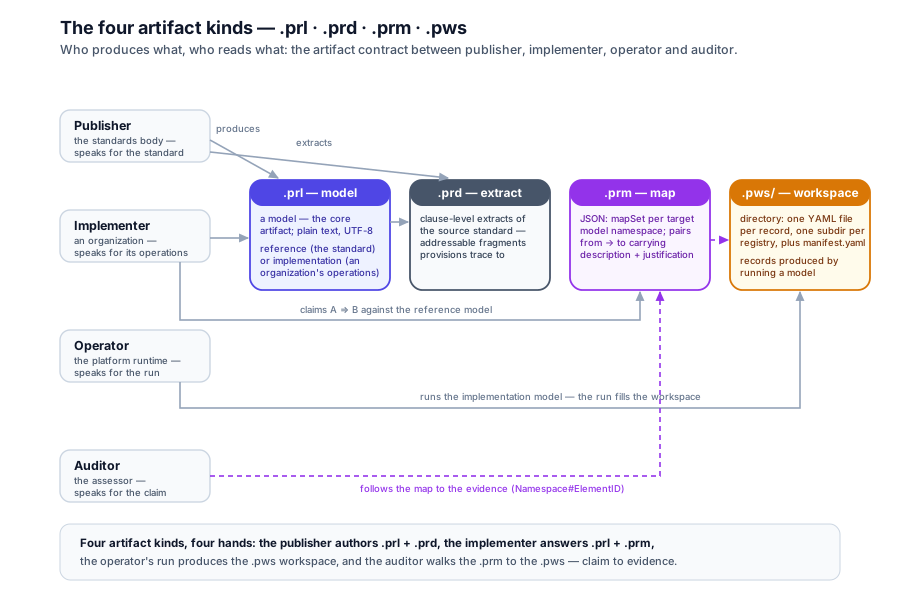
Section titled “1.6 Model kinds”Primmel authors three kinds of models, and the kind of a model says who it speaks for:
- Reference model, the semantic content of a standard document, published by the standards body. Faithful, machine-applicable, machine-readable, transferable. Speaks for the standard.
- Product reference model ●, a manufacturer’s model of their own product: what it is and claims, mapped aspect-by-aspect to the standards-reference model. Speaks for the product. The instrument user consumes it in two modes, abstract import (static, version-pinned) or live integration (the twin of chapter 14 inside their own implementation model); chapter 15 develops the supply chain.
- Implementation model, the operations of an organization: its actual processes as a digital twin of reality. Speaks for the organization. (Chapter 5 develops the mapping relation between them.)
- Workspace, the records produced by running implementation models: one store per registry, one file per record. Speaks for the evidence.
A standards publisher publishes reference models. A manufacturer publishes a product reference model ○ mapped to the standard’s. A lab or certification body publishes implementation models mapped to them. The platform runs implementation models and fills workspaces.
1.7 Artifact kinds
Section titled “1.7 Artifact kinds”Four artifact kinds carry these models on disk:
| Artifact | Kind | Contents |
|---|---|---|
.prl | file | a model, the core artifact; plain text, UTF-8 |
.prd | file | a Primmel Document, clause-level extracts of a source standard: the addressable fragments provisions trace to (chapter 9) |
.prm | file | a Primmel Map, a JSON mapping between two models, with per-pair description and justification (chapter 5) |
.pws/ | directory | a Primmel Workspace, records produced by running a model: one YAML file per record, one subdirectory per registry, a manifest.yaml at the root |
1.8 What Primmel v3 is not
Section titled “1.8 What Primmel v3 is not”Patterns from adjacent approaches that were examined and deliberately
rejected (see shared/alternatives-audit.md for the full comparison):
- Requirements-database rows. Not a flat list of tagged paragraphs with cross-references (the ReqIF profile pattern). Requirements here are constraints bound to a subject model.
- Narrative-fragment ontologies. Not a classification of text spans (the content-ontology pattern). Provisions here are typed, bound, and evaluated, the text is a rendering, not the model.
- Diagrams with semantics by convention. Not boxes-and-arrows whose meaning lives in a style guide. Every construct has execution semantics.
- A second expression language. All computable statements are OCL.
- BCP 47 language tags. Multilingual content carries ISO 24229 spelling codes instead (chapter 10), precise, registry-resolvable identifications of language, script and conversion system.
1.9 Summary
Section titled “1.9 Summary”- A standard can be modelled so its semantics execute; anything less is a document in a costume.
- Every element lives on one tier; dependencies point only upward; secondary models anchor to the primary tier and own no facts; evidence and judgment are firewalled apart.
- Anchoring makes coverage a graph property: completeness of requirements, tests, forms and verdicts is computed, not opined.
- Three model kinds (reference, implementation, workspace) answer “who
speaks”; four artifact kinds (
.prl,.prd,.prm,.pws) answer “how it is stored”.
Next: Chapter 2, Subjects: the center of the primary tier and its IS/HAS/DOES anatomy.