
Annex: Platform
The SMART Platform Runtime
Section titled “The SMART Platform Runtime”In this volume: the platform as the engine that executes the models , the Primmel packages as the single source of truth with the YAML trees and generated code derived from them, the build pipeline, the IndexedDB stores compiled from the store manifest, the engines (applicability, verdict, form-context, state-walk, dispatch), the role consoles and public register, the hybrid server-rendered shell, and the command gates that keep every claim in this tree honest.
The runtime chapters that postdate this overview: Simulated Instruments (the SST wind tunnel) · The Twin Lab (the generic twin workbench) · Multi-standard projection (the auditor lenses) · The composite twin (the weakest declared link) · The CNML bridge (sign + verify) · The program config seam (OIML SMART as instance #1) · Primmel Studio (the authoring tool, canvas, mapper, diff, simulation).
Status markers: ● exists in the running system · ◐ partial · ○ planned
for v3. Paths are relative to the oimlsmart/smart repository.
B.1 The engine, not the content
Section titled “B.1 The engine, not the content”The platform’s founding rule is design principle 1 of the language:
the model is the source of truth; tooling is a pure engine. All
Recommendation content, subject model, requirements, conformance tests,
forms, workflow, state machines, lives in the Primmel packages
(primmel-packages/, the single source of truth since the task-31b
flip, ● smart a549dab); the data/<rec>/ YAML trees are downstream
generated artifacts, regenerated from the packages and proven byte-clean
in both directions by npm run test:ssot. Services and composables
contain no domain content: adding a requirement, attribute, form, or
state transition is a model edit, never a code edit, and adding a new
Recommendation means a new package with zero schema changes
(docs/architecture.md §4).
The browser app (browser/, a typed component-based rendering layer)
renders the Recommendation content and runs the entire certification
workflow from that data: application, dispatch, testing, evaluation,
certificate, register (Volume IV). What follows is how the engine is
built.
B.2 Four layers, one direction
Section titled “B.2 Four layers, one direction”Layer 0 Vocabularies ../vocab/datasets/{viml-2022, vim-2012} (glossarist registers)Layer 1 Metamodel ontology-remix/OIML Core Models/Ontology/oiml-core-ontology.yaml (v0.6.1) + R 60 domain profile (ontology-remix/OIML Recommendation Models/)Layer 2 Domain data data/r60/ — model/ entities/ specification/ execution/ evaluation/Layer 3 App instances IndexedDB entities, seeded from data/r60/sample-data.yamlDependencies point only upward, the tier law, realized as a build.
Layer 2 instantiates layer 1 (the R 60 profile is data, not schema);
layer 3 is runtime instances of layer 2’s storable classes. The subject
chain, MeasuringInstrumentModelFamily → Group → Model → Sample
(VIML 4.02 / 4.06 “type” / 4.09), is the center: requirements bind to
the Model, tests run on Samples, evaluation aggregates back to the
Model (docs/architecture.md §2).
B.3 The build pipeline
Section titled “B.3 The build pipeline”Everything under browser/src/data/generated/ is generated at build
time and gitignored, never edited by hand; the YAML is changed and
the build regenerates. The pipeline (browser/build/, wired as vite
plugins + tsx scripts):
| Stage | Module | What it emits |
|---|---|---|
| discovery | standards-registry.ts | the standard set, every data/*/standard.yaml |
| generation | standards-generator.ts + standards-plugin.ts | per-standard generated TS from the YAML |
| vocabularies | vocab-plugin.ts | vocab-registers.ts from the glossarist registers (missing vocab dir → stub + warning; the build never fails) |
| types + stores | data-types-codegen.ts (npm run codegen:types) | canonical TS interfaces from entities/*.yaml + the store manifest (stores, indexes, FK edges) |
| seed | sample-data-compiler.ts | compiled entity flows from data/r60/sample-data.yaml (13 real-certificate flows) |
| validation | schema-validator.ts | AJV validation against data/schemas/*.yaml |
Since the Primmel v2 program (W6, ●), the same artifacts can be built
from a Primmel package: SMART_STANDARDS_SOURCE=primmel compiles
primmel-packages/oiml-r60 into the identical generated output, with
zero validation errors, the runtime cannot tell which source fed it.
That is the runtime plug: packages in, running standard out.
B.4 Stores: the manifest is the schema
Section titled “B.4 Stores: the manifest is the schema”Entity classes in data/r60/entities/*.yaml declare their own
persistence: store, indexes, and inlined reference fields
(reference(Class) + required + on_delete: cascade | nullify | restrict). The store manifest compiles those declarations into the
IndexedDB schema; runtime modules are manifest-driven, not hand-rolled:
browser/src/composables/database.ts,STORE_SCHEMAfrom the manifest; everyindexedDB.openis bounded by a 10 s timeout with one fresh retry, so a navigation racing the first-boot open rejects instead of wedging every island ongetDb();browser/src/data/entity-registry.ts, the manifest-driven registry;browser/src/composables/useSampleData.ts, the single seeder (layer 3 bootstrap).
There is no separate relationships file and no hand-maintained type layer: the FK graph and the TypeScript interfaces are two projections of the same entity declarations.
B.5 The engines
Section titled “B.5 The engines”Five engines evaluate the models; all are data-driven.
- The applicability engine (
browser/src/data/applicability.ts) , the ONE applicability engine, built per standard from its dimension registry (model/instrument.yaml). Every consumer, program.service form programs, the dimensions page, verdict filtering, report rows , evaluates through it. It handles dimension conditions (any/all, missing-value policy), category subsumption (implies:on dimension values, R 91 average-speed ⇒ fixed-distance), and runtime class-driven instantiation (instances:on conformance tests, R 60’sn_runs: A/B = 5, C/D = 3). ● - The verdict service (
browser/src/services/verdict.service.ts) , re-executes each applicable requirement’s limit against bound evidence: pass / fail / indeterminate per requirement × sample, with evaluator override. Acceptance quantities are declared once as VerdictQuantities (data/r60/specification/verdicts.yaml); the per-standard registry (browser/src/data/verdict-registry.ts) parses each derivation once at standard load and caches the ASTs. Input resolution follows one chain: entity attribute → observable form evidence (series-aware) → profile-bound symbol → formula symbol. Preconditions fire before limits (a violation voids the run ,invalid, neverfail); modality shades the outcome (a failedshouldis an observation, never a blocker). ● - The form-context binding engine (
browser/src/data/form-context.ts) ,resolveBind/writeBind/persistBindingContext. Form fields withbind:paths (164 of them across the R 60-3 forms) prefill from the resolved subject chain and write through to the owning entity on submit;FormInstance.valueskeeps only unbound entries (stripBoundFields). The vocabulary:model.parameters.e_max,sample.test_context.d_max,family.classification.accuracy_class, plus read-only identity paths (sample.serial_number,test_report.report_number). Form-level verdict fields evaluate through the same cached registry (data/form-calculation.ts), so a form and a requirement can never diverge on the same quantity. ● - The state engines (
browser/src/services/state-cascade.service.ts+browser/src/data/state-walk.ts) , entity lifecycles declared indata/r60/evaluation/state-machines.yaml, with guarded transitions and declarative cascades (set/where/create, token resolutionnow/user/${...});integrity.service.tsenforces cross-machine side-effects from the same declarations. ● - Dispatch derivation (
browser/src/data/dispatch.ts), from an accepted application to per-labTestRequests withTestAssignmenttuples at (form × sample × model × lab) granularity, assisted by capability-based lab selection (lab-selection.service.tsoverevaluation/lab-selection-criteria.yaml, a generic evaluator readingTestLaboratory.capabilities). ●
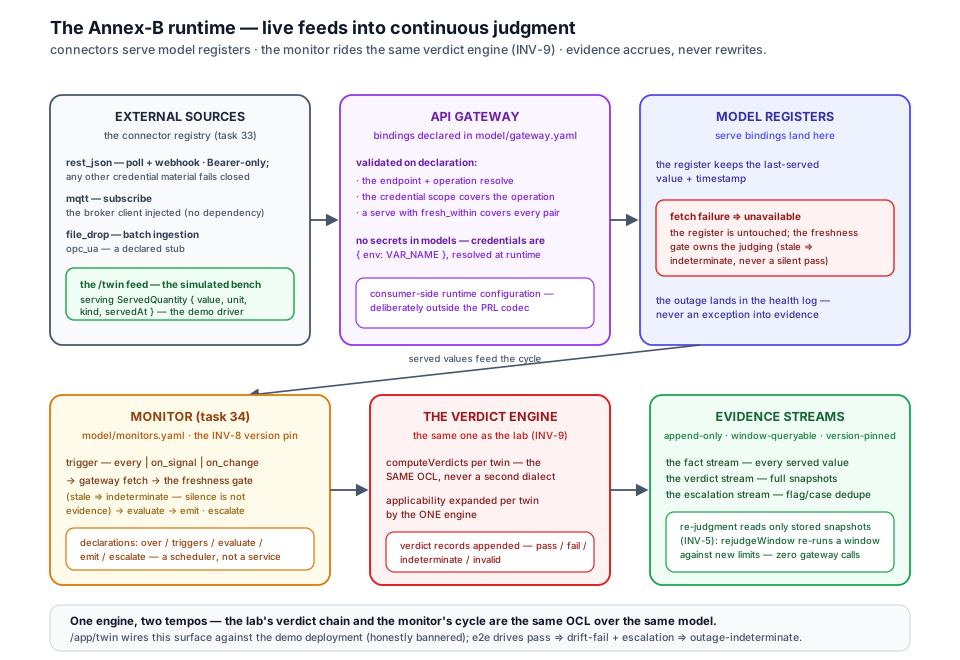
B.5.1 The monitor runtime and the API gateway (●, shipped, tasks 33/34)
Section titled “B.5.1 The monitor runtime and the API gateway (, shipped, tasks 33/34)”The twin direction’s two engine components are shipped and gated (● smart 2ef8f4b + 90ff7c8; Volume I, chapter 14 is their doctrine). Both are reuse, not new science, the verdict engine is the same one (INV-9: never a second dialect):
- The API gateway (● task 33), the connector layer. A deployment
declares
integrations:inmodel/gateway.yaml(consumer-side runtime configuration, deliberately outside the PRL codec): register bindings from external sources to model registers, validated on declaration, the endpoint resolves against the package’s twin declaration, the operation is a declared query/subscribe operation, the credential scope covers the operation’s access scope, a serve withfresh_withincovers every bound pair, and no secrets in models (credentials are{ env: VAR_NAME }references, resolved at runtime). Connectors are a registry (registerConnector): shipped built-ins arerest_json(poll + webhook ingest, Bearer-only, any other credential material fails closed),mqtt(subscribe; the broker client injected, no mqtt dependency in the browser runtime),file_drop(batch ingestion, the 2021 plugin pattern), andopc_uaas a declared stub. Failure semantics are the honesty core: a fetch failure degrades tounavailable, the register keeps its last-served value and timestamp, the freshness gate owns the judging (stale ⇒indeterminate, silence is not evidence), and the outage lands in the health log, never an exception into evidence. - The monitor runtime (● task 34), a scheduler over the same
verdict service. Declarations live in
model/monitors.yaml(over/triggers(exactly one ofevery|on_signal|on_change) /evaluate/emit/escalate, with the INV-8versionpin). A cycle is: trigger → gateway fetch → the freshness gate →computeVerdictsper twin, applicability expanded per twin by the engine → verdict records appended. Evidence streams are append-only, window-queryable and version-pinned, the fact stream (every served value that landed,delivery: cycle | push), the verdict stream (full snapshots, the re-judgment basis), the escalation stream (flag/case dedupe while open). Re-judgment reads only stored snapshots (INV-5):rejudgeWindowre-runs a verdict-stream window against new limits in the same OCL dialect with zero gateway calls, appending marked re-judged verdicts, evidence accrues, never rewrites.
The twin console (/app/twin) wires the monitor surface, the
escalation records and connector health against a demo deployment
(honestly bannered; never the seeded flows), and the puppeteer suite
drives pass ⇒ drift-fail + escalation ⇒ outage-indeterminate end to
end.
B.6 Consoles and the public register
Section titled “B.6 Consoles and the public register”The role model (browser/src/auth/roles.ts, session via
useAuth.ts, subject-chain edit matrix via useAuthz.ts) gives each
scheme actor a console (docs/architecture.md §12–13):
- applicant portal (
browser/src/vue-pages/portal/), declare the model family, submit, edit-and-resubmit underCHANGES_REQUESTED; - IA console (
vue-pages/ia/), review → dispatch → evaluate → issue; - TL workbench (
vue-pages/lab/), inbox, assignments, the run view (/app/lab/run/:assignmentId), report composer; - OIML-CS consoles (
/app/cs/*), the scheme-side runtime: participant registry, the issuance gate, operations (Volume IV); - live-twin console (
/app/twin), the monitor surface, escalation records and connector health over the demo deployment (§B.5.1); - simulated bench (
/app/sim), the simulated-instrument embed with guided practice flows (Annex: Simulated Instruments); - public BIML register (
/app/register),auth="public", whitelisted next to/app/loginin the guard; - public product passport (
/passport/:upi), no login: the model-native passport page over the passport resolver (Volume I, §12.5/§14.6).
The sidebar splits the standard’s reference content (requirements,
conformance tests, terminology, symbols & formulae, forms) from the
certification runtime (applications, test requests, test reports,
evaluations, certificates), data/r60/navigation.yaml.
B.7 The server-rendered shell
Section titled “B.7 The server-rendered shell”The shell is a server-rendered framework with selective client-side
hydration (browser/astro.config.mjs); the legacy SPA entry is
gone. The load-bearing facts (docs/architecture.md §14):
- Hybrid output,
output: 'server'with a standalone node adapter. Static shells carryexport const prerender = true; dynamic entity routes areprerender = falseand render on demand (ids are not build-time enumerable; islands read params from the URL, never from build-time props). - Generated routes,
browser/src/pages/contains only route shell files, all generated bybrowser/scripts/generate-astro-routes.ts(npm run codegen:routes: 194 route files); never edit the shells by hand. Page components live inbrowser/src/vue-pages/. - Two generic page shells,
src/astro/AppPage.vue(Gate → AppShell → page) andsrc/astro/PublicPage.vue(PublicShell → page), lazy-loading the page from animport.meta.globregistry , one chunk per page. - The guard,
src/astro/Gate.vuerunsbootstrap()+ the session check per page: unauthenticated →/app/login?redirect=…, role mismatch → role home. - The router shim is permanent,
src/astro/app-entrypoint.tsinstalls a real vue-router per island from the generatedROUTE_PATTERNS, so the ~46 pages callinguseRoute()/useRouter()behave as in the SPA;push/replacefall through to full page loads. De-routering pages is an unscheduled follow-up, not a plan. - PWA,
@vite-pwa/astroprecaches every prerendered shell (~450 entries);/apiis never cached;404.htmlis excluded from the precache (its 404 status would kill SW install);src/layouts/Base.astroreferences/registerSW.jsexplicitly (prod-only) because the plugin cannot inject registration markup.
B.8 Command gates
Section titled “B.8 Command gates”Every claim above is kept true by gates that must stay green
(docs/architecture.md §15 and the repo’s AGENTS.md; status as of
merges 8de8f4d + 8ef2752, 2026-07-26/27: vitest 3556/3556,
validate 0 errors / 435 warnings, e2e 55/55, the ISO 24229
render-baseline leg (task 25) is the 55th, test:ssot byte-clean,
pilot 6/6):
cd browser && npx vue-tsc --noEmit # type check (islands + vue-pages)cd browser && npx astro check # .astro route shells + layoutscd browser && npx vitest run # unit tests (vitest.config.ts)cd browser && npm run build # gen:data + astro production build (incl. codegen)cd browser && npm run validate # gen:data + schema + semantic validationcd browser && npm run test:round-trip # PRL build-equivalence + mutation gatecd browser && npm run test:ssot # SSOT drift guard — packages ≡ data trees ≡ app-config projectionscd browser && npm run test:from-packages # the from-packages release proofcd browser && npm run test:e2e # puppeteer suite against npm run devcd browser && npm run pilot # the live-twin pilot: ACME LC-500 → quarry, six steps assertedbin/check # repo gate wrapper (vue-tsc + astro check + test:round-trip)npm run validate (browser/scripts/validate.ts) is the model gate:
(1) YAML sources against the JSON Schemas in data/schemas/; (2)
semantic rules, the model linker (browser/build/model-linker.ts,
rules R1–R43) statically resolves every cross-reference in a package
(OCL identifiers, bind roots, applicability keys, symbol links, IRDI,
gateway and checklist refs); known-bad sites live in
data/<id>/linker-allowlist.yaml with clause-referenced reasons and go
STALE when they stop matching; the reconstruction congruence gate
(§1g, Volume I, chapter 9) proves coverage, order and text identity
over the .prd extracts; (3) compiled sample-data entities against the
entity schemas. Proof smokes against a running server: npx tsx scripts/astro-smoke.ts (61 checks), npx tsx scripts/astro-pwa-smoke.ts (15 checks).
B.9 Grammar sketch (the shipped contract)
Section titled “B.9 Grammar sketch (the shipped contract)”The platform consumes packages; it declares no language of its own. The one contract between package and runtime is the manifest and the runtime plug:
package { id oiml-r60 kind rec title "OIML R 60:2021 — R 60 package" version "2021" editions { 2021 2017 2000 1996 } baseUrn "urn:oiml:pub:r:60:2021" uses { iso-iec-17000 iso-iec-17065 iso-iec-17025 iso-iec-17067 oiml-cs oiml-smart-core oiml-smart-module-specimen-governance } status current}# platform runtime configuration (the plug, ● as SMART_STANDARDS_SOURCE=primmel)recommendations: - primmel: primmel-packages/oiml-r60 # compiled to the same generated artifactsThe package compiles to the identical store manifest, generated types,
and standard meta that the data/r60/ tree produces, the runtime is
unchanged whichever source feeds it. The SSOT flip has landed (●
task 31b, smart a549dab): the Primmel packages are the single source of
truth, the YAML data trees are downstream generated artifacts
(regenerated by npm run gen:data, never hand-edited), and
npm run test:ssot proves both directions byte-clean, data trees ≡
regeneration from the packages, packages ≡ rebuild from the app config.
New Recommendations are authored Primmel-native from the start (the
R 129 package is the first, task 22).
B.10 Validation rules
Section titled “B.10 Validation rules”- Never edit generated files (
browser/src/data/generated/**) , change the YAML and regenerate; a hand edit is overwritten by the next build and desynchronizes types from stores. - Encapsulation, pages never touch Repository directly; services
never touch IndexedDB directly; each layer calls only the layer below
it (
docs/architecture.md§12). - No domain content in code, a service file referencing R 60 domain concepts directly is a defect; the applicability engine is the single applicability evaluator, and a second one is a defect.
- Quantities, not numbers, every physical value is a
QuantityValue { value, unit }(INV-1); attribute values live in theparameters/test_contextmaps, never in dedicated entity fields (INV-2); resolution is by delegation upward Sample → Model → Group → Family (INV-10). - Gates green before done, a change is not complete while any command gate of §B.8 is red.
B.11 Summary
Section titled “B.11 Summary”- The platform is a pure engine: models in (Primmel packages, the single source of truth; the YAML trees generated from them), certification out (applications, reports, evaluations, certificates, the register, passports).
- One build pipeline compiles packages to generated types, the store manifest, vocabulary registers, and seed data; generated output is gitignored and never hand-edited.
- IndexedDB stores are the manifest; the FK graph and the TS interfaces are two projections of the same entity declarations.
- Five engines, applicability (the ONE engine), verdict, form-context,
state cascade/walk, dispatch, evaluate the models, all data-driven;
the monitor runtime and the API gateway (● tasks 33/34) extend the
same verdict engine to live twins: connectors with fail-
unavailablesemantics, freshness-gated cycles, append-only version-pinned evidence streams, and re-judgment from stored snapshots (§B.5.1). - The shell is a server-rendered framework with selective client hydration, generated routes, a permanent router shim, and a client-side guard; the gates (vue-tsc, astro check, vitest, build, validate, round-trip, ssot, from-packages, e2e, pilot) are the definition of done.
Next: Simulated Instruments, the
wind tunnel: a physics-core load cell whose /twin channel lets the
certification loop run against behavioral truth; then
The Twin Lab, the generic twin workbench; then
Shared, Glossary: every term of
the frame, one definition each.