
Chapter 3, The Eight Terms and Their Closure Rules
Chapter 3, The Eight Terms and Their Closure Rules
Section titled “Chapter 3, The Eight Terms and Their Closure Rules”In this chapter: the formal algebra 𝓜 that defines the IS–HAS–DOES modelling system. Eight terms (three relations, five sorts), arranged in five layers, sealed by three closure rules. Read this before Chapter 4 (Proofs), the theorems reference every definition here. Math is in Unicode (no LaTeX rendering in Phase 1); Chapter 4 is where the notation earns its keep.
3.1 The algebra at a glance
Section titled “3.1 The algebra at a glance”The system is the algebra
𝓜 = ⟨ O, P, V, T ; IS, HAS, DOES ; ∘, ρ, ι ⟩Five sorts of thing:
| Sort | Meaning |
|---|---|
O | objects, the bearers of all claims |
P | properties, the slots along which objects can vary |
V | values, what fills a property slot |
T | transitions, input→transform→output rules |
PROCESS = ρ(T) ⊆ O | reified transitions, transitions treated as objects |
Three relations:
IS ⊆ O × O (individuation: "x is the same as y" / "x is a K")HAS : O → (P ⇀ V) (attribution: "x has value v along property p")DOES ⊆ O × T (dynamics: "x does transition t")Three operations:
∘ : T × T ⇀ T (composition: t₂ ∘ t₁ is a transition if interfaces match)ρ : T → O (reification: a transition becomes an object)ι : O ↪ V (embedding: an object can be a value)Every claim the system can make is a truth-claim over these sorts, using these relations. Every transformation the system can perform is one of the three operations. There is nothing else.
The rest of this chapter unpacks each sort and relation layer by layer, then states the three closure rules that seal the system.
3.2 Layer 0, IS: the ground of individuation
Section titled “3.2 Layer 0, IS: the ground of individuation”Before you can say anything about a thing, you must be able to say which thing you are talking about, and what counts as the same thing across time and change. IS is that relation. It is not a property among properties: it is the precondition for property-tracking to be meaningful at all. You cannot record “this entity’s temperature at time 1 and time 2” unless something already tells you both readings belong to one entity’s timeline.
Formally:
IS ⊆ O × O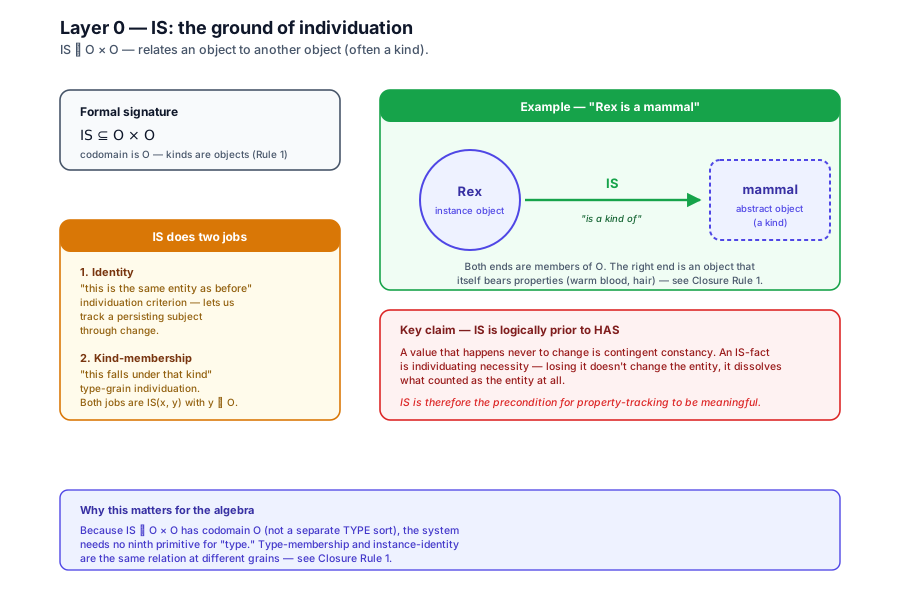
IS does two jobs:
- Identity: “this is the same entity as before”, the individuation criterion that lets us track a persisting subject through change.
- Kind-membership: “this entity falls under that kind”, Rex is a
mammal relates the object Rex to the object mammal. (Closure
Rule 1, §3.7, guarantees kinds live in
O.)
Crucially, IS-facts are not zero-variance HAS-facts. A value that happens never to change is contingent constancy; an IS-fact is individuating necessity, losing it doesn’t change the entity, it dissolves what counted as the entity at all. IS is therefore logically prior to everything outward of it.
3.3 Layer 1, OBJECT: what gets individuated
Section titled “3.3 Layer 1, OBJECT: what gets individuated”An object is anything IS can individuate: a dog, a door, a number, a kind, a specific run of a program. Objects are the bearers, the things all other claims attach to.
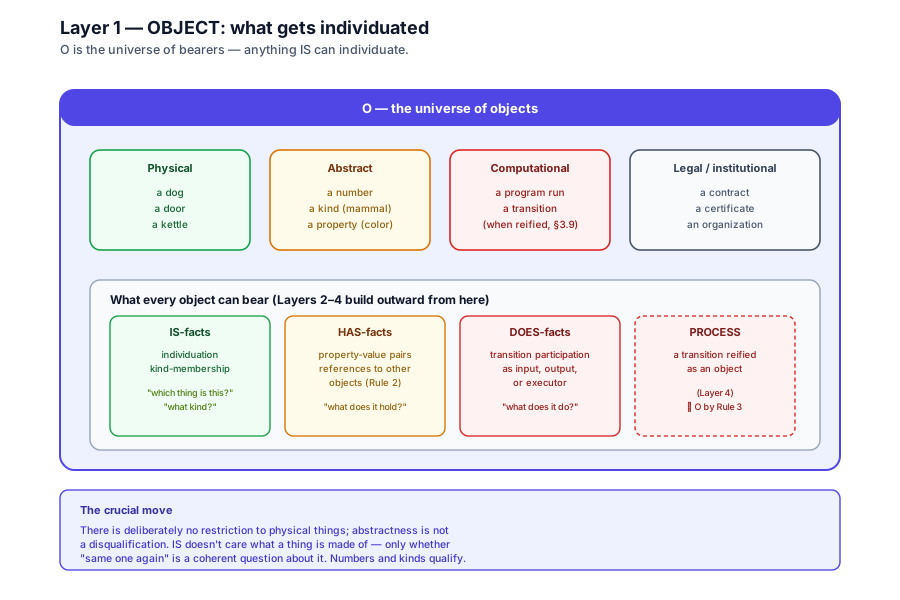
There is deliberately no restriction to physical things; abstractness
is not a disqualification. IS doesn’t care what a thing is made of,
only whether “same one again” is a coherent question about it. A
number is an object. A kind is an object (by Rule 1, §3.7). A program
run is an object (by Rule 3, §3.9). Everything outward from Layer 1
is either a claim about members of O, or something foldable into
O.
3.4 Layer 2, HAS, PROPERTY, VALUE: the static axis
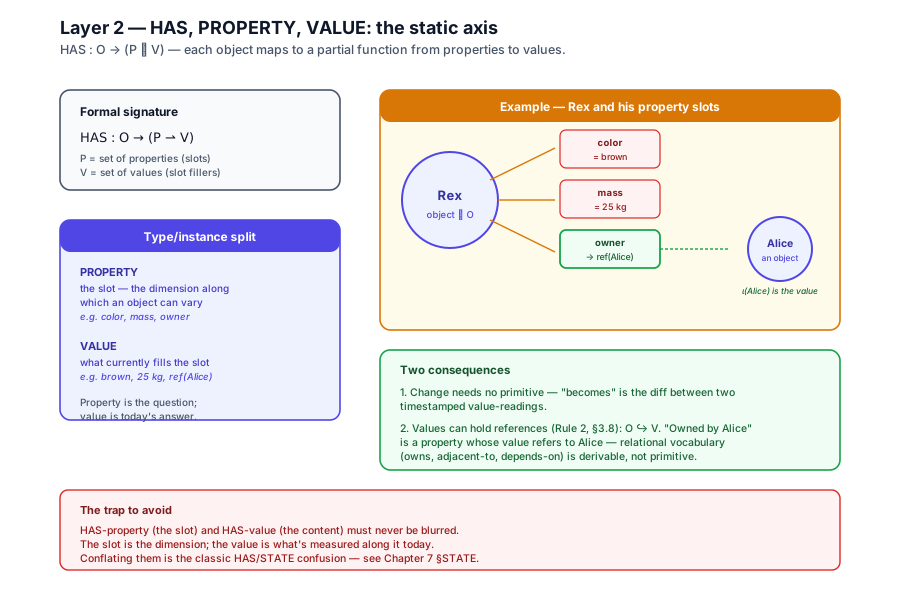
Section titled “3.4 Layer 2, HAS, PROPERTY, VALUE: the static axis”Objects hold things. HAS is the attribution relation, and it comes with a type/instance split that must never be blurred:
- a property is the slot, the dimension along which an object can vary (color, mass, owner);
- a value is what currently fills the slot (red, 4 kg, Alice).
Property is the question; value is today’s answer.
Formally, with P the set of properties and V the set of values:
HAS : O → (P ⇀ V)Each object maps to a partial function from properties to values. Two consequences:
- Change needs no primitive. “Becomes” is merely a difference between two value-readings indexed by time, and time itself is just a value attached via HAS.
- Values may contain references to objects (Closure Rule 2, §3.8):
O ↪ V. A value can be a pointer, not just raw data.
3.5 Layer 3, DOES, TRANSITION: the dynamic axis
Section titled “3.5 Layer 3, DOES, TRANSITION: the dynamic axis”Objects act. DOES is the dynamic relation, and its noun is the transition: a rule of the form
t : V_in → V_outinput, transform, output, nothing more. Input and output are the transition’s boundary interface: they are what makes it a function rather than a label, and they are where one entity’s doing touches another entity’s holdings. The input need not be the same object as the output; only the interface must be declared.
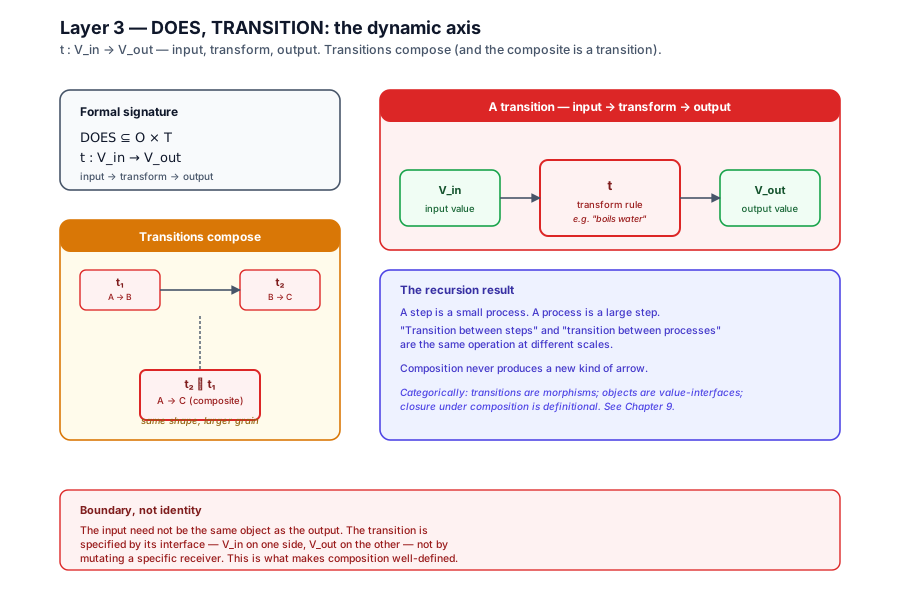
Transitions compose. If t₁ : A → B and t₂ : B → C, then
t₂ ∘ t₁ : A → Cand the composite is itself a transition, same shape, larger grain. This is the recursion result: a step is a small process, a process is a large step, and “transition between steps” and “transition between processes” are one operation applied at different scales. Composition never produces a new kind of arrow.
In categorical terms (developed in Chapter 9), transitions form the morphisms of a category whose objects are value-interfaces; closure under composition is definitional.
3.6 Layer 4, PROCESS: the reification bridge
Section titled “3.6 Layer 4, PROCESS: the reification bridge”A transition is a rule; but rules need to be named, instantiated, paused, retried, and tracked, that is, they need to bear IS-facts and HAS-facts. A process is exactly that move: a transition reified as an object.
ρ : T → O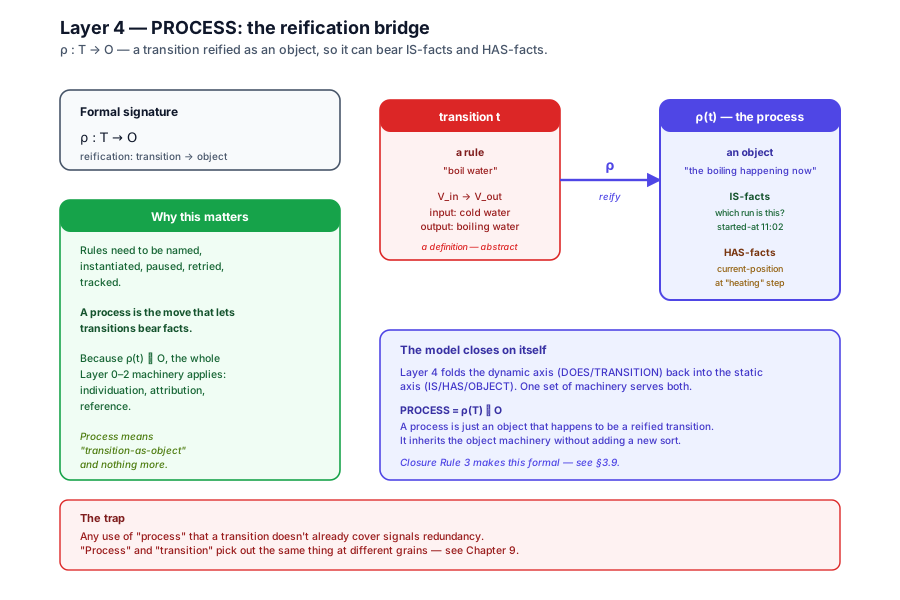
The reification map ρ takes a transition and returns an object that
represents it, so the whole Layer 0–2 machinery applies to it: a
process has an identity (which run is this?), has properties
(started-at, current-position), has values filling them. Process means
transition-as-object and nothing more; any use of “process” that a
transition doesn’t already cover signals redundancy.
This layer closes the model back on itself: the dynamic axis folds into the static one, so one set of machinery serves both.
3.7 Closure Rule 1, kinds are objects
Section titled “3.7 Closure Rule 1, kinds are objects”The first seal. IS needs a codomain: “is a mammal” has to point at something, a kind, and “kind” appears nowhere in the eight-term list. We had two choices: add TYPE as a ninth primitive, or declare that kinds are themselves objects (abstract ones). We chose the latter.
IS ⊆ O × O (codomain is O, not a separate TYPE sort)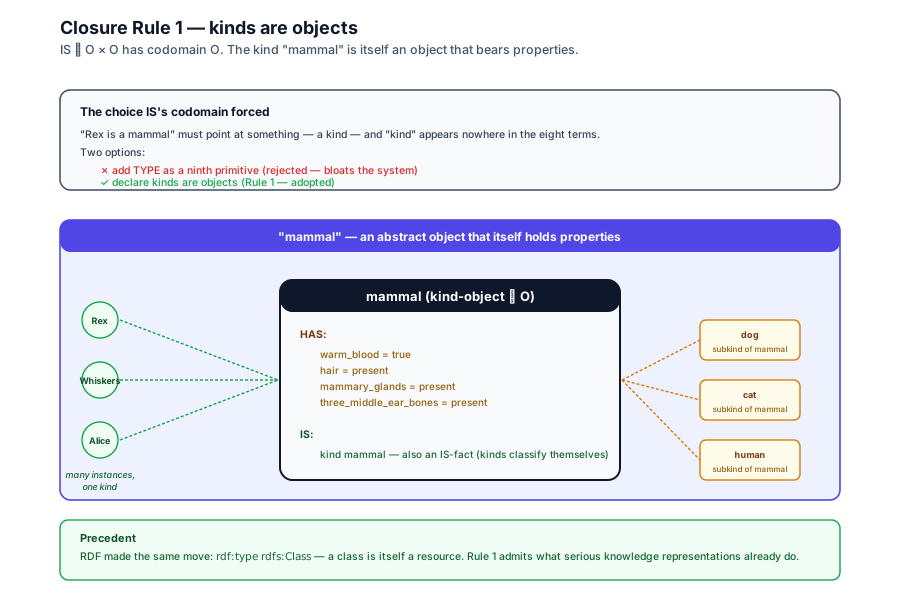
This is how every serious knowledge representation already works, a
class is itself a resource you can make claims about (RDF made this
move with rdf:type rdfs:Class). Kinds have properties (mammals have
warm blood as a defining property), which means they were already
behaving like objects; the closure rule just admits it.
Consequence. Type-membership (“x is a K”) and instance-identity
(“x is the same entity as y”) are both IS(x, y) with y ∈ O, just
at different grains. No ninth primitive is needed.
3.8 Closure Rule 2, values hold references
Section titled “3.8 Closure Rule 2, values hold references”The second seal. A value does not have to be raw data; it can be a reference to another object.
ι : O ↪ V (every object can be embedded as a value)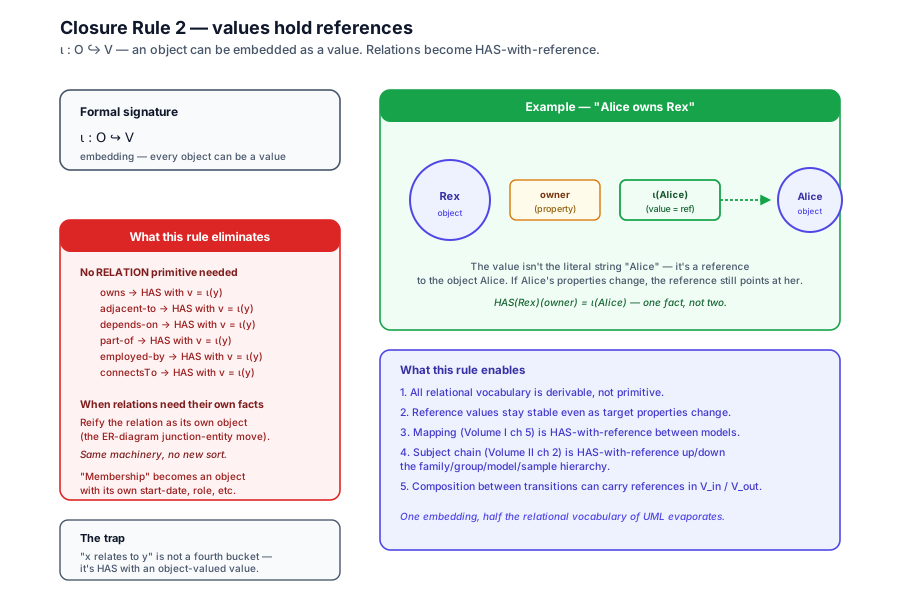
This single embedding is what makes all relational vocabulary (owns, adjacent-to, depends-on, part-of, employed-by) derivable rather than primitive. “Owned by Alice” is a property whose value refers to the object Alice. “Part of the team” is a property whose value refers to the team object.
Consequence. No separate RELATION primitive is needed. Every
relation between objects is expressible as a property whose value
happens to be an object-reference. We do not need to reify the
relation as its own sort unless the relation itself needs to bear
further properties, at which point we reify it as an object, which
is the same move ER diagrams make with junction entities.
3.9 Closure Rule 3, process is reified transition
Section titled “3.9 Closure Rule 3, process is reified transition”The third seal. “Process” must not mean anything a transition doesn’t already cover, or it is a redundant ninth sort.
PROCESS = ρ(T) ⊆ O (processes are a subset of objects)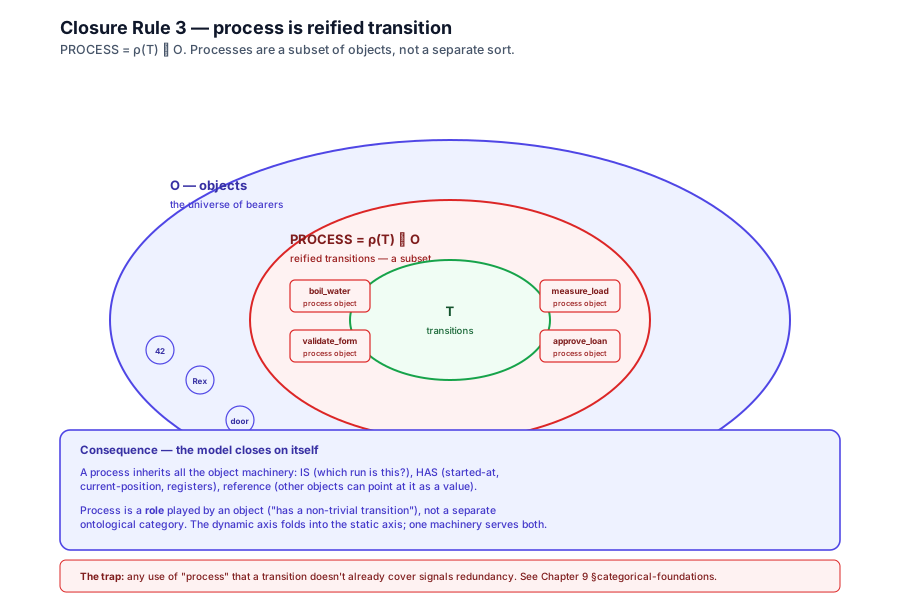
A process is just a transition that has been pushed through the
reification map ρ. It inherits all the object machinery (IS, HAS)
without adding any new sort.
Consequence. The dynamic axis (Layer 3) folds cleanly into the static axis (Layers 0–2). One set of machinery, IS, HAS, OBJECT, PROPERTY, VALUE, serves both. Process is a role played by an object, not a separate ontological category.
3.10 The algebra restated
Section titled “3.10 The algebra restated”With all three closure rules in place, the full system is:
𝓜 = ⟨ O, P, V, T ; IS, HAS, DOES ; ∘, ρ, ι ⟩- Sorts:
Oobjects,Pproperties,Vvalues (withO ↪ V),Ttransitions,PROCESS = ρ(T) ⊆ O. - Relations:
IS ⊆ O × O,HAS : O → (P ⇀ V),DOES ⊆ O × T. - Operations:
∘ : T × T ⇀ T(composition),ρ : T → O(reification),ι : O ↪ V(embedding).
Three operations, three relations, five sorts (one of which is a derived subset). Nothing else. Every operation’s codomain is one of the four base sorts; no operation ever produces a ninth kind of thing.
That last claim is Theorem 1, and we prove it in Chapter 4.
3.11 Where each term shows up downstream
Section titled “3.11 Where each term shows up downstream”This algebra is not just a museum piece. Every term earns its keep elsewhere in the documentation tree:
- IS, OBJECT → Volume I chapter 2 §2.3 (the IS aspect catalog: metadata, provenance, structure, design parameters, designed conditions, promises, artifact definitions).
- HAS, PROPERTY, VALUE → Volume I chapter 2 §2.4 (the HAS aspect catalog: attributes, dimensions, state, characteristics, environmental context, artifact instances).
- DOES, TRANSITION → Volume I chapter 4 (processes as recursive subjects; the step vocabulary; executors).
- PROCESS → Volume I chapter 4 §4.1 (a behavior is a Process; the recursion that keeps the language small).
- Closure Rule 1 → Volume II chapter 2 (the subject chain: Family → Group → Model → Sample as four grains of kind-membership).
- Closure Rule 2 → Volume I chapter 5 §5.6 (mapping as HAS with object-reference values).
- Closure Rule 3 → Volume I chapter 14 (live twins: a served process instance is a reified transition, queryable by HAS).
If a chapter ever seems to introduce a ninth modelling term, treat it as a materialized view (Chapter 7) and check what composite it is shorthand for.
Next: Chapter 4, Proofs: the three theorems (closure, completeness, extensibility) in full rigor.