
Chapter 12, Interop
Chapter 12, Interop
Section titled “Chapter 12, Interop”In this chapter: the export projections, ReqIF for requirements-management tools, RDF/OWL for linked-data consumers, OpenCDD back-references for attribute definitions, what survives each projection, what is lost, and why none of them is ever the kernel.
12.1 Projections, never the kernel
Section titled “12.1 Projections, never the kernel”The Primmel model is a strict superset of the document-centric alternatives: they represent a standard’s text; Primmel represents its semantics (chapter 1’s comparison). The interop rule follows:
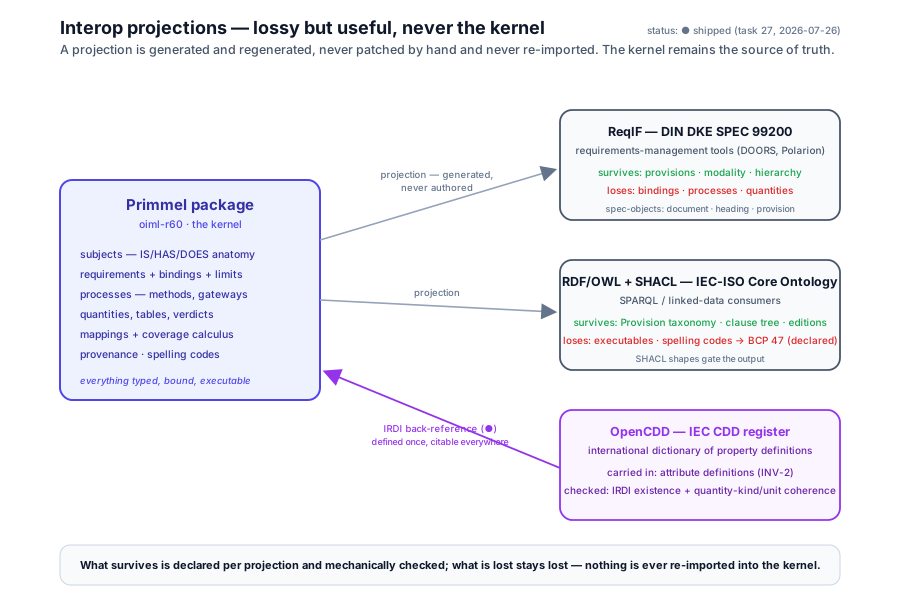
Exports are lossy-but-useful projections, never the kernel.
A projection is generated, never authored; it is regenerated on every build, never patched by hand; and it is consumed by ecosystems that cannot, today, run a Primmel engine. The test for every projection is honest bookkeeping: say exactly what survives and what is lost, and check mechanically that the “survives” list is faithful. Round-trip is explicitly not a goal: information lost on the way out cannot come back, so nothing is ever re-imported into the kernel.
12.2 ReqIF export, the DIN DKE SPEC 99200 profile
Section titled “12.2 ReqIF export, the DIN DKE SPEC 99200 profile”ReqIF (OMG Requirements Interchange Format) is the wire format of
the requirements-management ecosystem, DOORS, Polarion, the tools
manufacturers and test laboratories already run. DIN DKE SPEC 99200
is the ReqIF interpretation for public standards: it models a standard
as database rows, three spec-object-types (document, heading,
provision), one relation (cross-reference), XHTML text carrying a
modality tag. The specification ships with the digital material needed
to import, manage and re-export in target software (its clause 11), and
tooling such as Schematron rules and exchange examples (.reqifz)
exists to keep exchanges conformant.
That is a good target for a projection, because a Primmel reference package contains exactly the ReqIF profile’s content as a subset:
| Survives the projection | Is lost |
|---|---|
provision statements (the requirement statement texts) | bindings, binds_to anchor paths; a ReqIF row cannot say what is constrained |
| modality (shall / should / may → the provision’s bindingness) | limits, the OCL in limit.expression; the row has text, not a computable constraint |
| the document hierarchy (parts, clauses, headings) | processes, test methods, steps, gateways, executors |
| provenance (clause URNs as attributes on the row) | quantities, QuantityValue, units, tables/profiles |
| cross-references between provisions | applicability, verdicts, forms, mappings, the entire executable tier |
The projection’s value: a manufacturer consumes the standard inside its own RM tool, links its design documents to the provision rows, and answers “which clauses does our product file address?”, while the authoritative, executable form remains the Primmel package. The moment a consumer needs to know whether the instrument passes, the projection has nothing to say and the kernel must run.
Shipped (task 27b, ● primmel-ts 8840617). primmel export reqif
projects the R 60 package to the profile above: 1 document, 14
requirement classes, 180 requirements, 62 conformance tests, 128
spec-relations (depends-on, verifies, binds), 0 dropped
references, and the output validates against the official OMG ReqIF
XSD (xmllint --noout --schema reqif.xsd). The exporter’s header note
carries the honest survives/lost bookkeeping of the table above, and a
reference that names nothing exported is recorded in
stats.droppedReferences, never dangled. The evidence artifact is
analysis/reqif-export-oiml-r60.reqif in the platform repo.
12.3 RDF/OWL + SHACL, the IEC-ISO Core Ontology projection
Section titled “12.3 RDF/OWL + SHACL, the IEC-ISO Core Ontology projection”The second target is linked data. The IEC-ISO Core Ontology
(descended from the IEC SG12 Standard Information Model) defines an OWL
model for fragments of standards in RDF, with a scope it states
precisely: concepts from ISO/IEC Directives Part 2 (sections 3, 6, 7),
narrative content only, not figures, equations or tables; not
document metadata (number, edition, publisher); not presentation
(NISO STS owns that). Its center is the Provision hierarchy, one
class per directive verb-force: Requirement, Recommendation,
Permission, Possibility, Capability, Instruction, Statement,
ExternalConstraint, with hasBindingnessType, typed
ProvisionSupplements (notes, examples), Clause with
hasSectionNumber, and PublicationDocument carrying
dcterms:hasVersion / dcterms:replaces / dcterms:issued. SHACL
node shapes validate instances: ProvisionShape constrains
dcterms:isPartOf to exactly one parent, a Clause or the
PublicationDocument, each checked against its own shape, and allows
a dcat:distribution; ClauseShape applies the same single-parent
rule and types hasSectionNumber and dcterms:title;
PublicationDocumentShape constrains the three dcterms properties
above. The consumption pattern is SPARQL: competency questions like
“list every Requirement of this document with its bindingness and
supplements”.
The Primmel→RDF projection maps the package onto that vocabulary:
requirements become smart:Requirement instances, notes and examples
become typed supplements, clause structure becomes Clause/isPartOf,
the package’s edition relations (chapter 13) become dcterms:replaces.
What survives is wider than ReqIF in one respect (the Provision
taxonomy’s verb-force classification) and identical in the one that
matters: no bindings, no processes, no quantities, the ontology’s
own scope statement excludes them. Two projection notes are worth
recording:
- Language tags collapse. RDF mandates BCP 47 for language-tagged strings, so ISO 24229 spelling codes (chapter 10) map down to BCP 47 on export, a lossy step the projection declares, not hides.
- SHACL is the check. A projection that emits RDF the
ProvisionShaperejects is a projection bug; SHACL validation is part of the export gate, symmetric to chapter 11’s own gates.
Shipped (task 27c, ● primmel-ts f1a82d5). primmel export rdf
projects the R 60 package onto the smartSDU share’s IEC-ISO Core
Ontology vocabulary (core-ontology.ttl v2.0.0) as 4,252 triples ,
the provision hierarchy typed by modality (shall → smart:Requirement,
with primmel:obligation riding as data), the clause tree, terms with
SKOS-XL labels, provenance and cross-references
(dcterms:source/requires/references, primmel:verifies). The export
gate is real SHACL, twice over: the toolchain’s own evaluator and
pyshacl 0.31.0 both report Conforms: True (rdflib 7.6.0 parses
the artifact to the exact count, zero warnings) against six shapes ,
including the clause-tree acyclicity constraint as standard SHACL-SPARQL,
which fires on a seeded cycle under both evaluators. The five
competency questions execute on the projected graph with pinned
answers, shall-provisions with holding clause (157), the verification
coverage map (91), terms by source clause (69), the modality census via
rdfs:subClassOf* (242), the full clause tree (15 rows), identical
under rdflib’s SPARQL engine and the repo evaluator. Kernel check C85
baseurn-wellformed guards the IRI root every instance IRI resolves
against. The evidence artifact is analysis/rdf-export-oiml-r60.ttl in
the platform repo.
12.4 OpenCDD integration, the IRDI back-reference
Section titled “12.4 OpenCDD integration, the IRDI back-reference”The third relation runs the other way. OpenCDD (the open form of the
IEC Common Data Dictionary, IEC 61360) is an international register of
property definitions: every entry has an IRDI (International
Registration Data Identifier), a quantity kind, and a unit. Primmel does
not re-invent shared attributes per package; an attribute definition
carries its CDD citation in an irdi facet. This is already the
metamodel’s law, INV-2: an attribute is defined once as an
AttributeDefinition (symbol, clause, IRDI) and valued per subject
level.
The integration is shipped (task 27a, ● smart 8247d37), validation,
not export, against a pinned snapshot of the register
(data/opencdd/; OpenCDD offers no REST/RDF/SPARQL interface, a pinned
snapshot of the public mirror is the intended consumption, here pinned
at mirror commit 7ea6d4c, 2026-07-25, re-vendored on demand by
npm run snapshot:opencdd). Three dictionaries ship whole, IEC 62720
units (2,566 entries), IEC 61360-7 identification/marking (2,318),
IEC 63213 measuring-equipment properties (224), and IEC 61987 ships
filtered to the referenced IRDIs plus their unit-link closure (the full
dictionary is unvendorable). A checkout without the snapshot is a
graceful stub: R36 prints one note, never fails.
The R 60 attribute register carries 8 genuine annotations
(accuracy_class, t_min, t_max, warm_up_time, input_impedance,
output_impedance, interfaces, software_identification), annotate
only on a genuine match; the register’s other attributes are documented
honest absences, and honest absence is a correct outcome. The sweep also
removed a pre-existing citation (0112/2///61987#ABA000#000): invalid
IRDI syntax, and ABA000 is the IEC 61987 root class, not a property ,
no genuine rated-output entry exists, so the honest annotation is none.
Linker rule R36 irdi-resolve validates every annotation against
the snapshot on five axes:
- syntax, the full ISO/IEC 11179-6 IRDI grammar (registrant/semantic///scheme#code; version and revision live on the CDD entity, never in the IRDI);
- existence, the IRDI resolves to an entry in the snapshot;
- status, the entry’s
status_levelis in the accepted vocabulary (the register measures exactlyStandard); - unit-symbol coherence, the attribute’s unit matches the entry’s
MDC_P041-linked unit
short_name, Unicode-exact; - quantity-kind↔dimension coherence, the attribute’s quantity kind matches the entry’s dimension string via an ISO 80000 kind→dimension table.
Deliberate divergences are allowlisted, never silenced: five sites
where kind↔dimension coherence is genuine and only the symbol spelling
diverges, the platform’s degC vs the registry’s °C (on t_min and
t_max), warm-up time in min vs the SI second the entry links, and
Ω (U+03A9) vs the registry’s Ω (U+2126 OHM SIGN) on the two
impedances. Each carries a reason and an audit reference in the linker
allowlist; the issues print as KNOWN, and an entry that stops matching
is STALE and fails.
The payoff is the chapter’s thesis in miniature: an attribute with a checked IRDI is citable in an international dictionary rather than invented per package, the same “defined once, referenced everywhere” discipline the kernel applies internally, extended across organizations.
12.5 The passport projection, endpoint and DPP-registry feed (●)
Section titled “12.5 The passport projection, endpoint and DPP-registry feed ()”The twin direction’s outward faces belong to this family, and they are shipped (task 35, ● smart 244ea47). The passport endpoint serves the product’s model-native passport (chapter 14, §14.6), identity, composition, as-certified claims, and live compliance status under fail-closed access classes, and the DPP-registry feed emits the one-way outward projection to the EU registry, addressed by unique identifier. Both are projections in this chapter’s exact sense: generated from the product model, regenerated on every build, never authored, never re-imported. And both are honestly lossy: the registry receives the public fragment, while the executable product model and its evidence stay behind in the kernel. What ReqIF is to the RM-tool ecosystem, the passport feed is to the DPP ecosystem, the lossy-but-useful face the outside world actually consumes.
The shipped surface, each piece linted:
- The kernel
passportconstruct, a first-class declaration on the product model:upi { pattern … level … }(ESPR model/batch/item levels), thecarrierfacet (the QR payload resolves to the passport endpoint URL), and the content classes, the ACME LC-500 pilot declarespublic { identity composition promises_as_verified }andauthority { live_compliance_status }, withartifactsandsustainabilitydeliberately absent (nothing honest behind them yet). Kernel-linted by the catalog trio: C86 passport-content-resolves (every content entry resolves against the product model), C87 passport-access-leak (nothing restricted leaks into a less-privileged class), C88 passport-upi-scheme (the UPI pattern and level are well-formed). - The projection engine (
browser/src/data/passport.ts) ,buildPassportDocument(abstract mode pins a version; live mode requires the computed verdict-stream read, never fabricated) andprojectPassportDocument(the access-class enforcement point: public output carries only public entries, fail-closed). - The serving,
GET /passport/<upi>.json?class=public|restricted| authority(the resolver) and the public rendered view at/passport/<upi>(the authority class: the public content plus live compliance status). - The registry feed,
GET /passport/registry.json: the one-way outward projection (identifiers + locators), deliberately a stub: no authentication, no push protocol, the shape is shipped, the registry integration is the honest ○ remainder.
The alignment with CEN/CENELEC JTC24’s eight areas is itself authored
data, not a prose claim: data/r60/evaluation/r60-to-dpp.prm maps the
R 60 content onto the areas on the existing .prm primitive, gated by
the coverage calculus, an area neither mapped nor named is a silent
gap and fails the gate (the record: docs/dpp-jtc24-alignment.md in
the platform repo).
12.6 Grammar sketch (illustrative v3 syntax)
Section titled “12.6 Grammar sketch (illustrative v3 syntax)”projection reqif-din-99200 of oiml-r60 { spec_objects { document, heading, provision } carry { statement, modality, clause_hierarchy, provenance_ref, cross_references } drop { bindings, limits, processes, quantities, applicability, verdicts, forms, mappings } note "generated artifact; regenerate on build; never patch, never re-import"}
projection rdf-core-ontology of oiml-r60 { vocabulary smart # IEC-ISO Core Ontology map requirement -> smart:Requirement map note/example -> smart:ProvisionSupplement (typed) map clause tree -> smart:Clause + dcterms:isPartOf map editions -> dcterms:replaces languages spelling -> bcp47 (lossy, declared) gate shacl { ProvisionShape, ClauseShape, PublicationDocumentShape }}
attribute output_impedance { kind electrical-resistance ; unit Ω irdi "0112/2///61987#ABP162" # IEC CDD — a genuine annotation check cdd { syntax, exists, status, unit_symbol_coherent, kind_dimension_coherent }}12.7 Validation rules
Section titled “12.7 Validation rules”- a projection declares its
carryanddroplists; everything incarryis mechanically verified present and faithful in the output (a statement whose exported text differs from the content set fails the export gate); - a projection’s output passes the target’s own validator, the
official OMG ReqIF XSD for the ReqIF projection (● xmllint-clean on
the R 60 export), SHACL shapes for the RDF projection (● the repo
evaluator and pyshacl both
Conforms: True); - no import path: the kernel accepts no artifact generated from a
projection; provenance of every kernel element traces to a
.prdfragment or an authored model file, never to an export; - every IRDI on an attribute definition passes R36
irdi-resolveagainst the pinned snapshot, syntax, existence, status, unit-symbol coherence, quantity-kind↔dimension coherence (●); a deliberate divergence is an allowlist entry with reason and audit reference, never silence; an invalid IRDI is removed, not carried; - the BCP 47 downgrade of spelling codes is declared in the RDF
projection’s
languagesclause, an undeclared silent mapping is an error.
12.8 Summary
Section titled “12.8 Summary”- Exports are lossy-but-useful projections: generated, regenerated, never authored, never re-imported, the kernel stays the source of truth.
- ReqIF (DIN DKE SPEC 99200): provisions + modality + hierarchy survive; bindings, processes, quantities, verdicts are lost, ● shipped: R 60 exports to 180 requirements + 62 tests + 128 relations, 0 dropped, XSD-valid.
- RDF/OWL (IEC-ISO Core Ontology): the Provision taxonomy, supplements,
clause tree and edition relations survive; the same executable content
is lost, by the ontology’s own scope, ● shipped: 4,252 triples,
SHACL-clean under two evaluators (pyshacl
Conforms: True), five competency questions answered; spelling codes downgrade to BCP 47, declared. - OpenCDD runs the other way, ● shipped: attribute definitions carry
IEC CDD IRDIs validated by linker rule R36 against the pinned
data/opencdd/snapshot (8 genuine annotations, 5 allowlisted symbol-spelling divergences, the invalid ABA000 citation removed) , defined once, citable everywhere.
Next: Chapter 13, Model diff and lifecycle: editions as packaging, structural diff, and change audit.