
Chapter 15, The Model Supply Chain
Chapter 15, The Model Supply Chain
Section titled “Chapter 15, The Model Supply Chain”In this chapter: who publishes which model, the standards body, the manufacturer, the instrument user, and how a manufacturer’s product reference model, mapped to the Recommendation, is consumed by users in two modes: as an abstract reference or as a live twin. This is the ecosystem chapter: the one where conformance starts to compose.
15.1 Three publishers, three speakers
Section titled “15.1 Three publishers, three speakers”Chapter 5 taught two model kinds: reference and implementation. The twin direction asks a sharper question, who does this model speak for?, and the answer is three roles:
| Publisher | Model | Speaks for |
|---|---|---|
| Standards body | standards-reference model (R 60, OIML-CS) | the standard |
| Manufacturer | product reference model (their instrument model) | the product |
| Instrument user | implementation model (their operations) | the operations |
The manufacturer’s model is the new citizen. It is a reference model , it states what the product is and claims, and it is not derived from the Recommendation: ACME’s LC-500 exists as a product whether or not R 60 exists. What links the two is the mapping discipline of chapter 5.
15.2 The product reference model
Section titled “15.2 The product reference model”A manufacturer of an OIML SMART-compliant instrument authors their product model exactly as any subject model, the full IS/HAS/DOES anatomy:
- IS: design parameters (E_max = 500 kg), designed conditions, promises (“holds class C6 over the rated range”), structure, metadata, provenance;
- HAS: exhibited attributes per unit, dimensions (the classification the unit presents), characteristics (the error/creep quantities the standard’s tests will compute), state;
- DOES: the measurement process, the response behaviors, the self-tests.
And then the decisive act: every aspect, entity, relation and promise is mapped to the Recommendation’s, aspect-by-aspect, node to node, constraint to constraint, promise to requirement. The mapping is the manufacturer’s conformance claim, made computable: “our E_max is your E_max; our creep characteristic answers your creep requirement; our rated range satisfies your condition tiers.”
Why does the mapping matter so much? Because it converts marketing into machinery. An unmapped product model is a brochure. A mapped product model lets an engine answer: against which clause is this claim made, and does the evidence support it?
Type evaluation then does its job (chapter 7 of the core volume): samples of the model are tested, verdicts are computed, and the certificate is issued with the promises-as-verified. At that point the product model carries two strata of promise: the claims as declared and the claims as verified, distinguishable in the model, and both citable by downstream consumers.
15.3 The two consumption modes
Section titled “15.3 The two consumption modes”The instrument user, the integrator building a weighing system, the quarry running the belt scale, the factory whose QMS depends on the measurements, owns an implementation model: the digital twin of their organization’s operations. They consume the product model in one of two modes, and serving both is the manufacturer’s job:
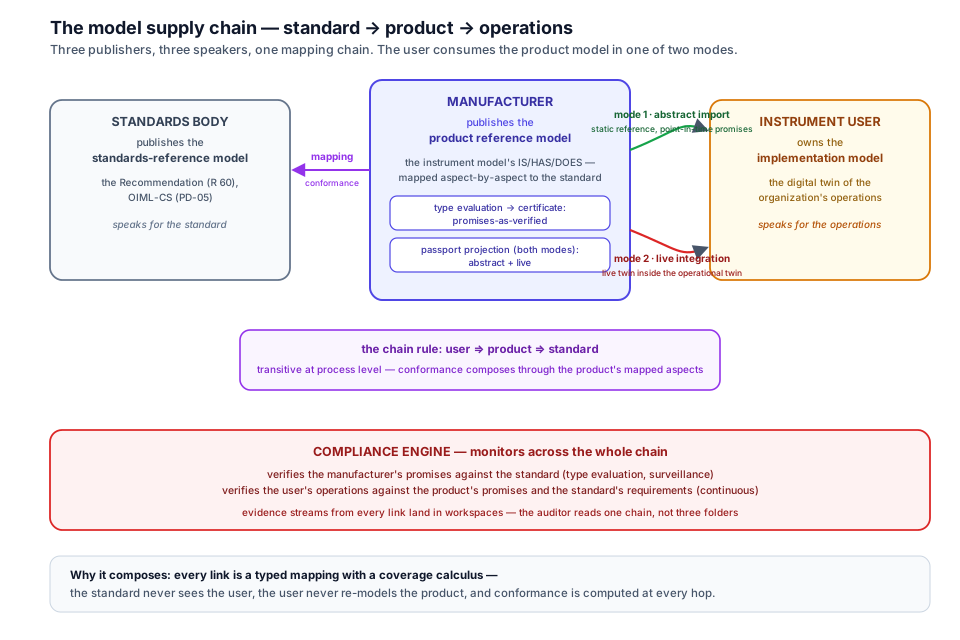
Mode 1, abstract import. The product model enters the user’s implementation model as static reference content: designation, design parameters, designed conditions, and the promises as general or point-in-time claims (as-certified, at a pinned version). This is design-time integration: the integrator’s model reasons about the instrument as-specified (“the scale’s capacity is within the cell’s E_max”), cites the certificate, and pins the version. Nothing is live; nothing needs to be. The import is a mapping too, the user’s model maps its usage to the product’s promised aspects, so coverage applies: how much of the product’s promised envelope does this installation actually use?
Mode 2, live integration. The deployed instance serves a live twin
(chapter 14), and the user’s implementation model integrates it
directly: the instrument becomes a live component of the operational
twin. Its served aspects feed the user’s registers (the quarry’s
throughput calculation reads the cell’s indication from the endpoint),
its operational state gates the user’s processes (no batch while the
cell reports fault), and its promises are monitored by the Compliance
Engine inside the user’s own compliance story. The user’s evidence now
contains the instrument’s evidence, by reference, with timestamps and
version pins, never by copy.
The choice is per deployment, per organization, per aspect: a buyer may import abstractly today and go live next year. Both modes read from the same product model; the manufacturer authors once.
15.4 The chain rule: user ⇒ product ⇒ standard
Section titled “15.4 The chain rule: user ⇒ product ⇒ standard”Stand back and the topology is a chain of typed mappings:
user's implementation ──maps──▶ product reference model ──maps──▶ RecommendationThe calculus of chapter 5 gives it teeth:
- Transitivity at process level: user ⇒ product and product ⇒ standard yield user ⇒ standard through the mapped aspects. The quarry can answer “is our weighing operation compliant with R 60?” partly by computation, the part that flows through the cell’s mapped promises.
- Model-level non-transitivity is the guardrail: the chain only works through shared components. If the user’s process never touches the cell’s mapped aspects, no compliance flows, and the coverage report says so, visibly.
This is what “conformance composes” means in practice: nobody re-models anybody. The standard never sees the user; the user never re-derives the product; each link is a typed, justified, coverage-computed mapping.
15.5 The Compliance Engine across the chain
Section titled “15.5 The Compliance Engine across the chain”The engine of chapter 14 operates at every link:
- Manufacturer ↔ standard: type evaluation first (samples tested, certificate issued), then surveillance, the engine monitors the product fleet against the promises it certified.
- User ↔ product: the user’s monitors watch the integrated twins against the product’s promised envelope (is this cell still within class? did its state gate trip?).
- User ↔ standard: where the standard reaches into operations (installation conditions, usage requirements), the same engine evaluates the user’s evidence directly.
Every link emits into workspaces, so the auditor reads one evidence chain, standard clause → product promise → live verdict → operational record, instead of three folders in three organizations.
15.6 The passport, both modes
Section titled “15.6 The passport, both modes”Chapter 14’s model-native passport is the product model’s public projection, and it too serves both modes:
- the abstract passport, point-in-time: identity, composition, as-certified claims. What a buyer integrates at purchase; what the EU DPP registry looks up by unique identifier;
- the live passport, continuous: the same identity and composition, plus live compliance status computed by the engine. What market surveillance actually wants when it scans the QR code on the product.
15.7 Worked example, ACME LC-500 into the quarry’s belt scale
Section titled “15.7 Worked example, ACME LC-500 into the quarry’s belt scale”- ACME authors
LoadCellModel LC-500: 38 attributes, promises per accuracy class, the creep behavior, endpointlc500_apideclared. Every promise mapped to R 60 clauses; the mapping published with the model. - Type evaluation: three samples, the full R 60 program; verdicts
computed; certificate
R60/2021-…issued with promises-as-verified (class C6 over −10…+40 °C). - The quarry’s integrator imports the product model abstractly:
designs the belt scale against
E_max,v_min, rated conditions; cites the certificate; pins edition 2021. - Go-live: one cell serves its endpoint; the quarry’s
implementation model subscribes to
watch_state, readsget_indicationper batch, and the IA’s engine monitors the mapped promises hourly. The quarry’s QMS dashboard shows the cell’s live compliance as one component of its own. - Audit day: the auditor follows one chain, R 60 clause → ACME promise → last quarter’s verdict history → this morning’s batch records. No emails.
Made real (TODO.roadmap/37). Every step of this example runs in the
smart repo: the packages are primmel-packages/acme-lc500 (steps 1–2 ,
the pilot EXECUTES the type evaluation against the real R 60 program:
three samples, verdicts computed, the certificate issued through the
signing gate with promises-as-verified derived from the executed
record) and primmel-packages/quarry-belt-scale (step 3, the abstract
import validated at design time by the chain-rule gate; step 4, one
simulated twin served by a demo provider, the hourly monitor accruing a
quarter of verdict history, the batch gate tripping on the pushed
fault); step 5 is the scripted audit-chain assertion (clause 5.3.2
→ mpe_within → the quarter’s batch_watch verdicts → the morning’s
three batch records, referenced from the fact stream). One command:
cd browser && npm run pilot; the passport resolves at
/passport/upi:acme:lc500.json. The authoring path is the Authoring
volume’s chapter 12,
on the OIML SMART site.
15.8 Grammar sketch (illustrative v3 syntax)
Section titled “15.8 Grammar sketch (illustrative v3 syntax)”package acme-lc500 { kind product_reference uses [oiml-core]
subject LC500 extends LoadCellModel { … }
map_profile to_r60 { mapping { from e_max to R60#attr_e_max justification "same quantity, same clause definition" } mapping { from creep to R60#behavior_creep } mapping { from mpe_within to R60#/req/metrological/mpe description "class-limited error promise answers the MPE requirement" } }
passport lc500_passport { identifier upi:acme:lc500 public { identity, composition, promises_as_verified } authority { live_compliance_status } }}15.9 Validation rules
Section titled “15.9 Validation rules”- a
product_referencepackage declares the standards-reference packages it maps to; unmapped IS promises are flagged at authoring; - mapping targets resolve into the Recommendation (no dangling clause refs); conformance-critical aspects (characteristics under test) unmapped ⇒ coverage warning;
- abstract imports pin a version (no unpinned reference consumption);
- live integrations declare the endpoint and the
servebindings they consume (chapter 14’s rules apply); - the passport projection contains only aspects that resolve, public classes contain nothing marked restricted.
15.10 Summary
Section titled “15.10 Summary”- Three publishers: the standard (reference), the manufacturer (product reference), the user (implementation). Each speaks for something different; mapping is the only relation between them.
- The product reference model is the manufacturer’s conformance claim made computable, every aspect mapped to the Recommendation; the certificate carries promises-as-verified.
- Users consume it as an abstract import (point-in-time) or as a live twin (continuous). Both read one model.
- The chain rule, user ⇒ product ⇒ standard, makes conformance compose through mapped aspects, with the coverage calculus as the guardrail.
- The auditor reads one evidence chain end to end.
Next: Chapter 6, Data and values continues
the kernel tour; the roadmap to make this chapter run is in
shared/roadmap.md.