
Chapter 16, Views and Lenses
Chapter 16, Views and Lenses
Section titled “Chapter 16, Views and Lenses”In this chapter: what a view is, a reference-shaped projection, read-only by construction; the CoverageReport as a lens; the coverage levels on a worked (fictional) integrated management system; the multi-reference composition fold; and the platform’s
/app/lensessurface that renders all of it. Chapter 5 defined the mapping relation; this chapter is about reading models through it.
16.1 What a view is
Section titled “16.1 What a view is”Chapter 5 (§5.6 d) stated the intuition: a complex model can be read through a shallower one, “the QMS view of an integrated management system” shows the QMS-relevant processes with their coverage against the QMS reference, while the model stays whole. This chapter makes the view precise.
The projected view is reference-shaped. A lens over an
implementation model and one of its map_profile namespaces is:
- the reference model’s process tree, each node decorated with its
computed coverage level and the implementation elements that fulfil
it (
mappedBy); plus, on the side, - the partition of the implementation’s elements into “in this lens”, the elements with at least one resolving mapping pair into the namespace, and “outside this lens” (everything else).
It is not the implementation’s tree filtered through the reference’s
shape. That alternative was considered and rejected: coverage levels
like minimal and partial exist only as roll-ups over the
reference-tree parents (aggregation up, inheritance down, §5.3), so
the reference tree is the only shape the calculus can decorate. The
implementation enters the lens as mapping sources, never as the
skeleton.
Two consequences worth internalizing:
- “Outside this lens” is first-class output, not an omission. Those are exactly the organization’s operations that make no claim against this reference, and the composition fold (§16.5) needs them to prove that every element serves some declared standard.
- A view never mutates anything (C26). The discipline holds at
three layers: the linter rejects a view that names an undeclared
element or an
againstnamespace with no declaredmap_profile; the kernel’s projection is deeply frozen (the input report is provably untouched); the platform’s lens service only reads packages and writes a generated artifact, it never writes back to a model.
16.2 The CoverageReport as lens
Section titled “16.2 The CoverageReport as lens”The lens’s content is one kernel computation: computeCoverage over
the implementation’s mappings filtered to one target namespace, walked
across the reference forest. The report carries, per reference
component (in tree order):
| Field | Meaning |
|---|---|
coverage | the level: full / minimal / partial / none (§5.3) |
directlyMapped | a pair names this component itself |
mappedBy | the implementation sources mapped directly to it |
inheritedFrom | the nearest mapped ancestor, when the cover is inherited |
, plus the implementation-side lists: unmappedImplementation (the
“outside this lens” set), unresolvedMappings (dangling pairs ,
reported, never silently dropped) and proposals (discovery
candidates: transitive, inherited, closure, flagged for confirmation,
never asserted: a human confirms with justification).
One report, two honest renderings ●:
- the auditor’s rendering (primary): the reference tree with
coverage badges; each node drills down to its fulfilling sources with
the pair
descriptionandjustification, the fulfilment documentation demanded at audit strictness; - the operator’s rendering (secondary): the inverse index, per implementation element, the reference targets it fulfils and the levels they compute to. A fold over the same report, never computed afresh.
A view_profile is a second, optional filter on top of the report:
it narrows which implementation voices are audible in the lens
(visible { … } against one namespace) without changing the lens’s
reference shape. An empty visible means “all”, so the plain
per-reference lens needs no authored profile; profiles are for
role-scoped sub-lenses. Their roles are display metadata, rendered,
never gated: a lens is a reading convenience, not an access boundary.
16.3 The worked example: a fictional IMS
Section titled “16.3 The worked example: a fictional IMS”These models are FICTIONAL.
qms-ref,isms-refandims-demoare tiny invented teaching models shipped underprimmel-packages/. They are flavored like ISO 9001 / ISO/IEC 27001 and an integrated management system, but they contain no real ISO content, the calculus mechanics are what is being demonstrated, and licensing is avoided by construction. Every number below is computed by the kernel from these toy models and pinned in the platform’s test suite.
The toy IMS runs five operating processes and maps them to two toy
references, one map_profile per reference:
| IMS process | maps to | the rule it exercises |
|---|---|---|
PolicyAndObjectives | qms-ref#QualityPolicy and qms-ref#QualityObjectives | multi-target pair list |
InternalAudit | qms-ref#CorrectiveAction and isms-ref#RiskTreatment | one process serving both standards |
RiskProcess | isms-ref#RiskManagement (the parent) | inheritance down the subtree |
AccessAndIncidents | isms-ref#AccessControl | one branch of a gateway |
LogisticsOutsourcing | nothing | the deliberately uncovered element |
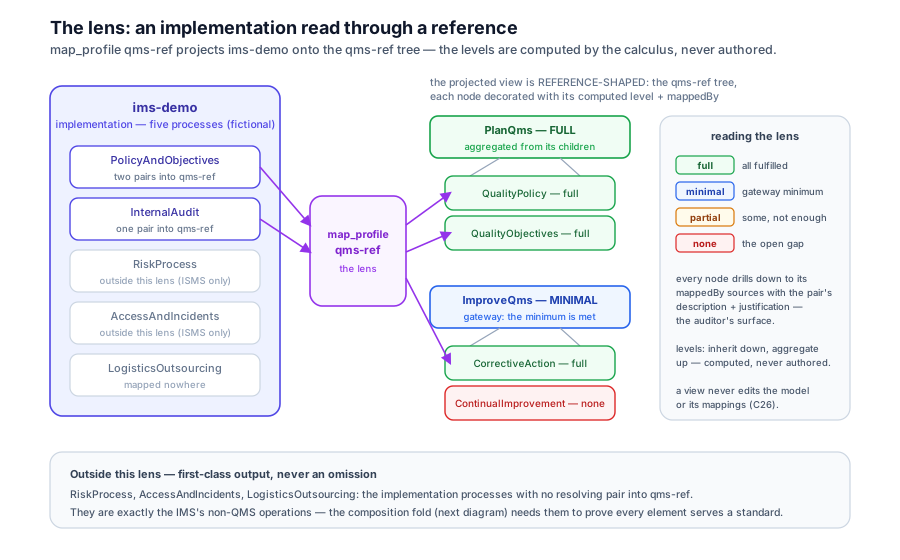
The two computed tables, small enough to print, rich enough to fire every rule:
| qms-ref component | level | why |
|---|---|---|
PlanQms | full | aggregated, both children full |
QualityPolicy | full | direct pair |
QualityObjectives | full | direct pair |
ImproveQms | minimal | gateway minimum met by one branch |
CorrectiveAction | full | direct pair (the shared InternalAudit) |
ContinualImprovement | none | the open QMS gap |
Summary: full 4 · minimal 1 · none 1, plus one closure proposal (both children mapped ⇒ a pair to the parent is proposed, never asserted).
| isms-ref component | level | why |
|---|---|---|
RiskManagement | full | direct pair at the parent |
RiskAssessment | full | inherited from the parent |
RiskTreatment | full | its own direct pair (the shared InternalAudit) wins over the inherited cover |
IsmsOperation | minimal | gateway minimum met by one branch |
AccessControl | full | direct pair |
IncidentResponse | none | the open ISMS gap |
Summary: full 4 · minimal 1 · none 1, plus two inherited proposals (one per descendant of the mapped parent).
Each map_profile also carries a coverage block of authored
assertions, tripwires, not content: coverage is computed; the block
only asserts what the calculus already proves, and the linter errors
when the two disagree.
16.4 N map_profiles validate independently
Section titled “16.4 N map_profiles validate independently”One implementation declaring several map_profiles needs no new
validation machinery, independence is the calculus’s semantics ●:
computeCoveragefilters the mappings to one target namespace; namespaces never leak into each other’s reports;- the linter checks each profile’s coverage tripwires against its
own namespace’s reference (references are keyed by namespace; an
absent reference falls back to the implementation’s own
Namespace#…alias forest, the declared local copies, C21).
The platform pins this over the real packages: each of ims-demo’s two
profiles, computed from its own pairs alone, reproduces exactly the
report computed from the full mapping set, in either computation
order, and the per-namespace levels, mappedBy sets and open gaps are
distinct and correct per the tables above. The only overlap between
the two lenses’ fulfilling sources is InternalAudit, and that is not
pollution, it is the authored shared pair: the “write once, comply
twice” economy the next section reports on. Each namespace even carries
its own description and justification for that shared pair.
16.5 The composition fold
Section titled “16.5 The composition fold”The multi-reference report is a pure fold over the N per-namespace lenses, no new calculus, no kernel change:
ComposedCoverage { implementation: string references: CoverageReport[] # the N reports, as-is sharedSources: Record<string, string[]> # source → the ≥2 namespaces it serves exclusiveSources: Record<string, string> # source → its single namespace uncoveredImplementation: string[] # sources in NO namespace uncoveredReferenceComponents: Record<string, string[]> # ns → components at none}The derivation is mechanical: group each lens’s resolved sources by source; the intersections fall out. Each field is an audit answer:
sharedSources, the “write once, comply twice” witness: for the toy IMS,InternalAudit → [isms-ref, qms-ref];exclusiveSources,PolicyAndObjectives → qms-ref;RiskProcess, AccessAndIncidents → isms-ref;uncoveredImplementation, the ∩ of the per-lens unmapped lists:LogisticsOutsourcing, this operation serves no declared standard;uncoveredReferenceComponents, each reference’s own open gap list:qms-ref → [ContinualImprovement],isms-ref → [IncidentResponse].
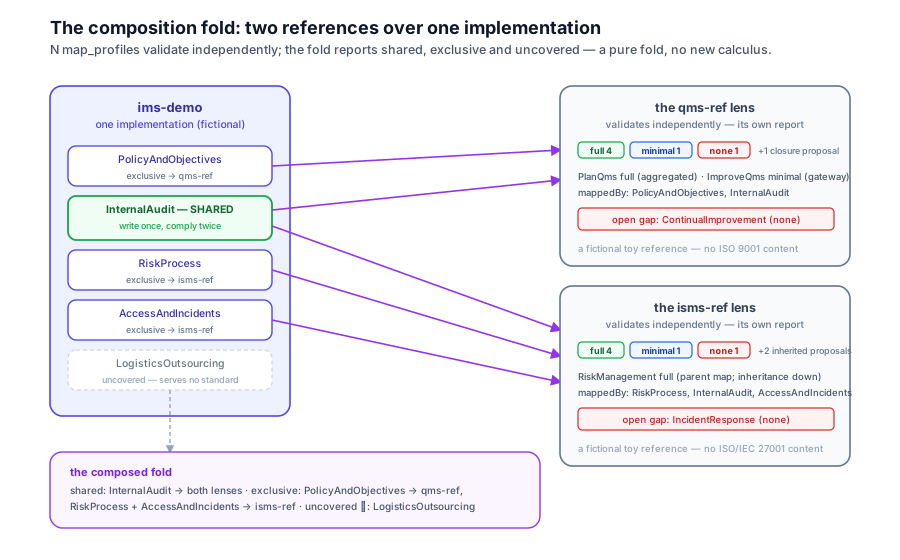
Layered chains (reference ⇒ reference ⇒ implementation, any number of layers, §5.6 a) compose hop by hop; the supply-chain gate of chapter 15 remains their home. The fold here is about one implementation read against several references at once.
16.6 The platform surface: /app/lenses
Section titled “16.6 The platform surface: /app/lenses”The platform renders all of this from a generated projection ●, the
coverage-surface discipline of the coverage pages, applied to lenses:
a build-side module discovers every map_profile pair over
primmel-packages/, computes each lens with the kernel (plus one
filtered lens per view_profile, and the fold per implementation), and
serializes a typed artifact; the page renders the artifact with no
runtime recomputation.
The walkthrough:
- The selector, implementation → map namespace → optional
sub-lens (a
view_profile, its roles shown as badges). The default is always the full, unfiltered lens. - The projected tree, the reference-shaped rendering with level badges, “inherited from X” markers, and the per-node drill-down to the fulfilling sources’ descriptions and justifications. A toggle switches to the inverse index (the operator’s rendering).
- Warnings and proposals, unresolved mappings in red when non-empty; discovery proposals in their own block, explicitly flagged for confirmation, never asserted.
- Outside this lens, the unmapped implementation elements, with
one honesty footnote: the C21
Namespace#…alias declarations ride the kernel’s unmapped list (they are implementation-side processes, never mapping sources), so the page filters them out and counts them in the footnote, reported, never hidden. - The union report (implementations mapping ≥2 namespaces), the per-reference lenses side by side; the shared elements with both fulfilments visible (each namespace’s own pair documentation); the exclusive elements with their targets; the per-reference open gaps with their drill-down paths; and the uncovered ∩ with the same alias-count footnote.
16.7 Validation rules
Section titled “16.7 Validation rules”The mapping-family rules (C21–C26, chapter 11) as the lens relies on them:
- mapping targets resolve, as
Namespace#ElementIDaliases declared locally in the implementation (C21), never content-merged; - the direction is fixed: implementation ⇒ reference, never the reverse (C22);
- authored coverage assertions match the calculus for their namespace (C23), the tripwire semantics of §16.3, checked per profile against its own reference;
- an import is never expressed as a mapping, nor a mapping as an
import (C24), a
map_profilenamespace is not auses; - pairs carry a
descriptionat audit strictness (C25), the auditor’s surface is authored, not optional; - a view never adds, removes, or edits the mappings of the model it reads (C26), §16.1’s three-layer discipline.
16.8 Summary
Section titled “16.8 Summary”- A lens is reference-shaped: the reference tree decorated with computed coverage and the fulfilling sources, plus the honest partition of the implementation into in-lens and outside.
- One CoverageReport, two renderings: the auditor’s tree and the
operator’s inverse index. A
view_profilefilters which voices are audible; roles are displayed, never gated. - The worked IMS is fictional, toy references, no ISO content , and every number it produces is kernel-computed and test-pinned.
- N
map_profiles over one implementation validate independently; the composition fold (shared / exclusive / uncovered / per-reference gaps) is a pure fold over their reports, “write once, comply twice” made visible, and “serves no declared standard” made findable. - The platform computes it all build-side and renders it read-only at
/app/lenses.
Next: OIML Core, on the OIML SMART site: the measurement vocabulary and the subject chain the OIML models are built from.