
Chapter 8, Packages
Chapter 8, Packages
Section titled “Chapter 8, Packages”In this chapter: how models are published, composed, and versioned , the package manifest, the directory convention,
usescomposition across packages, the layering rules that keep overlays honest, modules, editions, and the native ⇔ YAML round-trip.
Chapters 1–7 modelled content. This chapter models containment: how
a body of content becomes a distributable, composable, versioned unit ,
where a model begins and ends, how one model builds on another without
copying it, how two editions coexist. The running system’s answer is
on disk: primmel-packages/oiml-r60/ is the full R 60 Recommendation
as .prl files, and it runs the application end to end (●).
8.1 The manifest
Section titled “8.1 The manifest”A package is a directory whose root carries package.primmel, the
only required file; everything else is merged by convention. The
manifest of the shipped R 60 package
(primmel-packages/oiml-r60/package.primmel), verbatim:
package { id oiml-r60 kind rec title "OIML R 60:2021 — R 60 package" version "2021" editions { 2021 2017 2000 1996 } baseUrn "urn:oiml:pub:r:60:2021" uses { iso-iec-17000 iso-iec-17065 iso-iec-17025 iso-iec-17067 oiml-cs oiml-smart-core oiml-smart-module-specimen-governance } requires { core subject-chain-entities party-entities workflow-entities evaluation-skeleton iso-iec-17000 ca-terminology-17000 iso-iec-17025 lab-requirements-17025 ca-terminology-17025 iso-iec-17065 cb-requirements-17065 ca-terminology-17065 iso-iec-17067 scheme-content-requirements-17067 ca-terminology-17067 oiml-cs cs-process-requirements cs-certificate-requirements sample-selection-rules eut-continuity-contract test-execution-entities } supersedes { urn:oiml:pub:r:60:2017 } validity { from 2021-01-01 } status current description "Metrological regulation for load cells — requirements, test procedures, and test report forms." source { collection "sources/r060/collection.yml" parts { 1 2 3 } }}The fields, each doing one job:
- id, the package’s name in the global id-space; all cross-package
references (
Namespace#ElementID) key on it. - kind, the package’s place in the layer stack:
core(a shared layer),module(a parameterized skeleton family),rec(a Recommendation), orproduct_reference(a manufacturer’s product model, chapter 15). §8.4 develops the stack. - title / description, the human face; multilingual in v3 (chapter 10).
- version, the package’s own version, the coordinate edition pinning (INV-8) records against.
- editions, the document editions this package’s lifecycle covers (§8.5).
- baseUrn, the provenance root: clause URNs
(
urn:oiml:pub:r:60-1:2021#clause-5.2) resolve against it (chapter 9). - uses, the composition declaration: the packages this package builds on, in merge order. §8.3 is its semantics.
- requires, the capability tokens the composition must supply:
each names a
providestoken of an upstream package, so a half-composed package fails loudly instead of silently missing its foundations. - supersedes / validity / status, the lifecycle facets: which
document edition this package replaces, the window it is valid in,
and where it stands (
current,preview,superseded,withdrawn). §8.5 develops the lifecycle. - source, the authoritative document collection the package models, down to its parts; the anchor for the text-coverage and reconstruction audits (chapters 9, 11).
The v2 manifest’s single-string extends oiml-core is retired, §8.3
shows what replaced it and why.
8.2 The directory convention
Section titled “8.2 The directory convention”Inside the package, content is split by layer, the same five-layer
split the YAML tree uses (data/r60/), so the round-trip is
structurally obvious. The shipped R 60 package:
oiml-r60/ package.primmel # the manifest — the only required file model/ # the subject: instrument, attributes, capabilities, # behaviors, conditions, state, twin (primary tier) entities/ # storable classes: subject chain, parties, workflow # (registries: store/indexes/FK graph) specification/ # requirements, conformance, constraints, tables, # symbols, calculations, formulas (secondary tier) execution/ # forms, subforms, test-report skeleton (evidence views) evaluation/ # workflow, processes, state machines, gateways, # certificate, selection (tertiary tier) terminology.prl # terms with vocab_ref into the registers references.prl # document references value-types.prl # the value-type register (SI units) layers.prl # GENERATED include list — layer files consumed # verbatim (§8.3); do not edit payload/ # codec exclusions shipped inside the package # (pair_list blocks, formula engine variants, …) sources-prd/ # .prd extracts + coverage/congruence payloads (ch. 9)Directory names are fixed; file names within them are free; the loader
merges all files into one effective model. References cross files by
stable id only, /req/metrological/mpe, load-cell-errors,
e_max, Manufacturer, never by path. One id space per package: the
same identifier defined twice anywhere is a duplicate-id error at load
(● W2 loader, cross-file duplicate detection). An author reorganizes
files freely; nothing that referenced the content can tell.
The convention is the tier system made visible on disk: model/
primary, specification/ secondary, evaluation/ tertiary,
entities/ the registries. A new Recommendation adds a package
directory and changes zero existing files (OCP).
8.3 Composition: uses
Section titled “8.3 Composition: uses”No Recommendation stands alone. R 60 needs the metamodel’s subject
chain, the OIML-CS workflow skeletons, the EMC test family, the IEC
60068 methods. The v2 manifest expressed this with a single-string
extends: oiml-core, and that is precisely where v2 ran out:
- Single inheritance cannot express the real shape. A rec package
is foundation + scheme + core + N modules, not one parent. The v2
tree made the gap visible: recs declared
extends oiml-corewhile no such package existed, the reference dangled. The shipped tree closed it:oiml-smart-coreis a real package (● smart e80b349, tasks 13–17), and every rec composes it throughuses. - Copy-residue is the failure mode composition must kill. The
cross-standard census found 12 R 91 files byte-identical to R 60 and
8 R 144 structurally identical, including copies wrong for the
copying rec (R 91 shipping R 60’s gateways and certificate
template). Between “copy” and “restate from scratch” there was no
mechanism.
usesis that mechanism.
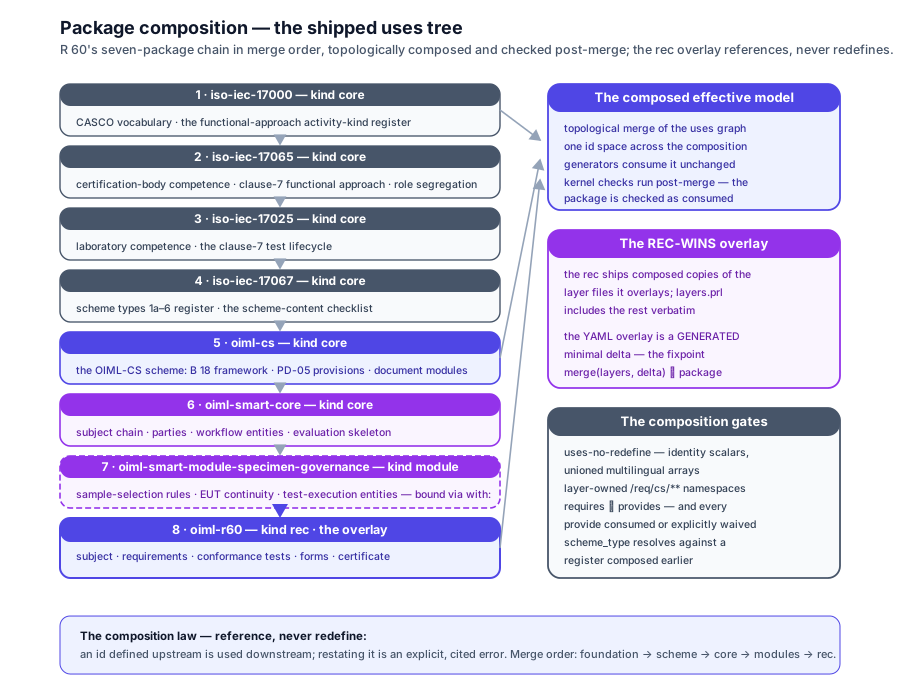
v3 composition is shipped (●, smart e80b349 for the layers, 424a46a for the v3-native recs, a549dab for the SSOT flip). The R 60 manifest’s composition line, verbatim:
uses { iso-iec-17000 iso-iec-17065 iso-iec-17025 iso-iec-17067 oiml-cs oiml-smart-core oiml-smart-module-specimen-governance }Seven upstream packages, in merge order: the CASCO vocabulary, the certification-body and laboratory competence models, the scheme taxonomy, the OIML-CS scheme package, the SMART core, and the specimen-governance module. The semantics:
- Topological merge. Dependencies order themselves, the
foundation packages, then the scheme, then core, then modules, then
the rec overlay, and the effective model is the merge, fed to the
generators unchanged. primmel-ts composes the
usesgraph topologically with no-redefine semantics (the kernel’s package resolver); the kernel’s post-merge checks (C74–C76 among them, chapter 4) run over the composed package, so a module’s skeleton is checked as consumed, not as authored. - An overlay may reference, never redefine. Any id defined
upstream is used downstream, and redefining it is an error ,
enforced twice over: the standards registry’s uses-no-redefine leg
fails the build when a rec overlay restates a layer’s identity
scalar or unions an owned multilingual array, and the layer-owned
requirement namespaces (
/req/cs/**and its per-document sub-namespaces) are pinned so a rec cannot even declare scope there. Conflict detection moved from “silent skip + build warning” (the v2 codegen heuristic, which sorted R 60 first so its shapes won) to explicit, cited errors. - The app build rides a generated include transport. Post-SSOT-flip,
a rec package ships composed copies of the layer files it overlays
and consumes the rest verbatim through
layers.prlincludedirectives (generated, never edited); the YAML-side overlay files are themselves generated as the minimal delta over the layers-only composition, with the fixpointmerge(layers, delta) ≡ package contentasserted per file. Composition is proven semantics-preserving by the layering snapshot tests, and the REC-WINS merge keeps the rec’s own values authoritative where it genuinely overlays. - Requirements are checked. Each package’s
requiresnames capability tokens an upstream package’sprovidesmust supply; the composition fails when a token is unmet, and a provided capability that no consumer uses must be explicitly waived, partial consumers compose cleanly, silent gaps do not. - An implementation package maps, it does not extend. A lab’s SOP
package declares
usesfor vocabulary, then maps its processes to the reference package (chapter 5). Composition is for structure; mapping is for compliance. - A package classifies itself in its own manifest. The OIML-CS
layer declares
scheme_type: type_1a(B 18:2025 §1.3) against the ISO/IEC 17067 scheme-type register, the taxonomy package (types 1a–6, chapter 4’s classification doctrine hoisted to package level) composed earlier in itsuseschain, so the id resolves at composition time and downstream gates read the classification mechanically (the OIML-CS coverage gate discharges type-conditioned checklist items against it, Volume IV, chapter 7). The declaration never lives in the taxonomy package: a foundation package naming its consumer would invert the composition.
8.4 The layer stack
Section titled “8.4 The layer stack”Packages arrange into the layer stack the concept frame fixes:
| Layer | Package kind | Contents | Status |
|---|---|---|---|
| 0 | vocabulary registers | glossarist VIML/VIM term registers (sibling repo) | ● |
| 1 | Primmel kernel | the language itself, this volume | ● (this documentation) |
| 2 | OIML core + CASCO foundation + scheme | the oiml-smart-core package (subject chain, parties, workflow entities, the evaluation skeleton, the certificate lifecycle); the four ISO/IEC CASCO packages (iso-iec-17000/17065/17025/17067); the oiml-cs scheme package, composed into every rec’s effective tree in uses order | ● (all six ship; composition, linker and coverage gates green, Volume IV) |
| 2b | shared modules | the seven oiml-smart-module-* packages: parameterized test/form families with with:/each: binding slots | ● (all seven ship; R 144 and R 129 the proving consumers) |
| 3 | rec packages | normative content only: subject, dimensions, attributes, requirements, tests, forms, tables, terminology | ● (R 60, R 91, R 129, R 144) |
The seven shared modules the census isolated, each a family that at
least two Recommendations replicate with only parameters differing, now
shipping as kind module packages (● smart e80b349):
oiml-smart-module-emc-disturbances, the IEC 61000-4-x immunity family (esd, bursts, surge, rf-emf, conducted-rf, power-voltage-variation, short-time-power-reduction, low-battery): stabilize-baseline → apply disturbance at severity → record observable → fault verdict.oiml-smart-module-env-iec60068, climatic/mechanical methods (dry-heat, cold, damp-heat cyclic/steady, vibration, shock, ambient-pressure).oiml-smart-module-software-d31, the OIML D 31 software-examination checklist.oiml-smart-module-reference-materials, certified reference records (certified value + uncertainty), the test-point subform, and the U:MPE validity hook.oiml-smart-module-specimen-governance, sample-selection rules, the EUT-continuity contract, and the test-execution entity layer.oiml-smart-module-report-headers, bind-driven TRF identification/conditions blocks and the PD-05 18-element checklist binding rules.oiml-smart-module-examination-docs, documentation/marking examination skeletons.
A module is a shared, parameterized package: it freezes a skeleton
(variables with source typing, steps, verdict pattern, form skeleton)
and declares what consumers must bind, provides (the capability
tokens), requires (what core and the consumer supply), and the
consumer’s with: bindings (its attribute ids, severities, acceptance
expressions, clause URNs). A slot declared each: true binds a list
of binding maps and the skeleton materializes once per entry, so a
whole test family instantiates from one with-map. The proving
consumers, all shipped: R 60 binds specimen-governance (its
sample-selection clauses and unit-continuity rules); R 144 binds
specimen-governance and reference-materials with
with: { subform: cgm-point }, its cgm-point subform a thin
overlay; R 129 binds emc-disturbances and env-iec60068 through
each: slots, the 8-disturbance-form family and the environmental
forms instantiate from one with-map each, binding severities, clause
URNs, labels and enum values (● smart e80b349 + the R 129 migration,
task 22). One skeleton, three bindings, zero copies.
The supply chain of chapter 15 adds one package kind beside the stack:
product_reference (● smart c24a644, task 36), the manufacturer’s
product model, mapped aspect-by-aspect to the Recommendation. The ACME
LC-500 package ships as the reference instance. A user consumes it as
an abstract import, static reference content under the same
version-pinning discipline uses enforces (uses { acme-lc500@2021 },
no unpinned consumption), or as a live integration of the deployed
instance’s twin; the shipped quarry belt-scale package demonstrates
both modes at once. Chapter 15 is the authority for both modes; the
package layer treats the kind as one more composable unit.
8.5 Editions and lifecycle
Section titled “8.5 Editions and lifecycle”The manifest’s editions { 2021 2017 2000 1996 } is not decoration.
Editions are arbitrary packagings used for provenance and lifecycle
management, orthogonal to the kernel, and implemented as such (●
smart cb5eab6, task 28):
- Edition pinning. Every definition executed in a run is
version-pinned in the test report (● INV-8), so a re-evaluation
under a new edition is an explicit act; kernel check C80 proves an
instance’s
definition_versionspins resolve against the manifest’s edition register. - Versioning relations live on the package, not in subject models.
supersedes/replaceschains,validity { from … to … }windows, andstatus current|preview|superseded|withdrawnare manifest content, the R 60 manifest above carries all three, validated by kernel checks C77–C80. A 2000-edition load cell and a 2021 one differ by package reference, not by a version field smeared through the subject graph. - Model diff is the kernel capability editions owe: structural diff between two package versions (elements added/removed/changed/ moved, including mapping diff and the clause-drift table), powering edition comparison, change audit, and clause-drift detection , shipped, with the R 60 2017→2021 renumbering corpus as its acceptance fixture. Chapter 13 develops this in full (●).
8.6 Round-trip: Primmel-native ⇔ Primmel-YAML
Section titled “8.6 Round-trip: Primmel-native ⇔ Primmel-YAML”A package has two serializations with a semantic round-trip between
them (●, implemented and tested): Primmel-native .prl (the
authoring form) and Primmel-YAML (the runtime form, data/r60/).
The contract:
- YAML → native: one
.prlfile per YAML file, per the §8.2 convention; every YAML construct has a native counterpart. - Native → YAML: parse the package, emit the exact runtime shapes
(snake_case keys, structure-map paths); output passes the JSON
Schemas and
npm run validate. - Round-trip fidelity:
native → yaml → nativedeep-equal after normalization;yaml → native → yamldeep-equal modulo unordered- map ordering, property-tested over the entire R 60 tree, not samples. Comments becomenote:fields; meaningful order (steps, transitions, table rows) is preserved; unknown constructs fail loudly, never silently drop. - The runtime plug: a Primmel package drops into the SMART build
(
SMART_STANDARDS_SOURCE=primmel) and compiles to the same generated artifacts, the app runs identically from either serialization (● W6: zero validation errors).
The point is not format sympathy but that the model is the source of truth in both directions: authoring and runtime forms are projections of one semantics, so neither drifts from the other without the test kit failing.
8.7 Grammar sketch (shipped v3 syntax)
Section titled “8.7 Grammar sketch (shipped v3 syntax)”# ── a rec package manifest ─────────────────────────────────package { id oiml-r60 kind rec title "OIML R 60:2021 — Metrological regulation for load cells" version "2021" editions { 2021 2017 2000 1996 } baseUrn "urn:oiml:pub:r:60:2021" source { collection "sources/r060/collection.yml" parts { 1 2 3 } } uses { iso-iec-17000 iso-iec-17065 iso-iec-17025 iso-iec-17067 oiml-cs oiml-smart-core oiml-smart-module-specimen-governance } supersedes { urn:oiml:pub:r:60:2017 } validity { from 2021-01-01 } status current}
# ── a module manifest ──────────────────────────────────────package { id oiml-smart-module-emc-disturbances kind module uses { oiml-smart-core } requires { oiml-smart-core } provides { disturbance-test-skeletons disturbance-form-skeletons disturbance-verdict-variants }}
# ── the consumer binds, never redefines ────────────────────# (layer-manifest form; the skeleton's ${slot} placeholders# materialize at the target path — an `each:` slot binds a# list and instantiates once per entry)uses: - module: module-emc-disturbances with: forms: # an each: slot — one with-map, - test_id: /conf/disturbance-tests/esd # eight R 129 forms form_id: esd requirement_clause: urn:oiml:pub:r:129-1:2020#clause-4.3.1 # … severities, labels, enum values, verdict variant8.8 Validation rules
Section titled “8.8 Validation rules”package.primmelis present and complete: id, kind, title, version, baseUrn; the id is unique across the composed set (●);- one id space per merged package: a duplicate id across any two files is an error within a package, and restating an upstream id at all is a uses-no-redefine error across the composition (● both legs);
- overlay discipline: no id defined upstream is redefined downstream;
every
requirestoken is satisfied by an earlier package’sprovides; every provided capability is consumed or explicitly waived (●); - layer-owned requirement namespaces (
/req/cs/**and its per-document sub-namespaces) reject rec-side declarations at composition (●); usesis acyclic and topologically mergeable; a cycle is an error (●);- a manifest classification facet (
scheme_type:) resolves its id against a register package composed earlier in theuseslist; the classification record never lives inside the taxonomy package (●); - every cross-file and cross-package reference resolves by id
(
Namespace#ElementIDacross packages); path references are rejected (● within packages; ● across, the linker runs over the composed tree); - editions are a descending, duplicate-free list;
supersedes/validity/statusare well-formed; the pinned edition of any executed definition exists in the list (● C77–C80; the diff checks of chapter 13 ●); - round-trip: the package converts both directions with zero loss warnings; a hand-introduced semantic edit fails the kit (●).
8.9 Summary
Section titled “8.9 Summary”- A package is a directory with one manifest (
package.primmel: id, kind, title, version, editions, baseUrn, uses/requires, the supersedes/validity/status lifecycle facets, source) and a fixed directory convention mirroring the tier system. - References cross files by stable id, never by path; one id space per package makes reorganization free.
uses { foundation… scheme core modules… }replaced single-stringextends, topological merge, overlay-may-reference-never-redefine, shipped for all four recs. Composition is for structure; implementation packages map, they do not extend; a scheme package classifies itself (scheme_type:) against a register composed earlier.- Packages stack: vocabulary registers, kernel, the CASCO foundation
and OIML-CS scheme packages,
oiml-smart-core, the seven shippedoiml-smart-module-*packages (●, R 60, R 144, R 129 the proving consumers), rec overlays;product_referencepackages compose beside the stack (●, ACME LC-500, consumed abstract-pinned and live). - Editions are lifecycle packaging: pinning (INV-8), the C77–C80 manifest checks, and the shipped model diff of chapter 13.
- The native ⇔ YAML semantic round-trip is implemented and property-tested; the app runs from either serialization.
Next: Chapter 9, Provenance: clause and fragment
provenance, .prd extracts, and document reconstruction.