
Chapter 2, Subjects
Chapter 2, Subjects
Section titled “Chapter 2, Subjects”In this chapter: the Subject, the center of the primary tier, and its anatomy: the three questions IS / HAS / DOES, the complete aspect catalog, and the tests that tell you which family an aspect belongs to.
2.1 The Subject: center of the primary tier
Section titled “2.1 The Subject: center of the primary tier”Everything in a Primmel model is about something. That something is the Subject: the entity the standard governs. In OIML SMART the subject is the measuring instrument (VIML 0.10); in a management-system standard it is the organization; in a product standard it is the product family. The kernel does not care what the subject is, it cares that the subject is modelled with a complete, disciplined anatomy.
The subject is primary: requirements constrain it, tests operate on it, forms record its exhibition, verdicts judge it. Get the subject right and the secondary models write themselves as derivations of it; get it wrong and every downstream model compensates with duplication , which is exactly how untyped requirement databases rot.
2.2 The three questions
Section titled “2.2 The three questions”Formal grounding. The IS / HAS / DOES trichotomy is not a convenience, it is provably exhaustive. See Volume 0 ch 2 §2.2, the Claim-Form Axiom for the philosophical commitment, and Volume 0 ch 4, Proofs for the closure, completeness, and extensibility theorems. The eight terms and three closure rules of the underlying algebra are defined in Volume 0 ch 3. What follows is the applied form: how the three relations turn into a usable subject anatomy.
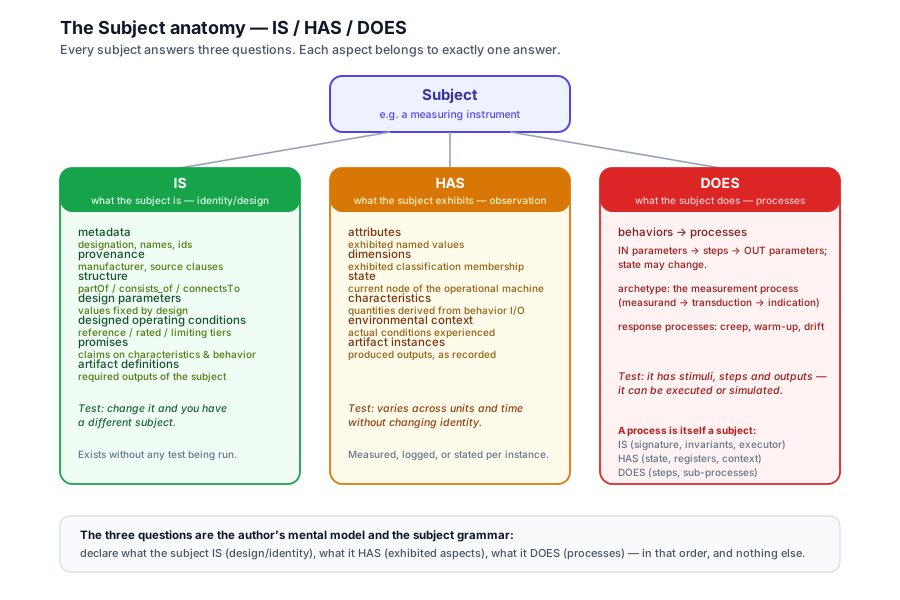
Every aspect of a subject answers exactly one of three questions:
| Question | Level | The discriminator |
|---|---|---|
| IS, what is it? | identity / design | Change it and you have a different subject. Exists without any test being run. |
| HAS, what does it exhibit? | observation / instance | Varies across units and time without changing identity. Measured, logged, or stated per instance. |
| DOES, what does it do? | function / process | It has inputs, steps and outputs, it can be executed or simulated. |
These are not three buckets for convenience; they are three levels of being of the same subject. A designed operating envelope (IS) and the actual temperature during a test (HAS) are the same kind of value at different levels. The anatomy keeps the levels apart so that a test can say “hold the environmental context (HAS) within the designed envelope (IS)” without confusing which is which.
2.3 The IS catalog, what the subject is
Section titled “2.3 The IS catalog, what the subject is”Seven aspect kinds, plus one twin-era addition (○, chapter 14). Each is intrinsic: modify it and you are describing a different subject.
| Aspect | Definition | Example (OIML R 60) |
|---|---|---|
| metadata | designation, names, ids, definition | LoadCell, model designation ACME-LC-500 |
| provenance | pedigree: manufacturer, source clauses, supersedes, legally-relevant software | manufacturer record; source: r:60-1:2021 §3.1.3 |
| structure | designed composition: partOf / consists_of / connectsTo | a moving speed meter consists of a target meter + an ego meter |
| design parameters | values fixed by design that define the type | E_max = 500 kg, p_LC, transducer material |
| declared classification | kind-membership: the declared dimension values, identity-defining (the exhibited reading is HAS, below) | the group presents as accuracy class C, the family as humidity class CH |
| designed operating conditions | the designed envelopes: reference / rated / limiting tiers | rated −10…+40 °C; reference 20 °C ± 2 |
| promises | manufacturer claims on characteristics and behavior | ”holds class C6 over the rated range”; a durability claim |
| artifact definitions | outputs the subject must produce, with content contract + produced-when | the R 91 evidence file per enforcement measurement |
| endpoint ○ | the declared API surface: operations the subject serves (query / subscribe / invoke) with access scopes, part of the type definition, like a marking | lc500_api serving get_indication, watch_state, run_self_test |
Two of these are commonly confused away and must stay distinct:
- Design parameters are not attributes. A design parameter is part of the type definition, changing it makes a different model. An attribute (below) is an exhibited value. The same quantity may exist at both levels (§2.6), but the roles never merge.
- Promises are not declared attributes. A declared attribute is a claim stated as one parameter value (“t_min = −10 °C”). A promise is a claim about a characteristic or a behavior, possibly envelope-shaped, possibly conditional. A promise cites no regulator: the manufacturer binds itself, and evaluation will verify. The certificate prints promises-as-verified.
2.4 The HAS catalog, what the subject exhibits
Section titled “2.4 The HAS catalog, what the subject exhibits”Six aspect kinds. Each is observable: it can be measured, logged, or stated per unit, and it may differ between two units of the same model without them becoming different models.
| Aspect | Definition | Example (OIML R 60) |
|---|---|---|
| attributes | exhibited named property values | test-context values d_min, d_max; as-found readings |
| dimensions | exhibited classification readings (declared membership is IS) | this unit presents as class C6, humidity class CH |
| state | current node of the operational state machine | off → warming → ready → measuring → fault |
| characteristics | quantities derived from behavior I/O | error e_l, repeatability e_r, creep c_c |
| environmental context | actual conditions experienced | logged 23.4 °C during run 7; installation site |
| artifact instances | produced outputs, recorded as evidence | one emitted evidence file |
And the third classic confusion:
- Environmental context is not designed operating conditions. The designed tiers (IS) say where the instrument is meant to perform; the environmental context (HAS) is what it actually experienced. A test constrains the latter to lie within the former and records both.
In the twin direction (○, chapter 14) this catalog doubles as the
serving catalog: a live instance exposes its HAS aspects through serve
bindings, each bound to an endpoint operation with a freshness window ,
a stale value degrading the verdict to indeterminate, never a silent
pass.
2.5 The DOES catalog, what the subject does
Section titled “2.5 The DOES catalog, what the subject does”One aspect kind, recursively defined: behaviors, and a behavior is a Process, IN parameters, steps, OUT parameters; state may change.
The archetype is the measurement process itself: measurand IN → transduction chain → indication OUT. Response processes (creep, warm-up, drift) follow the same anatomy: constant load IN, drifting indication OUT, over time.
Because a process is itself a subject, the anatomy recurs:
- Process IS, signature (IN/OUT parameters), invariants, designed envelope, actor/executor, obligation.
- Process HAS, current state, registers/variables, actual context, process characteristics (duration, rate).
- Process DOES, steps and sub-processes, bottoming out in atomic steps (a register write, a stimulus application, a wait).
Chapter 4 develops the process model in full. What matters here: DOES is
processes, not narrative, a behavior you cannot in principle execute
or simulate is a characteristic wearing a costume. And a process may
itself be reachable: in the twin direction (○, chapter 14) the subject’s
endpoint can declare an invoke operation over a behavior, making it
remotely invocable, “run your self-test” from across the wire.
2.6 The IS/HAS duality
Section titled “2.6 The IS/HAS duality”Designed vs exhibited is a duality relation between levels, not an overlap: one value structure (a quantity with unit and tolerance), two aspect roles. The designed operating envelope and the actual conditions are duals; a design parameter and its exhibited realization are duals.
The duality is what makes verification statable in one sentence: the exhibited value must satisfy the designed claim. Tests exist to put the two levels on record side by side.
2.7 Characteristics: the quantitative interface
Section titled “2.7 Characteristics: the quantitative interface”Characteristics deserve their own note because everything downstream hangs off them:
behavior (DOES) ──produces──▶ I/O values ──derived──▶ characteristic (HAS) │ │ │ promises requirements claim constrain │ │ └── tests compute, verdicts judge- error = OUT − reference IN
- repeatability = dispersion of OUT under repeated identical IN
- creep = ΔOUT/Δt under constant IN
A characteristic is defined once (symbol, derivation from behavior I/O), claimed by promises, limited by requirements, computed by tests, and judged by verdicts. Defined in the primary model; referenced everywhere else, the one-home rule for quantities.
2.8 The universal anatomy
Section titled “2.8 The universal anatomy”The triad is not specific to instruments. Every first-class model kind answers the same three questions:
| Model | IS | HAS | DOES |
|---|---|---|---|
| Subject (instrument) | metadata, provenance, structure, design parameters, designed conditions, promises, artifact definitions | attributes, dimensions, state, characteristics, environmental context, artifact instances | behaviors |
| Process | signature, invariants, executor | state, registers, context, process characteristics | steps, sub-processes |
| Requirement | statement, provenance, modality | bindings, limit expression | its evaluation (→ verdict) |
| ConformanceTest | id, kind, provenance | variables, preconditions, enforced conditions | its method |
| Form | id, provenance | fields (bound + evidence slots) | bind/write-through, derivations |
| Workflow | phases, role model | lifecycle state per object | dispatch/evaluate/issue processes |
| Verdict | requirement × sample identity | outcome, fact, limit snapshot | its re-execution |
| Evidence/Run | which test, sample, operator | values, conditions log, timestamps | , (terminal record) |
This is why the anatomy is the subject grammar: the author answers three questions per model, and the linter asks the same three questions back (did you declare its IS? its HAS? its DOES?).
2.9 Grammar sketch (illustrative v3 syntax)
Section titled “2.9 Grammar sketch (illustrative v3 syntax)”Status ◐: the subject construct is implemented in the language
toolchain (primmel-ts: is:/has:/does: blocks, extends merge
rules, anatomy checks C6–C9, TODO.roadmap/01). The sketch below is
normative for the concepts; small surface details (e.g. extends sits
inside the block) follow the implementation.
subject LoadCell { is { metadata { name "Load cell" source "urn:oiml:pub:r:60-1:2021#clause-3.1.3" } provenance { manufacturer ACME } design_parameters { e_max : mass by design # origin: design-fixed } designed_conditions { reference ref-conds rated rated-conds } promises { accuracy_class C6 over rated } structure { } artifacts { } } has { attributes { d_min : mass test_dependent } dimensions { accuracy_class ∈ {A,B,C,D} } state OperationalStates characteristics { creep c_c = ΔOUT/Δt under constant load } environmental_context { logged conditions } } does { behavior measure { in force -> out indication } behavior creep { in force, time -> out indication } }}2.10 Validation rules
Section titled “2.10 Validation rules”The linter enforces, per aspect family:
- every aspect belongs to exactly one family (IS, HAS, or DOES), a declaration in the wrong family is an error, not a warning;
- every IS aspect is instance-independent (no test-context values among design parameters);
- every HAS characteristic names its derivation from behavior I/O;
- every DOES behavior declares its IN/OUT signature (abstract form is allowed; unsigned narrative is not);
- duality pairs share one value structure (unit coherence between the designed tier and the actual log).
2.11 Terminology traps
Section titled “2.11 Terminology traps”The four confusions this chapter exists to prevent:
- attributes = characteristics = design parameters, no: exhibited values (HAS) vs behavior-derived quantities (HAS) vs type-defining values (IS).
- environmental context = operating conditions, no: actual (HAS) vs designed (IS).
- promises = declared attributes, no: claims on characteristics and behavior (IS) vs single parameter values (HAS, or IS when declared).
- behavior = a paragraph about response, no: a process (DOES) with signature and steps, or a characteristic derived from one.
2.12 Summary
Section titled “2.12 Summary”- The subject is primary; everything else is derivation, evidence, or judgment about it.
- IS = identity/design (change it → different subject); HAS = exhibition (varies without identity change); DOES = processes (executable or simulatable).
- Seven IS aspects, six HAS aspects, one recursive DOES aspect.
- The IS/HAS duality (designed vs exhibited) is a relation between levels, never an overlap.
- Characteristics, quantities derived from behavior I/O, are the interface that requirements constrain, tests compute, and verdicts judge.
Next: Chapter 3, Instantiation: definition and instance, the subject chain, and Sample as instance of Model.