
Chapter 1, Intuition
Chapter 1, Intuition
Section titled “Chapter 1, Intuition”In this chapter: the IS–HAS–DOES modelling system, without any math. We start with the three questions every description of anything must answer, walk through why every “fourth bucket” you might be tempted to add collapses back into three, and end with what the system promises, closure, completeness, extensibility, stated in plain language. The formal version of these arguments lives in Chapter 4 (Proofs); the rest of the volume builds on this chapter’s intuitions.
1.1 The three natural questions
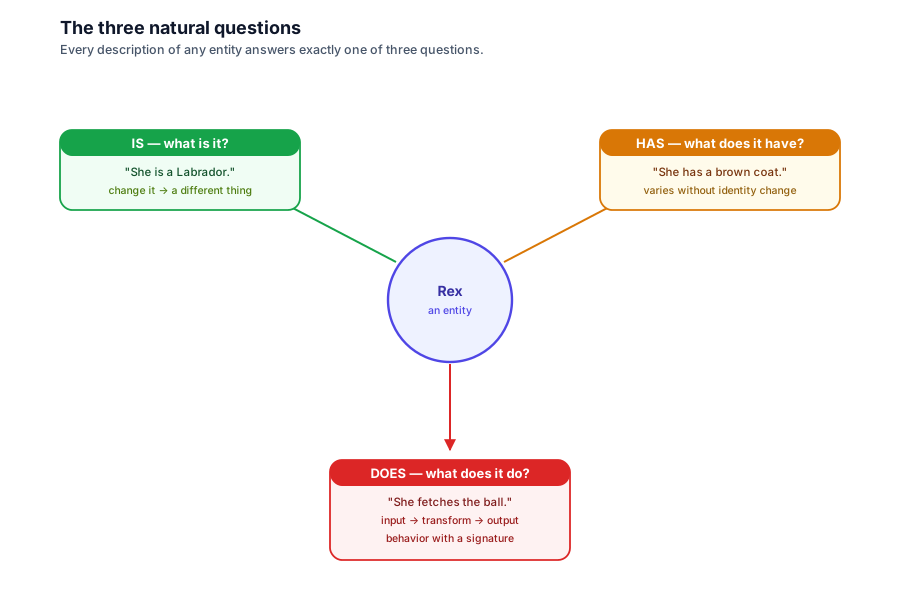
Section titled “1.1 The three natural questions”Imagine you are describing a dog. You can say any of these things:
- She is a Labrador. (She is a kind of thing.)
- She has a brown coat. (She holds a particular property.)
- She fetches the ball. (She does something, she transforms an input into an output.)
Three questions, three answers. Every description of every entity in the world reduces to one of these three:
| Question | Level | Test |
|---|---|---|
| IS, what is it? | identity / kind | Change it and you have a different thing. |
| HAS, what does it have? | property / value | Can vary without changing identity. |
| DOES, what does it do? | behavior / process | Has inputs, a transformation, and outputs. |
These are not three buckets we picked for convenience. They are three levels of being that any description must navigate. A door is a door regardless of whether it is open or closed; whether it has a red coat of paint doesn’t change its identity; what it does (swing on hinges, block a doorway) is a behavior that depends on its structure but is not reducible to it.
The three questions cover everything you can truthfully say about a door, a dog, a kettle, a country, an algorithm, a legal statute, a running program.
1.2 The layers at a glance
Section titled “1.2 The layers at a glance”The three questions are the surface. Below them, the system has five layers, nested like shells. Each layer depends only on the layers inside it.
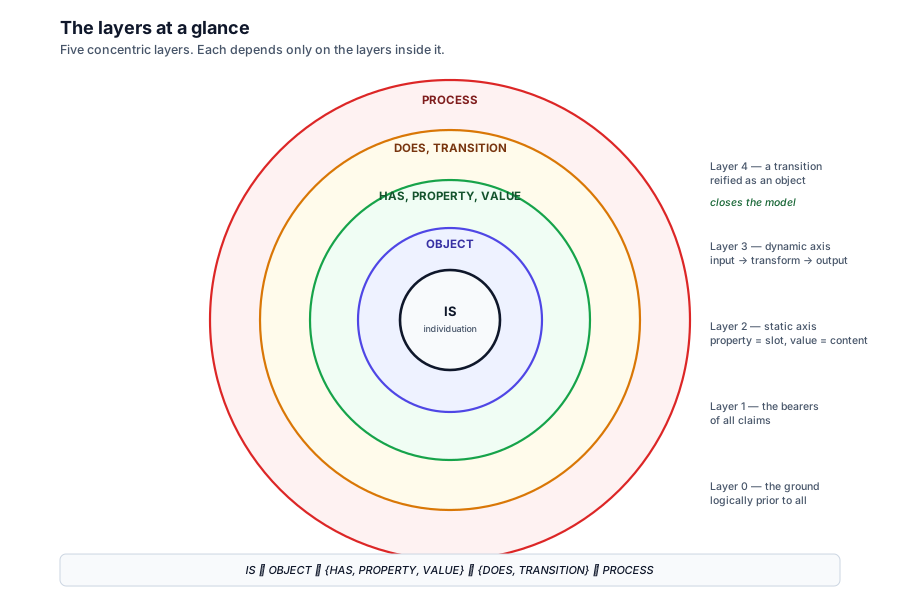
IS ⊂ OBJECT ⊂ {HAS, PROPERTY, VALUE} ⊂ {DOES, TRANSITION} ⊂ PROCESS- Layer 0, IS. Individuation: which thing we are talking about, and what counts as the same thing across time and change.
- Layer 1, OBJECT. Anything IS can pick out (a dog, a door, a number, a kind, a program run).
- Layer 2, HAS, PROPERTY, VALUE. The static axis. PROPERTY is the slot (color, mass, owner); VALUE is what fills it (red, 4 kg, Alice).
- Layer 3, DOES, TRANSITION. The dynamic axis. A TRANSITION is a
rule
input → transform → output. - Layer 4, PROCESS. The bridge that folds the dynamic side back into the static side: a transition reified as an object, so it can bear IS and HAS facts like anything else.
The layered shape is not accidental, its symmetry (three relations, each with its nouns) is what lets us prove the system is closed and complete. We will get to those proofs in Chapter 4.
1.3 Why not more buckets? The dialectic
Section titled “1.3 Why not more buckets? The dialectic”A natural objection: surely the world has more than three kinds of fact. What about:
- STATE, a kettle is currently boiling
- CAN, a bird can fly (whether or not it is flying)
- RECEIVES, a door is pushed (someone else’s action, viewed from the receiving end)
- RELATES-TO, a person is part of a team
- BECOMES, a caterpillar becomes a butterfly
These are intuitive categories. They feel like fourth, fifth, sixth buckets. The honest question is: do they earn their place, or are they re-packagings of the three primitives?
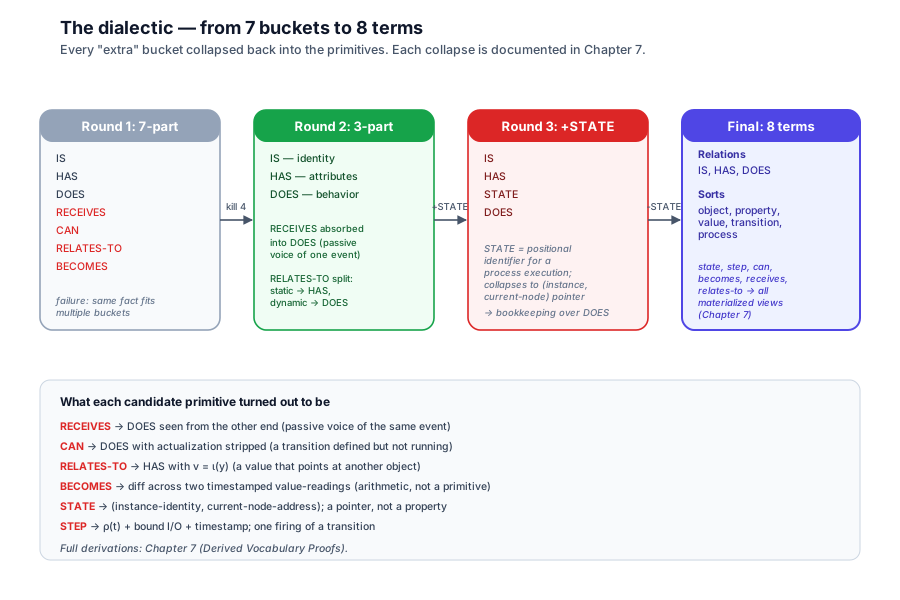
We walked through this carefully. Each candidate collapses:
- STATE collapses into HAS. “The kettle is currently at 100°C” is just a value (100°C) filling the temperature property at this moment. The fact that temperature changes fast doesn’t make it a different kind of fact from a slow-changing property like mass.
- CAN collapses into DOES. “A bird can fly” is the same behavior as “a bird flies,” just not currently actualized. Capability is behavior minus commitment to a particular execution.
- RECEIVES collapses into DOES seen from the other end. “The door is pushed” and “the wind pushes the door” describe the identical event; only the grammatical voice changed.
- RELATES-TO collapses into HAS with a reference value. “Alice is part of the team” is “Alice has a team-membership property whose value points at the team object.”
- BECOMES collapses into a diff. “The door becomes closed” is nothing more than: at time t₁ its state-property returned open; at time t₂ it returned closed; we subtract the two readings and call the difference “became.”
Every candidate primitive, STATE, CAN, RECEIVES, RELATES-TO, BECOMES, STEP, turned out to be a materialized view of the three primitives, kept around for convenience but owing nothing ontologically. The full derivations are in Chapter 7 (Derived Vocabulary); here we only need the conclusion.
1.4 What the system promises
Section titled “1.4 What the system promises”Three promises, in plain language:
-
Closure. You cannot break the system by combining its parts. Compose two transitions, you get a transition. Reify a transition as an object, you get an object. Embed an object as a value, you get a value. No operation ever produces a ninth kind of thing. The list of primitives stops growing.
-
Completeness. Every claim you can make about an entity reduces to one of three forms, an identity claim, an attribution claim, or a transformation claim. Each of those forms has a primitive that catches it. So every claim the system can be asked to express can be expressed.
-
Extensibility. Adding new content (new kinds of object, new properties, new values, new transitions) never requires adding new primitives. You grow the system by enlarging its populations, not by adding to its vocabulary. New domains (legal metrology, software process, business workflow) all live inside the same eight terms.
These three promises are stated here as intuition. Chapter 4 (Proofs) proves them as theorems, relative to one philosophical axiom (the Claim-Form Axiom, see Chapter 2).
1.5 What this volume is and is not
Section titled “1.5 What this volume is and is not”What it is: the formal ground under everything else in this documentation tree. Primmel (Volume I) is one language that operationalizes this system. OIML SMART (Volumes II–III) is one domain encoded in Primmel. The system itself is generic, it applies to any modelling task, not just legal metrology.
What it is not:
- It is not a piece of pragmatics. You will not learn Primmel syntax here; that is Volume I.
- It is not a comparative survey. For how the system compares to OOP, UML, BPMN, EXPRESS, OPM, RDF/OWL, and Petri nets, see Chapter 8 (Comparative Analysis).
- It is not a closed set of opinions. Chapter 11 (Open Questions) states what is not proven and where the system could be falsified.
1.6 How to read this volume
Section titled “1.6 How to read this volume”The volume is layered. Read what you need; stop when you’ve had enough.
- Novice track, this chapter alone. You will walk away understanding what IS/HAS/DOES is, why it’s three buckets and not seven, and what the system promises.
- Professional track, read through Chapter 7 (Derived Vocabulary). You will be able to model with the system, argue for it, and recognize when something is being passed off as a new primitive that is actually a composite.
- Expert track, read the whole volume. You will be able to defend the system against methodological comparison, contribute to its extension, and locate the seams where it could break.
If a chapter ever seems to introduce a ninth modelling term, treat it as a materialized view (Chapter 7) and check what composite it is shorthand for.
Next: Chapter 2, Claims and Falsifiability: what the system commits to, and what would refute it.