
Chapter 8, Comparative Analysis
Chapter 8, Comparative Analysis
Section titled “Chapter 8, Comparative Analysis”In this chapter: how the IS–HAS–DOES foundation compares to the major modelling methodologies, OPM, OOP, UML/fUML, SysML v2/KerML, BPMN, EXPRESS, RDF/OWL, and Petri nets/process calculi. Each is examined for what it gets right, where it stops or fragments, and what the foundation repairs. The chapter ends with a positioning matrix and the adoption-via-executability thesis.
This is the longest chapter in the volume because the comparative argument is the strongest external validation: every individual fragment of the foundation has precedents, and the foundation’s claim is the conjunction under one closed algebra.
8.1 The escape hatch problem
Section titled “8.1 The escape hatch problem”Every mainstream modelling methodology has a point where the model ends and opaque text begins. In OOP, that point is the method body. In UML, it is the action label. In BPMN, it is the task name. In EXPRESS, behavior is explicitly out of scope. In RDF/OWL, inference replaces execution.
Call this the escape hatch: the place where every existing methodology stops modelling and starts trusting prose or code. The consequence is universal and expensive, the model and the implementation become two artifacts, they drift, and the model becomes documentation rather than truth.
The foundation has no escape hatch. A transition is , and the transform is not an opaque body, it decomposes into smaller transitions, by the same composition operator, all the way down. Behavior is inside the model all the way down.
We will examine eight methodologies through this lens.
8.2 OPM (ISO/PAS 19450:2015), the near miss
Section titled “8.2 OPM (ISO/PAS 19450:2015), the near miss”OPM (Object-Process Methodology, Dori’s framework) is the closest intellectual relative. Its core thesis: the universe of a model contains exactly two things, objects and processes, where objects exist and processes transform objects. Dori’s polemic against UML was the same polemic implicit here: nine diagram types and hundreds of metaclasses are a symptom of missing foundations.
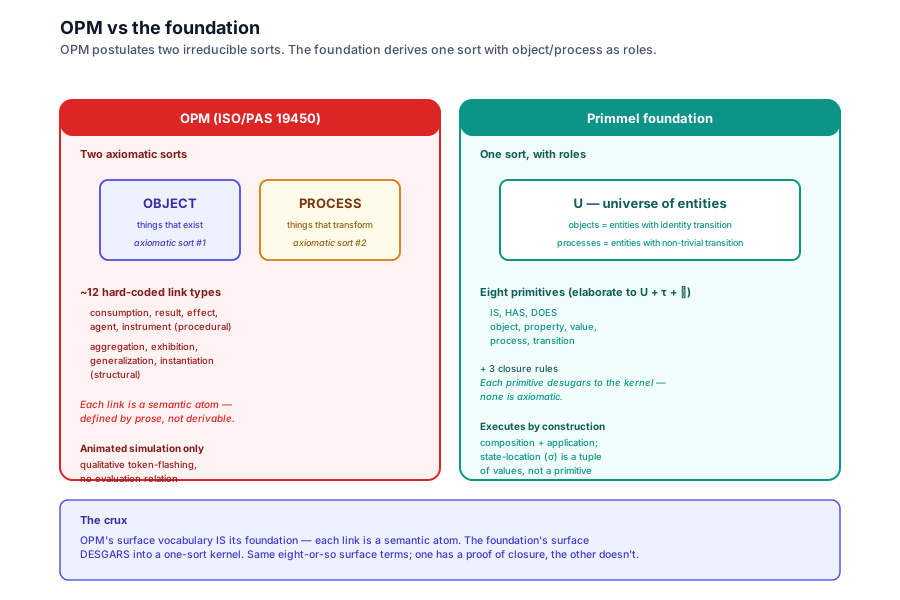
What OPM gets right
Section titled “What OPM gets right”- A unified object/process ontology (most methodologies split these).
- A single diagram kind (OPD) instead of UML’s dozen.
- A controlled-natural-language rendering (OPL) paired with the graphical view, superficially resembles the kernel/surface split of Chapter 5.
Where OPM stops
Section titled “Where OPM stops”Three failure points, each instructive:
-
The object/process duality is axiomatic, not derived. OPM postulates two sorts and never asks whether one reduces to the other. The foundation proves the unification (object = identity transition, Chapter 5 §5.4). Because OPM has two irreducible sorts, every cross-sort relationship requires dedicated link machinery, about a dozen hard-coded link types: consumption, result, effect, agent, instrument on the procedural side; aggregation, exhibition, generalization, instantiation on the structural side. These are the foundation’s eight surface primitives with no kernel underneath to elaborate into.
-
OPM is not executable. OPCAT offers “animated simulation” , qualitative token-flashing over the diagram, not computation. There is no evaluation relation, no composition algebra. OPL looks formal but is actually a paraphrase generator. Both modalities are surface; there is no kernel.
-
States are structural in OPM, positional in the foundation. OPM places states inside objects as sub-shapes, and processes move objects between them. This conflates the definition of a process with the trajectory of an execution. The foundation’s treatment (state as a locator within a composed process instance) keeps definitions and executions as distinct entities.
What the foundation repairs
Section titled “What the foundation repairs”All three. Object/process is unified by the kernel (§5.4). The kernel is only execution (composition + application, Chapter 6). State is a positional identifier, not a structural sub-shape (Chapter 7 §7.2).
Document status (for precision)
Section titled “Document status (for precision)”ISO/PAS 19450:2015 is a Publicly Available Specification, not a full International Standard, not a Technical Report. A PAS is a fast-track deliverable approved by simple technical-committee vote; it skips the DIS/FDIS enquiry and formal ballot stages. Adoption record: academic courses at MIT/Technion, a handful of aerospace research projects, two tools from the same lineage (OPCAT, OPCloud). No ecosystem of independent implementations, which is the real test of a modelling standard.
8.3 SysML v2 / KerML, the strongest precedent
Section titled “8.3 SysML v2 / KerML, the strongest precedent”The SysML v2 effort concluded, after two decades of living with UML’s foundationless metamodel, exactly what the foundation concludes: it built KerML (Kernel Modeling Language), a small kernel language with declarative formal semantics, and defined SysML v2 as a surface layer that elaborates into it.
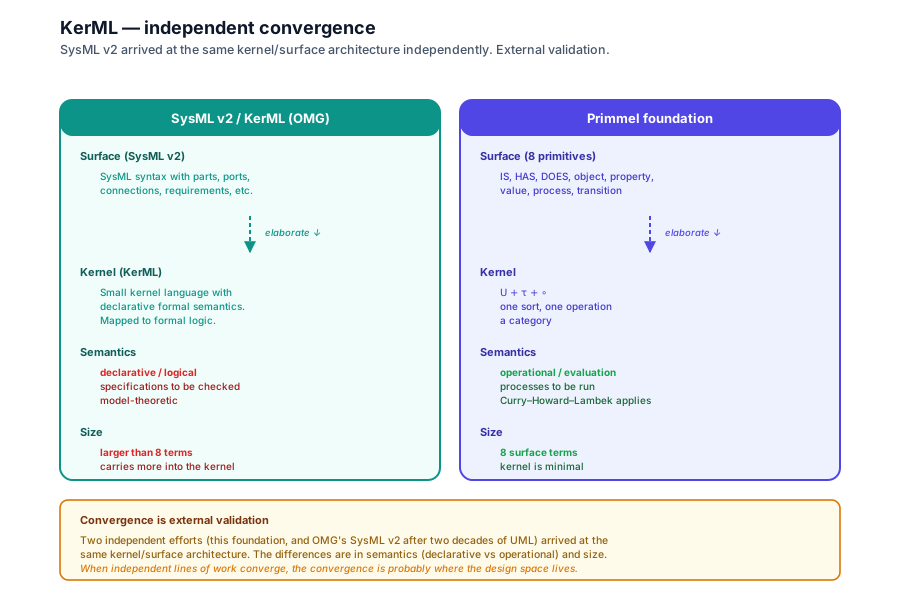
What SysML v2 / KerML gets right
Section titled “What SysML v2 / KerML gets right”- The two-level architecture (kernel + surface) is precisely Chapter 5’s structure.
- The kernel is small and has declarative formal semantics (a mapping to formal logic).
- Surface SysML is defined by elaboration into the kernel, exactly the elaboration algorithm of Chapter 6 §6.2.
This is powerful external validation: the largest standards body in the field arrived at the same architecture independently, as a correction to their previous approach.
Where SysML v2 / KerML stops (or differs)
Section titled “Where SysML v2 / KerML stops (or differs)”- KerML’s semantics is declarative/logical, specifications to be checked, model-theoretic. The foundation’s is operational , processes to be run, evaluation-based. KerML models are checked for consistency; foundation models are executed.
- KerML’s kernel is far larger than eight terms. It carries more of the surface ontology into the kernel, trading minimality for expressiveness in the base layer.
What the foundation repairs (or does differently)
Section titled “What the foundation repairs (or does differently)”The foundation’s kernel is strictly smaller (one sort, one operation , Chapter 5 §5.2). The cost is that more of the work is in elaboration; the benefit is a smaller trusted base (see adoption thesis, §8.12).
8.4 UML / fUML, the cost of retrofitting
Section titled “8.4 UML / fUML, the cost of retrofitting”UML includes behavioral notations, activities, state machines, interactions, but UML as a general modelling language does not make every ordinary UML model directly executable. The existence of the separate Foundational UML (fUML) specification is the evidence: OMG created a defined executable subset and supplied it with a separate execution semantics.
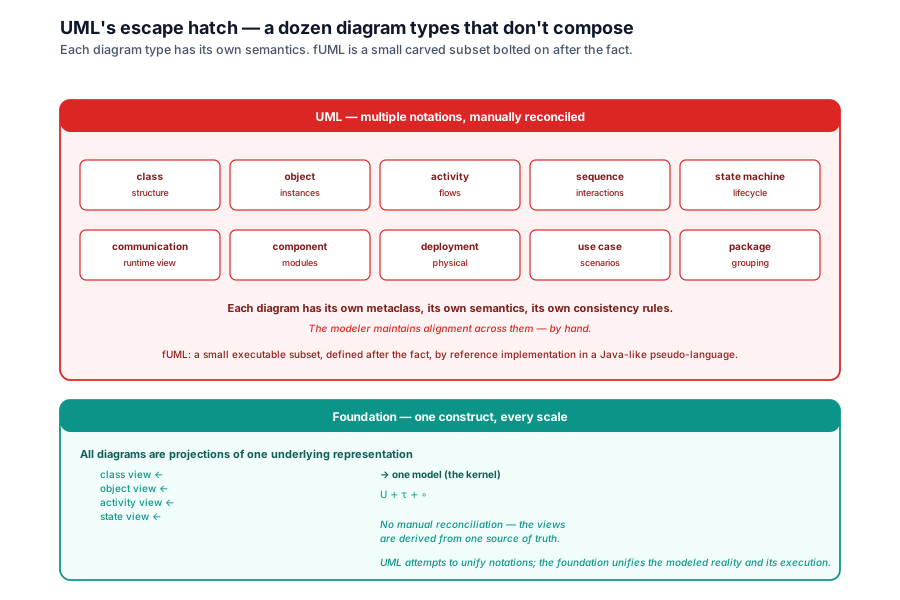
What UML gets right
Section titled “What UML gets right”- Readable by humans across specialties (architects, developers, business analysts). Its multiplicity of diagram types is a feature for communication, not just a bug.
- Mature tooling, certification programs, training materials.
Where UML stops
Section titled “Where UML stops”- A class diagram may declare an operation; an activity diagram may claim to describe that operation; a sequence diagram may show one interaction involving it; a state machine may show the affected lifecycle; and implementation code may perform something different. The modeler must maintain semantic alignment across these artifacts by hand.
- fUML and PSCS attempted to bolt execution semantics onto a UML subset after the fact. The executable subset is small, awkwardly carved, and semantically defined by a reference implementation in a Java-like pseudo-language rather than by an algebra.
What the foundation repairs
Section titled “What the foundation repairs”When the surface comes first, the kernel you can extract is whatever happens to be consistent, not what you would have designed. The foundation’s kernel came first, by construction.
8.5 OOP (classes/methods), the original escape hatch
Section titled “8.5 OOP (classes/methods), the original escape hatch”Object-oriented modelling gives us class, object, attribute, operation, inheritance, association, composition. These are predominantly structural concepts.
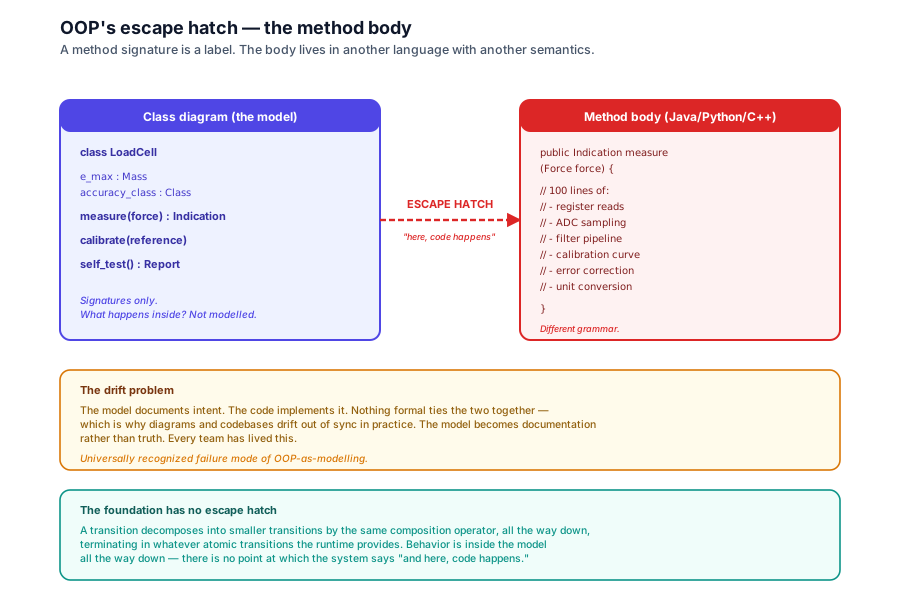
What OOP gets right
Section titled “What OOP gets right”- Decades of compiler, type-system, and runtime tooling.
- A working ontology of object/attribute/method that maps to the foundation’s static half.
Where OOP stops
Section titled “Where OOP stops”A method signature in a class diagram is a name, a parameter list, and a return type. That’s it. The behavior, what actually happens between input and output, lives in a separate artifact (Java, Python, C++) governed by a separate grammar, compiler, and semantics that OOP-as-modelling-notation never specifies.
The diagram is a label for a black box; the box’s contents are defined by a different language entirely. That’s the translation gap: the model documents intent, the code implements it, and nothing formal ties the two together, which is why diagrams and codebases drift out of sync in practice.
What the foundation repairs
Section titled “What the foundation repairs”The foundation has no escape hatch, a transition decomposes into smaller transitions by the same composition operator, terminating in whatever atomic transitions the runtime provides. Behavior is inside the model all the way down.
8.6 BPMN, the inverse failure mode from OPM
Section titled “8.6 BPMN, the inverse failure mode from OPM”BPMN is much closer to process modelling than OOP or ordinary UML. It defines tasks, events, gateways, flows, participants, messages, and process execution concepts.
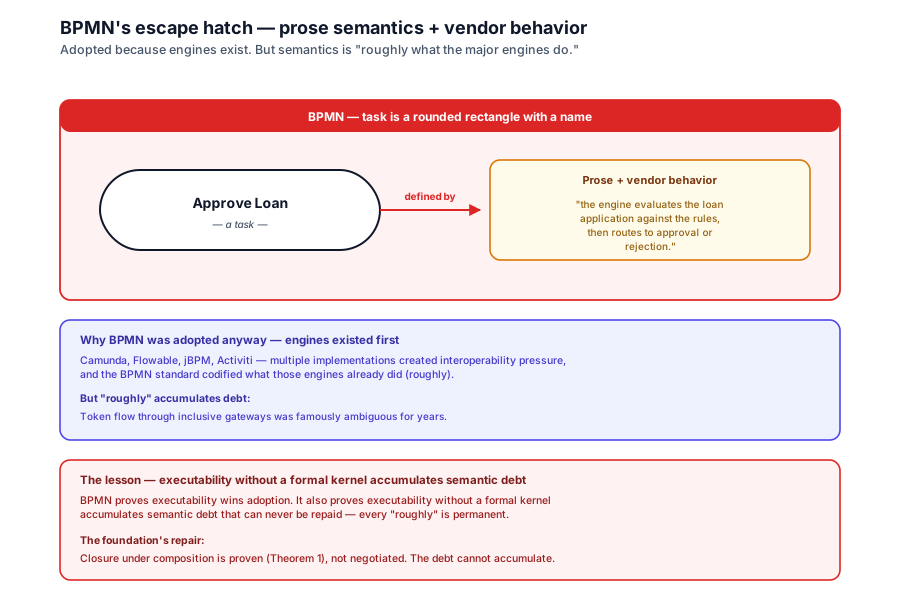
What BPMN gets right
Section titled “What BPMN gets right”- Execution semantics and interchange machinery in the spec.
- Widely adopted, Camunda, Flowable, jBPM, and others.
Where BPMN stops
Section titled “Where BPMN stops”- Its semantics is defined by prose plus vendor behavior. Token flow through inclusive gateways was famously ambiguous for years.
- Conformance means “roughly what the major engines do”, not a mathematical invariant.
- BPMN’s task is a rounded rectangle with a name. What an action does is a string a human interprets.
What BPMN proves (and what the foundation repairs)
Section titled “What BPMN proves (and what the foundation repairs)”BPMN proves executability wins adoption; it also proves that executability without a formal kernel accumulates semantic debt that can never be repaid. The foundation’s kernel is closed under composition (Theorem 1, Chapter 4) by construction; the debt cannot accumulate.
8.7 EXPRESS (ISO 10303 / STEP), only the static half
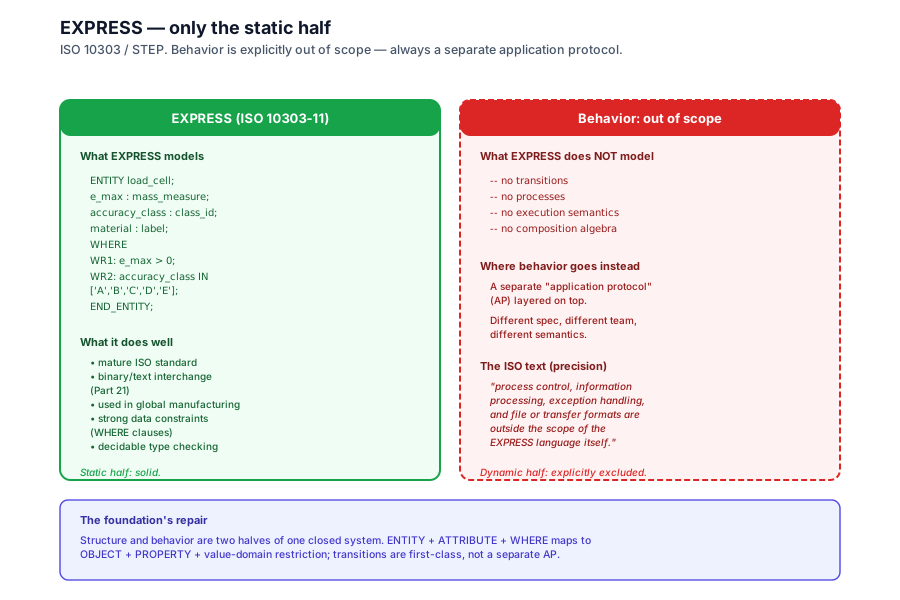
Section titled “8.7 EXPRESS (ISO 10303 / STEP), only the static half”EXPRESS is explicitly a data-specification language. ISO identifies data types and constraints as within its scope, while process control, information processing, exception handling, and file or transfer formats are outside the scope of the EXPRESS language itself. ISO also explicitly states that EXPRESS is not a programming language.
What EXPRESS gets right
Section titled “What EXPRESS gets right”- Mature ISO standard with real binary/text interchange (Part 21) used in global manufacturing pipelines.
- ENTITY + ATTRIBUTE + WHERE-clause maps cleanly to OBJECT + PROPERTY + value-domain restriction.
- Decades of interoperability testing.
Where EXPRESS stops
Section titled “Where EXPRESS stops”EXPRESS has no native behavior/transition layer, it’s a pure data-schema language. Behavior is always handled by a separate application protocol layered on top.
What the foundation repairs
Section titled “What the foundation repairs”The foundation treats structure and behavior as two halves of one closed system. EXPRESS only ever formalized the structure half.
8.8 RDF / OWL, closest formal relative, missing dynamic half
Section titled “8.8 RDF / OWL, closest formal relative, missing dynamic half”ER’s entities/attributes and RDF’s subject-predicate-object triples
both map directly onto OBJECT/PROPERTY/VALUE. OWL’s class/subclass
hierarchy is IS. The foundation’s IS-as-property move
(Chapter 5 §5.6) is exactly the
rdf:type move.
What RDF / OWL gets right
Section titled “What RDF / OWL gets right”- Decidable reasoning, OWL’s description-logics reasoners give you decidability results, provably terminating inference over class/property assertions.
- Mature serializations (Turtle, JSON-LD, RDF/XML) and a global identifier scheme (IRIs).
- Kinds-as-objects:
rdf:type rdfs:Class, the same move as Closure Rule 1.
Where RDF / OWL stops
Section titled “Where RDF / OWL stops”RDF’s kernel operation is entailment, not evaluation. Description logics infer; they do not transition. RDF can say what is true of a process; it cannot run one. Like EXPRESS, standard OWL has weak native support for behavior/process (hence separate efforts like OWL-S or SHACL rules bolted on for dynamics), again, only the static half.
What the foundation repairs
Section titled “What the foundation repairs”The foundation is RDF’s structural minimalism married to an operational semantics, a cell in the design space that is genuinely unoccupied. The cost: the foundation lacks OWL’s decidability results (see Chapter 11).
8.9 Petri nets / π-calculus / process calculi, the opposite corner
Section titled “8.9 Petri nets / π-calculus / process calculi, the opposite corner”Plain Petri nets, finite-state machines, the π-calculus, CCS, and the process calculi occupy the corner opposite from OPM.
What process calculi get right
Section titled “What process calculi get right”- Rigorous executable kernels with sixty years of metatheory: reachability analysis, deadlock/boundedness detection, model checking.
- Closure under composition (the same property the foundation proves in Theorem 1).
- Mature semantics for concurrency, channels, and synchronization.
Where process calculi stop
Section titled “Where process calculi stop”- No object model, no properties, no notion of a thing that persists and bears attributes. Data must be encoded (colored tokens in Petri nets; channel-passing tricks in π-calculus).
- The static half is missing, there is no HAS.
What they prove (and where the foundation differs)
Section titled “What they prove (and where the foundation differs)”They confirm that the foundation’s kernel ambitions are formally realizable while showing why a kernel alone, without the surface’s ontological vocabulary, never became a general modelling language. The foundation’s contribution is not the kernel, it is the two-tier architecture with the elaboration seam.
8.10 The positioning matrix
Section titled “8.10 The positioning matrix”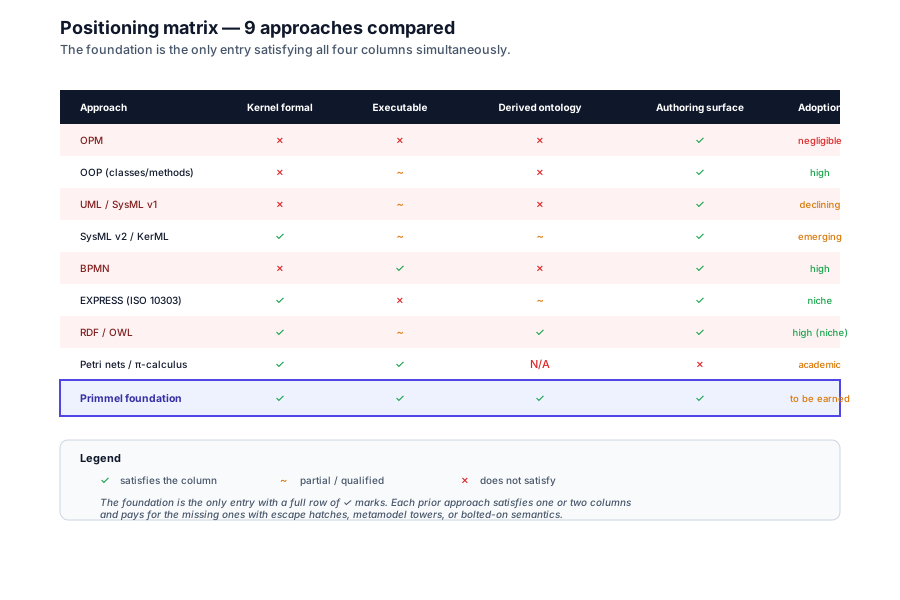
| Approach | Kernel with formal semantics | Executable | Derived (not axiomatic) ontology | Authoring surface | Adoption |
|---|---|---|---|---|---|
| OPM (ISO/PAS 19450) | No | No (animation only) | No, two sorts, ~12 link atoms | Yes (OPD/OPL) | Negligible; PAS, single toolchain |
| OOP (classes/methods) | No | Partial (via host language) | No | Yes | High |
| UML/SysML v1 | No (MOF is structural only) | Partially (fUML retrofit) | No | Yes, sprawling | High, declining |
| SysML v2/KerML | Yes (declarative) | Specification-checking, not running | Partially | Yes | Emerging |
| BPMN | No (prose semantics) | Yes | No | Yes | High |
| EXPRESS (ISO 10303) | Yes (data-spec only) | No (out of scope) | Partially | Yes | High in niche |
| RDF/OWL | Yes (model-theoretic) | Inference, not execution | Yes (rdf:type as data) | Layered vocabularies | High in its niche |
| Petri nets / π-calculus | Yes (operational) | Yes | N/A, no object ontology | No | Academic + niches |
| Primmel foundation | Yes (operational) | Yes | Yes, objects, values, IS all derived | Yes (eight primitives via elaboration) | To be earned |
The foundation is the only entry that satisfies all four columns simultaneously. Each prior approach satisfies one or two and pays for the missing ones with escape hatches, metamodel towers, or bolted-on semantics.
8.11 The synthesis
Section titled “8.11 The synthesis”Three lessons from the comparative record:
-
OPM proves the demand. A unified object/process ontology is wanted. But OPM also proves such an ontology without an executable kernel dies regardless of standards paperwork.
-
The process calculi prove the kernel is viable. Rigorous executable kernels with sixty years of metatheory exist. But a kernel without ontological surface never reaches modelers.
-
KerML proves the two-level architecture is where mature standards efforts converge. Independent arrival at the same structure, after decades of attempting the alternative.
The foundation is the intersection, and the OPM comparison is the cleanest way to articulate why the intersection was empty until now: everyone before either had the ontology or had the algebra, and the elaboration seam between them is the thing nobody built.
8.12 The adoption-via-executability thesis
Section titled “8.12 The adoption-via-executability thesis”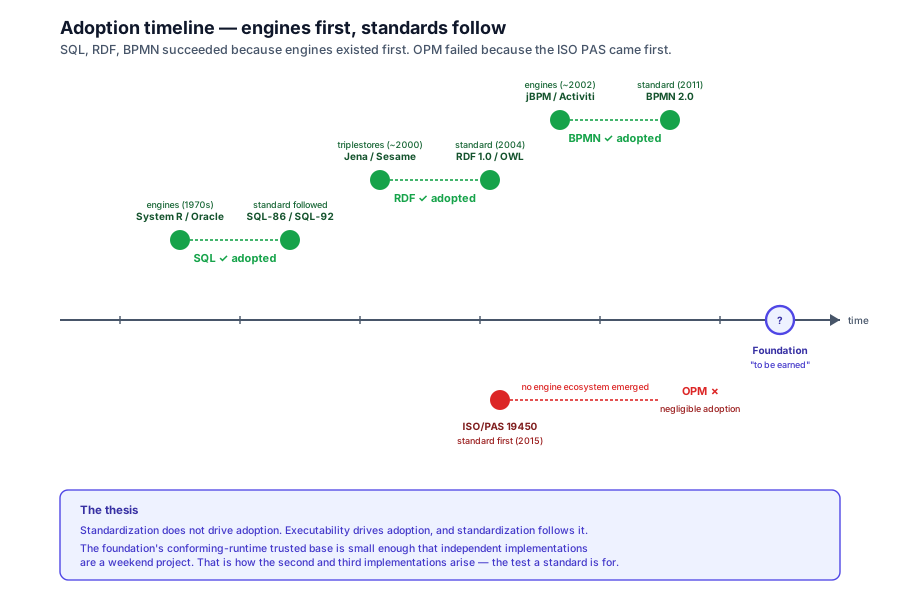
Standardization does not drive adoption. Executability drives adoption, and standardization follows it.
- SQL was adopted because engines existed, IBM System R, Oracle, Ingres, and the standard codified interoperability among them.
- RDF was adopted because triplestores existed, Jena, Sesame, Stardog, and the standard codified interchange.
- BPMN was adopted because engines existed, Camunda, Flowable, jBPM, and the standard codified execution semantics (loosely).
In every case, the engines came first. The standard followed.
OPM went the other way: it acquired the ISO document first (and only a PAS) with no executable semantics and a single-vendor toolchain. Adoption never came, because there was nothing to run and no second implementation to interoperate with.
What this means for the foundation
Section titled “What this means for the foundation”The foundation’s conforming-runtime trusted base (composition + application, Chapter 6) is small enough that independent implementations are a weekend project rather than a consortium effort, and small enough that a conformance test suite can be genuinely exhaustive. That is how the second and third implementations arise, and their existence is what a standard is for.
This is the adoption strategy: ship the kernel, ship a reference runtime, ship a conformance suite. Standardization follows.
8.13 What this chapter does not claim
Section titled “8.13 What this chapter does not claim”- We do not claim the foundation is adopted. Its adoption record is “to be earned”, the matrix above says so explicitly.
- We do not claim individual primitives are novel. Object, property, value, transition, process, each has precedents. The novelty is the conjunction under one closed algebra with the type/instance split applied symmetrically.
- We do not claim the foundation is the only possible foundation. It is one candidate. Others may exist; if one is closed, complete, and extensible in stronger senses, we want to know.
The honest positioning: the foundation is a candidate universal executable metamodel, with closure and completeness proofs relative to a stated axiom, and a comparative record against eight alternatives. The next chapter (Chapter 9) deepens the formal treatment; the chapter after (Chapter 10) makes the positive case for the executable ground.
Next: Chapter 9, Categorical Foundations: the kernel as a category; Curry–Howard–Lambek; objects as identity morphisms.