
Chapter 17, Twin Certification
Chapter 17, Twin Certification
Section titled “Chapter 17, Twin Certification”In this chapter: the certification program that answers the question chapter 14 left open, a live twin serves its state, but who certifies that the served state is true? The three-layer framing (physical device → full digital twin → the Primmel twin as governed projection), the fidelity requirement model, the probe channel that closes the two-channel relation, the verdict chain and the twin certificate’s scoped claim, and the surveillance regime that keeps the certificate honest. This chapter teaches the shipped program , the
oiml-twin-certpackage, its services and its gates.
17.1 The three-layer stack: what the twin is
Section titled “17.1 The three-layer stack: what the twin is”Start from the device and stack upward:
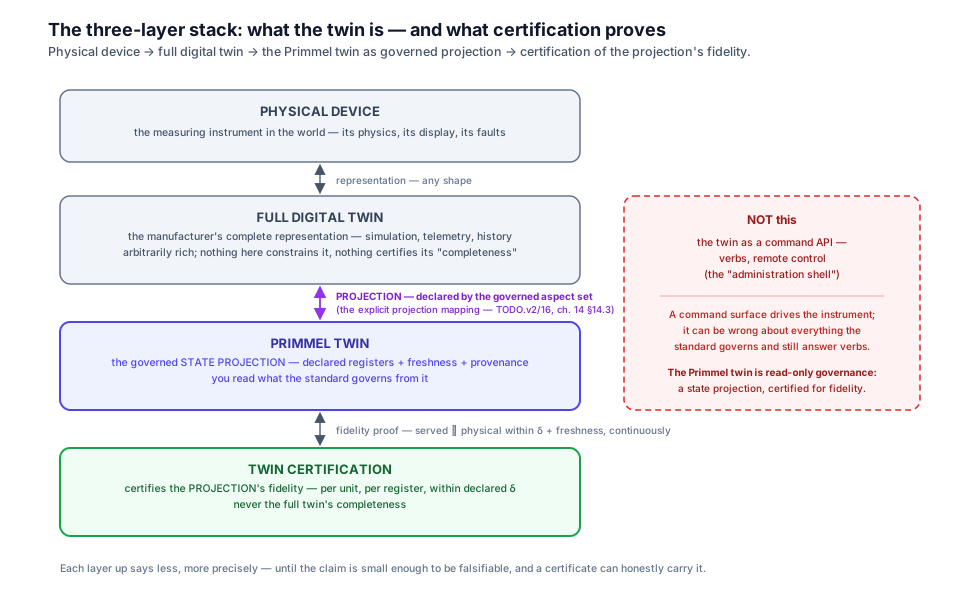
- The physical device. A measuring instrument in the world, a load cell bolted into a belt weigher, with its own physics, its own display, its own faults.
- The full digital twin, the manufacturer’s complete representation of that device, arbitrarily rich: physics simulation, telemetry, history, documentation. Any shape. Nothing in this program constrains it, and nothing in this program could certify its “completeness”, completeness against what?
- The Primmel twin, the tailored projection of what Primmel
governs: the declared registers the Recommendation names, served with
declared freshness and declared provenance (chapter 14 §14.3–14.4:
the endpoint declaration, the serve bindings,
fresh_within). The decisive contrast: the Primmel twin is not a command API. The industrial “administration shell” pattern (a digital twin as a set of verbs, configure, calibrate, command) exposes remote control; the Primmel twin is a governed state projection. You do not drive the instrument through it. You read what the standard governs from it. - Twin certification, certifies the projection’s fidelity: that the served value equals the physical state, within declared bounds and freshness, continuously. Never the full twin’s completeness.
The stack reads as a narrowing of claims. Each layer up says less, more precisely, until the claim is small enough to be falsifiable , and a falsifiable claim is the only kind a certificate can honestly carry (Volume 0, claims and falsifiability).
Where the projection comes from. The governed aspect set is
declared in the Recommendation packages (the serve/twin-interface
vocabulary of §14.4), and the projection layer is explicit
(TODO.v2/16): the manufacturer’s full twin is related to the governed
register set by a declared mapping (the map_profile machinery of
chapters 5 and 16), the coverage report proves the projection covers
everything governed (C23, computed, never authored), and the
product’s served twin section is derived from the governed aspect
set plus the mapping, never hand-authored, with a byte-clean drift
guard where a mirrored copy would drift silently. The full twin’s
richer anatomy shows as deliberately unmapped: the filtered richness,
never gaps. Chapter 14 §14.3 carries the worked framing on the LC-500;
the certification program of this chapter then evaluates the
projection’s fidelity, coverage first, fidelity second.
17.2 The program package: a fourth publisher
Section titled “17.2 The program package: a fourth publisher”The twin certification program is a Primmel package,
primmel-packages/oiml-twin-cert/, of a package kind introduced for
it: kind certification_program ●. The shape follows the
product-reference precedent of chapter 15, a publisher related to
everything by mapping and pinned imports, composed into nothing:
- related to the Recommendations by mapping only ,
maps_to { oiml-r60 }: the metrological definitions of the served aspects live in the Recommendation; the program never restates them (kernel rule C97 checks the mapping resolves); - related to the product it certifies by a pinned abstract import ,
uses { acme-lc500@2021 }, C83’s edition-pin discipline: the program certifies this product package’s twin declarations at a pinned edition; - built on the CASCO foundations by ordinary composition ,
requires { iso-iec-17000, iso-iec-17065, iso-iec-17025, iso-iec-17067 }: the conformity-assessment vocabulary, the certification-body and laboratory competence requirements, and the scheme taxonomy; - composed into nothing, no Recommendation
usesthe program; its requirement vocabulary never leaks into rec trees.
Scheme type 5, the surveillance teeth. Against the ISO/IEC 17067
register the program self-classifies scheme_type: type_5 ●: per-unit
certification with surveillance. The contrast matters: the OIML-CS’s
own type 1a certifies a type sample with no surveillance and
structurally cannot say “continuously”, the register’s
surveillance.required facet makes this program’s surveillance
provisions non-dischargeable at the scheme level.
A standalone certificate, a hard prerequisite. The twin certificate does not ride the instrument’s type-evaluation certificate: the type certificate certifies the type; the twin certificate certifies one unit’s serving layer (serial-scoped). But fidelity to a broken instrument is faithful and useless, so admission requires a valid type certificate for the instrument’s model, cited as provenance ●, the decision refuses otherwise.
The governing document, TW-1. The program publishes its own
governing document, TW-1, Digital-Twin Fidelity Certification
Program (urn:oiml:pub:cs:twin-1:2027), as the package’s
documents/tw-1/ module ●, the same documents-<doc> pattern the
OIML-CS package uses for its document corpus (Volume IV, ch. 3). Every
requirement, test, register, symbol, term and form of the package
cites TW-1 by clause anchor, and a cite-integrity leg pins the
contract both ways ● (twin-1-cite-integrity.test.ts): every cited
anchor, exactly 3.1, 4.1–4.4, 5.1–5.5, 6.1–6.4, exists in the
document, and every leaf section of the document is cited. TW-1’s 3.1
also records the naming decision: VIML names no twin-verification kind
(2.09 and 2.12–2.14 verify the instrument), so the new kind is named
twin-fidelity evaluation, a determination activity per ISO/IEC
17000 A.3.2 with attestation per A.4.3. The OIML-CS is the program’s
recorded long-term home, a category scheme inside the B 18 framework
when the OIML-CS adopts it; nothing of that migration is modelled yet.
17.3 The fidelity requirement model
Section titled “17.3 The fidelity requirement model”A twin-fidelity requirement is, per served register, the conjunction of four claims, each landing on machinery that already exists; no new requirement kind was needed (chapter 11’s validation family is unchanged):
| TW-1 | requirement | the claim |
|---|---|---|
| 5.1 | static-conformance | the twin serves exactly the interface its certified product package declares, endpoint id, operations, payload schemas and quantity kinds, access scopes (admission; a mis-serving twin never reaches value probes) |
| 5.2 | indication-band | value fidelity: |served − reference| ≤ δ_indication at every probe point, paired within the pairing window |
| 5.3 | freshness-declaration | every fidelity register is served under a declared fresh_within; a stale value degrades the verdict to indeterminate, never a fail, never a silent pass; the window is inherited from the serve, never re-declared |
| 5.4 | timestamp-provenance | a parseable served timestamp on every register, timestamp_fields declared per operation (freshness is judged against the twin’s own clock), the endpoint id bound to the certified unit’s serial, every fact stamped with provenance and the definition version pin |
| 5.5 | state-fidelity | the served operational state equals the physical state at every transition, fault annunciation included |
The deviation itself is derived once, as the characteristic
twin_deviation_indication (ocl{abs(indication - reference_indication)}),
and the band requirement consumes it through the canonical
accepts { verdict … op lte limit … } shape, the same one-home
discipline as the R 60 MDLO criterion (chapter 6; INV-7’s
values/facts/judgments separation). Freshness and provenance are not
re-invented either: they are the serve’s fresh_within, the gateway’s
timestamp_fields, and the evidence stream’s provenance record,
surfaced as declaration requirements enforced by the freshness gate.
Note the normative line 5.5 draws: a served fault state faithfully reporting the instrument’s fault is not infidelity, it passes fidelity and triggers service. A twin serving “healthy” over a faulted instrument fails; a twin truthfully serving “fault” passes. The certificate’s surveillance regime (§17.6) depends on that line.
17.4 The probe channel: closing the two-channel relation
Section titled “17.4 The probe channel: closing the two-channel relation”Fidelity is a two-channel relation, served channel versus physical-side reference channel, and the continuous monitor of chapter 14 cannot close it: the monitor’s epistemic wall is deliberate (the verdict only ever reads the served value; the simulated-instruments annex keeps the two channels apart by construction). Only a probe, a paired reading of both channels at one moment, closes the relation. That is why the program’s determination half is a conformance-test schedule, not a monitor:
- Static-conformance admission (TW-1 6.1) ●, the served interface read and compared against the pinned product package’s endpoint declaration; every probe test depends on it.
- The measuring-range probe (6.2) ●, paired readings at minimum load and ≈25 %, 50 %, 75 %, 100 % of E_max, increasing and where the physics demands decreasing, the load-point discipline of the Recommendation’s MPE test.
- The operational-envelope probe (6.3) ●, paired readings at the certified product’s declared envelope corners (the rated temperature corners; the humidity corner only where the product declares a humidity class, the corner is the scheme’s declaration, never an assumption), and return to reference conditions.
- The operational-transitions probe (6.4) ●, off→warming→ready, ready→measuring, and the fault-annunciation leg and clear, judging state fidelity per 5.5.
The three reference sources, honestly declared. The physical side
of a pair arrives by exactly one of three channels, recorded on the
evidence with its register citation (the variable provenance facet
●, kernel rule C99):
reference_instrument, PREFERRED: a traceable reference, cited by equipment-register id with its calibration trace.observer_attestation, a verification officer reads the instrument’s own display into the probe form (attestation per ISO/IEC 17000 A.4.3), admitted with the declared traceability limitation: attestation-only evidence proves twin ≡ display, not twin ≡ mass, the reference IS the EUT’s own indication, never an independent physical standard. The limitation is declared data, carried on the evidence and printed on the certificate , never silently upgraded. And the officer is not self-certifying: attestation evidence from an officer without the citing lab’s ISO/IEC 17025 6.2.6verification_attestationauthorization is inadmissible at decision time, it grounds no certification decision, and it is never a fidelity fail of the twin ●.sim_ground_truth, the acceptance environment’s ground truth, never a production channel.
The pairing window. Each pair is timestamped on both sides, the
twin’s own served timestamp and the reference observation timestamp ,
and the pairing skew is derived once at evidence capture. A pair whose
skew exceeds the declared window (at most the register’s
fresh_within, declared per register, never a platform constant) is
INVALID: the probe’s setup was wrong, never a fail of the twin ●.
Each probe execution lands in the D2 probe form, served value and timestamp, reference value and observation timestamp, channel, register citation, carried limitation, pairing skew. Facts only: the fidelity judgment is the verdict chain’s, never the form’s.
The pilot values are declared examples. The pilot campaign certifies the fictional ACME LC-500 load cell (chapter 15): δ = 0.1 kg, the scheme’s declared pilot parameter (25× the good cell’s noise σ, so the faithful twin passes cleanly and the sim’s 0.25 kg lying-twin offset is unmistakable), pairing windows 5 s (indication) and 1 s (state) from the certified product’s serves, the
mtl_f_001deadweight force standard and officerp_weberas declared register citations. These are the scheme’s declarations, pinned in test , not measured fact about any real device.
17.5 The verdict chain and the twin certificate
Section titled “17.5 The verdict chain and the twin certificate”Facts become judgments through a four-level chain on the existing verdict engine, INV-9’s one dialect, the same cached-AST OCL the lab and the monitor run ●:
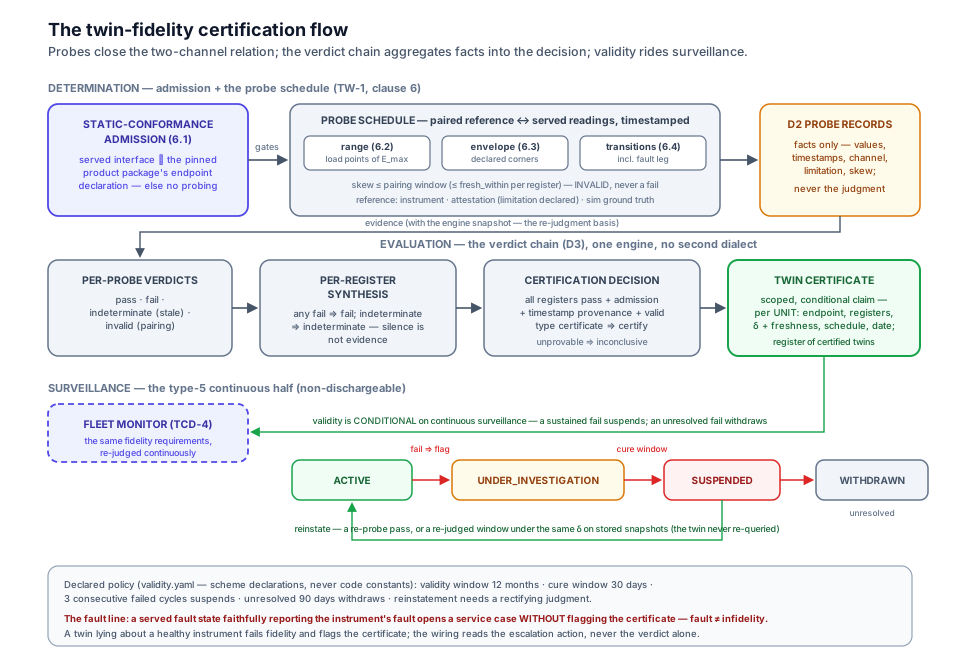
- Facts (D2), the probe pairs: reference value, served value, both timestamps, the pairing skew, the channel provenance.
- Per-probe verdicts (D3), pass / fail / indeterminate (stale) / invalid (pairing violated), computed at probe time and stored with the full engine snapshot.
- Per-register synthesis (D3), any fail ⇒ fail; no fail but any indeterminate ⇒ indeterminate (silence is not evidence); every scheduled point judged pass ⇒ pass; otherwise incomplete, an invalid run voids the point; missing and void points ground nothing.
- The certification decision (D3), all registers pass, plus the static-conformance admission, the timestamp-provenance declaration, and the hard type-certificate prerequisite ⇒ certify. Any register fail ⇒ refuse. Anything unprovable ⇒ inconclusive , never a silent certify.
Re-judgment follows INV-5 ●: a stored probe verdict is re-judged against a tightened δ from its own snapshot, zero re-probing, evidence appends, never rewrites.
The certificate’s claim is scoped tight enough to be falsifiable ,
each clause citing its evidence ● (twin-certificate.service.ts
renders it from the declared template):
For instrument ⟨model/serial⟩, the twin served at endpoint ⟨endpoint-id⟩ via operations ⟨op-list⟩ reflects the physical state of registers ⟨aspect-list⟩ within tolerance ⟨δ per register⟩ and freshness ⟨fresh_within per register⟩, verified by probe schedule ⟨schedule-id⟩ on ⟨date⟩ (report ⟨id⟩), with served-timestamp provenance declared. Validity is CONDITIONAL: continuous surveillance per the declared monitor; a sustained fail suspends; an unresolved fail withdraws.
The certificate is per-UNIT (the serial is on the claim), numbered
TW-1/{edition}-T5-{authority}-{year2}.{seq}, TW-1 the governing
document, T5 the scheme type, and its print rows resolve by name from
the decision’s claim context: the endpoint identity, the certified
operations and registers, δ and freshness per register, the schedule,
the verification date, the fidelity report, the surveillance monitor,
the type-certificate prerequisite, the probe channels used, plus the
traceability limitation, printed only when attestation evidence was
used. The decision also flips the product passport’s
live_compliance_status (chapter 14 §14.6) ●, and the unit enters
the register of certified twins maintained by the program ●.
17.6 Surveillance and suspension: the type-5 teeth
Section titled “17.6 Surveillance and suspension: the type-5 teeth”A probe schedule certifies a point in time; the program’s claim is continuously. The duality is forced, not chosen: scheduled probes close the two-channel relation at certification (and re-close it on the validity calculus’s re-probe triggers), and continuous surveillance watches the served channel between probes, the same fidelity requirements re-judged by the compliance-engine monitor of chapter 14 §14.5, the type-5 scheme’s non-dischargeable half.
Post-certification infidelity walks the core certificate machine ,
one machine, no second dialect ●, and the wiring reads the declared
policy (evaluation/validity.yaml), never code constants:
| trigger | action | state |
|---|---|---|
| monitor fail on a fidelity requirement | flag_certificate + open_service_case (deduped while open) ⇒ investigate | UNDER_INVESTIGATION |
| case unresolved past the cure window (declared: 30 days), or 3 consecutive failed cycles | suspend | SUSPENDED, decertified in fact; the passport’s live_compliance_status flips |
| rectified, a re-probe pass, or a re-judged window under the same δ returning pass on stored snapshots | reinstate | ACTIVE |
| unresolved past the withdrawal threshold (declared: 90 days) | withdraw | WITHDRAWN, the register drops the unit |
The fault leg is the degraded-mode special case, wired by escalation
action, never by verdict alone: a served fault state opens a
service case without flagging the certificate, the twin
truthfully reported the instrument’s fault (§17.3’s normative line) ,
while a lie about a healthy instrument flags it. The declared policy
records exactly that (fault_service_case_only: true).
17.7 Status: shipped now, and the TBD backlog
Section titled “17.7 Status: shipped now, and the TBD backlog”Shipped and gate-proven ●:
- the
oiml-twin-certpackage, the firstcertification_programpackage,primmel checkclean at all four strictness levels, the layer↔manifest projection pinned (twin-cert-package.test.ts); - the TW-1 governing document with the cite-integrity leg
(
twin-1-cite-integrity.test.ts); - the probe flow, service-level against the live sim, real gateway,
real pairing, the committed requirement layer judged end-to-end
(
twin-fidelity-probe.test.ts); - the verdict chain and the D2 twin-fidelity test report
(
twin-fidelity-chain.test.ts), the certificate issuance and the full suspension state-walk (twin-certificate.test.ts).
Landed ● (2026-07-28):
- TCD-4, the surveillance monitor binding ●. The fleet monitor
declaration (
primmel-packages/oiml-twin-cert/model/monitors.prl, triggersevery 1h+on signal certificate_registered+on change sample.test_context.op_state, theapplicablefidelity selector, the emit sinks, the escalation set) with the codec loop intodata/oiml-twin-cert/model/monitors.yaml; the register-driven deployment binding (browser/src/monitor/twin-cert-deployment.ts) , the certified-twins register drives the watch set (ACTIVE ∪ UNDER_INVESTIGATION; SUSPENDED/WITHDRAWN drop); the tightened-δ fleet re-judgment SOP (rejudgeFleetWindow) on stored snapshots with ZERO gateway calls, and the stale-original pin (null-valued facts rejudge indeterminate, never flip). The fault-state rule rides the binding (the grammar admits verdict outcomes only,on: 'always', when op_state = fault ⇒ open_service_case, no flag), with the pin at the declaration site, the deployment header,layer.yaml, and AGENTS.d/12.monitor_idis bound: parsed fromvalidity.yamland cross-checked at issuance. (twin-cert-surveillance.test.ts, 8 legs.) - TCD-5, the four-scenario acceptance ●. The teeth, service-level
against the live sim (
twin-cert-acceptance.test.ts, 5 legs, skip-guarded without it): faithful ⇒ the full chain, admission, probes (deviation ≤ δ with pair-skew evidence), aggregation, issuance, register entry, passportIN TOLERANCE; lying (the 0.25 kg knob, 2.5× δ) ⇒ per-probe fail with the deviation evidence on record (admission correctly passes, a value-lie is not a contract violation; the probe is the teeth) ⇒ decision refuse, no certificate; stale (30 s served lag vs the 5 s window, viatimestamp_fields, served time, never receipt) ⇒ indeterminate at every point, inconclusive decision, no issuance, never a fail, never a silent pass; post-certification ⇒ the fault leg opens service cases with ZERO certificate flags (the twin truthfully reported the fault) while the lie leg drives flag ⇒ investigate ⇒ three consecutive fails ⇒ suspend ⇒ cure via same-δ rejudge (zero gateway calls) ⇒ reinstate, and recurrence ⇒ cure-window suspend ⇒ withdraw, register empty. The sizing pin checks δ = 0.1 kg against the knob (2.5×) and the window (6×) against the sim’s own declarations.
17.8 Summary
Section titled “17.8 Summary”- The stack: physical device → full digital twin (any shape) → the Primmel twin as a governed state projection, declared registers, freshness, provenance; never a command API, → twin certification of the projection’s fidelity, never the full twin’s completeness.
- The program is a fourth publisher (
kind certification_program), mapped to R 60, pinned to the product it certifies, type-5 against ISO/IEC 17067, surveillance is constitutive, not optional. - A fidelity requirement per register: value band (the one-home deviation characteristic), freshness (inherited, never re-declared), provenance (the twin’s own clock, declared), state fidelity (a true fault is not infidelity).
- The probe channel closes the two-channel relation the monitor cannot: three declared sources, the attestation limitation carried as data, the pairing window with INVALID-never-fail semantics.
- The verdict chain aggregates per-probe → per-register → decision on the existing engine; the certificate claims a scoped, conditional relation; post-certification infidelity walks the core certificate machine on declared policy.
Next: OIML Core, on the OIML SMART site: the measurement vocabulary and the subject chain the OIML models are built from.