
Chapter 11, Open Questions
Chapter 11, Open Questions
Section titled “Chapter 11, Open Questions”In this chapter: what the foundation does not claim, where it could be falsified, and what future work remains. The honest close of the volume, falsifiability is a feature, not a vulnerability.
This chapter returns to the stakes set in Chapter 2 (Claims and Falsifiability) and asks: what would change our minds?
11.1 What’s proven, what’s argued, what’s open
Section titled “11.1 What’s proven, what’s argued, what’s open”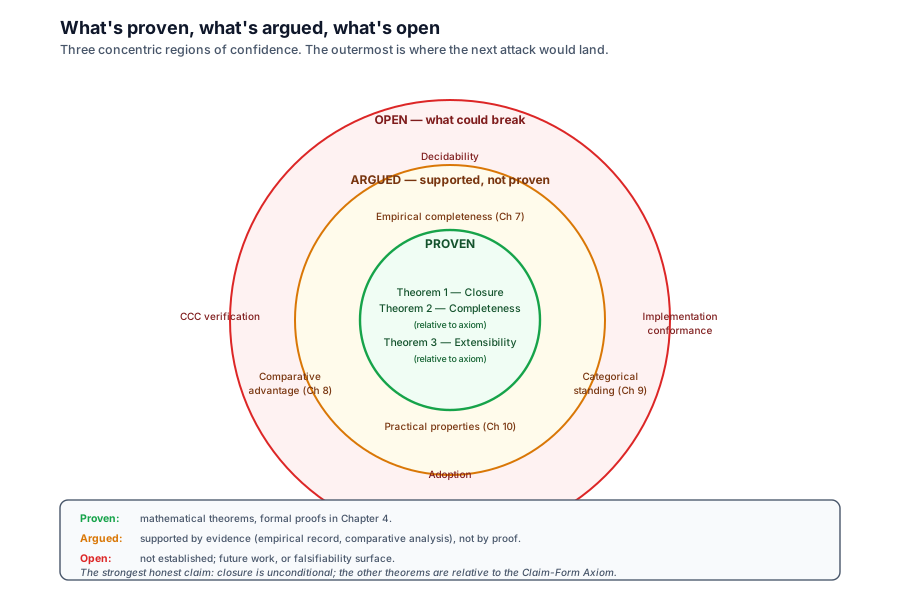
What is formally proven
Section titled “What is formally proven”- Closure (Theorem 1, Chapter 4): every operation of applied to elements of yields an element of . Unconditional.
- Completeness relative to the Claim-Form Axiom (Theorem 2): every atomic claim under the axiom has a primitive that catches it. Conditional on the axiom.
- Extensibility (Theorem 3): the system grows by enlarging sorts, never by adding primitives. Conditional on the axiom.
What is argued (not proven, but supported)
Section titled “What is argued (not proven, but supported)”- Empirical completeness: every candidate ninth primitive proposed and examined (STATE, STEP, CAN, RECEIVES, RELATES-TO, BECOMES) reduced to a composite (Chapter 7). Strong evidence, not proof.
- Comparative advantage: the foundation satisfies all four columns of the positioning matrix (Chapter 8 §8.10) while no other methodology does. Strong external validation.
- Categorical standing: the kernel is a category, with Curry–Howard–Lambek giving operational semantics “for free” (Chapter 9). Conditional on the kernel being Cartesian closed (which we believe but have not formally verified).
What is open
Section titled “What is open”- Decidability: reasoning over an arbitrary model is not guaranteed to terminate.
- Cartesian-closed verification: we believe the kernel is a CCC, but have not written the proof.
- Implementation conformance: the runtime contract (Chapter 6) is a specification, not (yet) a widely-implemented and tested runtime.
- Adoption: the foundation’s adoption record is “to be earned.”
11.2 The attack surface
Section titled “11.2 The attack surface”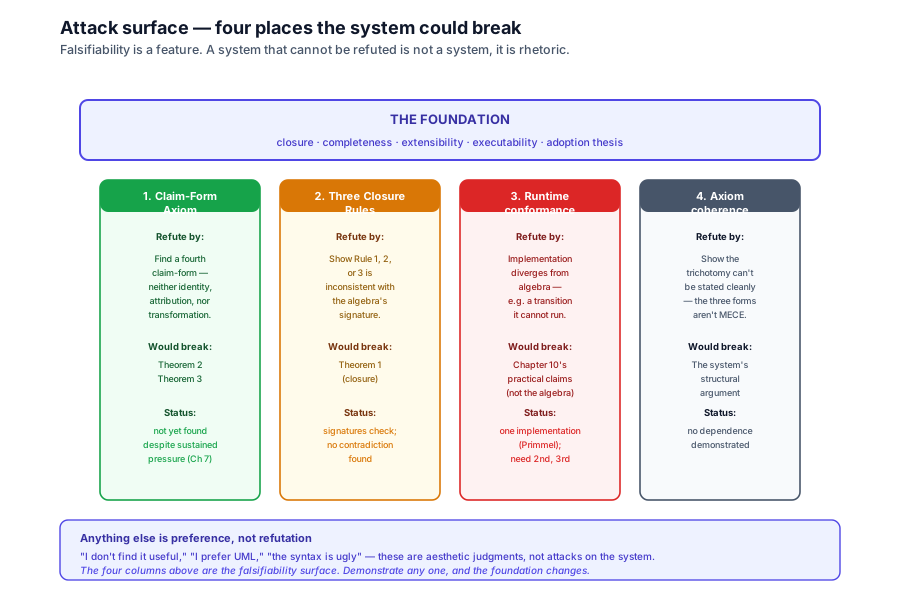
Four places the system could break:
1. The Claim-Form Axiom
Section titled “1. The Claim-Form Axiom”The strongest attack. Find a genuine fourth claim-form: an atomic descriptive claim about an entity that is neither identity, nor attribution, nor transformation, and cannot be reduced to any of them without information loss.
- If found: refutes Theorem 2’s completeness and forces a ninth primitive.
- Status: not yet found, despite sustained pressure during the design dialogue.
2. The Closure Rules
Section titled “2. The Closure Rules”Show that one of Closure Rule 1 (kinds are objects), Rule 2 (values hold references), or Rule 3 (process is reified transition) is inconsistent with the rest of the algebra.
- If found: the closure proof collapses.
- Status: signatures check. No contradiction found.
3. The runtime implementation
Section titled “3. The runtime implementation”Show that the implementation diverges from the algebra, e.g., a transition that the runtime cannot execute, or a process instance the runtime cannot reify.
- If found: the practical claims of Chapter 10 fall. The algebra itself stands.
- Status: implementation is one (Primmel); we need second and third implementations to test.
4. The Claim-Form Axiom’s coherence
Section titled “4. The Claim-Form Axiom’s coherence”Show that the trichotomy cannot be stated cleanly, e.g., that “transformation” depends on “attribution” in a way that makes the three forms not actually mutually exclusive.
- If found: the system’s structural argument fails.
- Status: no such dependence has been demonstrated.
Anything else, “I don’t find it useful,” “I prefer UML,” “the syntax is ugly”, is preference, not refutation.
11.3 What the system explicitly does not claim
Section titled “11.3 What the system explicitly does not claim”For honesty, restated from Chapter 2 §2.5:
- We do not claim decidability. OWL’s description logics have decidable reasoning; this system has no analogous result.
- We do not claim a tooling ecosystem. The foundation is a candidate universal descriptive algebra, not a shipped product.
- We do not claim novelty for any individual primitive. Each has precedents. The novelty is the conjunction under one closed algebra.
- We do not claim the runtime exists in finished form. Where the implementation falls short of the algebra, the algebra is the reference, not the implementation.
- We do not claim the system is the only possible foundation. It is one candidate. Others may exist.
11.4 Future work
Section titled “11.4 Future work”The volume establishes the foundation. Much remains to build on it.
Near-term
Section titled “Near-term”- Implement the runtime contract (Chapter 6) as an independent reference, separate from the Primmel compiler.
- Write the Cartesian-closed proof for the kernel category.
- Build a conformance test suite that any kernel implementation must pass.
- Specify the interchange format, what a serialized model looks like, and how elaboration/resugaring round-trip.
Medium-term
Section titled “Medium-term”- Apply the foundation to a second domain outside legal metrology (e.g., software build pipelines, business workflows, scientific data provenance). Tests the extensibility claim.
- Develop tooling, compilers, debuggers, profilers, IDE integration, comparable to what OOP built over thirty years.
- Engage with OMG / ISO on standardization. The KerML convergence suggests the time is right.
Long-term
Section titled “Long-term”- Pursue decidability results for restricted fragments of the algebra, the analogue of OWL’s description-logics stratification.
- Explore the meta-theory, what can be proven about models in the foundation? What kind of model-checking is possible?
- Build the adoption case, second and third implementations, real-world deployments, the test that any standard is for.
11.5 The volume’s thesis, restated
Section titled “11.5 The volume’s thesis, restated”The IS–HAS–DOES foundation is a candidate universal executable descriptive algebra, with:
- closure under three operations, proven;
- completeness relative to a stated axiom, proven;
- extensibility, proven;
- a kernel that is a category, recognized;
- a two-tier architecture with elaboration as the formal seam, defined;
- a comparative record against eight alternative methodologies, surveyed;
- practical properties (no escape hatch, reification, scale invariance, model = program) that follow from the algebra;
- and explicit honest limits, no decidability, no tooling, no adoption yet.
It is a candidate, not a final answer. The strongest claim available is Gödel-style: we cannot prove completeness from inside, but we can exhibit the record of every attack so far. If a fourth claim-form exists, it has not yet been found.
11.6 How to read this volume’s claim
Section titled “11.6 How to read this volume’s claim”If you finish this volume thinking “this is unfalsifiable,” you have caught a real problem and we have not done our work. The four attack points in §11.2 are the falsifiability surface. Any one of them, demonstrated, would change the foundation.
If you finish thinking “I want to use this”, good. The foundation is for building with. Primmel (Volume I) is one language that targets it; the platform annex describes one runtime. The OIML metamodel (Volume II) is one domain encoding. Pick a domain of your own and try the algebra on it. Either it works (extensibility theorem holds, and the foundation earns another data point), or it breaks (you have found the next attack, and the foundation gets stronger from the repair).
Either outcome is a contribution.
This is the end of Volume 0’s numbered chapters. The annexes (FAQ and Notation Reference) provide supporting material. Volume I (Primmel Kernel) picks up where this volume leaves off, showing how one language operationalizes the algebra.