
Chapter 9, Categorical Foundations
Chapter 9, Categorical Foundations
Section titled “Chapter 9, Categorical Foundations”In this chapter: the kernel of Chapter 5 recognized as a category in the mathematical sense. Objects as identity morphisms, transitions as morphisms, composition as categorical composition. The Curry–Howard–Lambek correspondence positions the kernel inside a sixty-year-old family of structures for which sound operational semantics are already a solved problem. SysML v2’s KerML arrives at the same architecture independently , powerful external validation.
This is the most formal chapter in the volume. KaTeX renders the math; the prose stays grounded.
9.1 The kernel is a category
Section titled “9.1 The kernel is a category”Recall the kernel from Chapter 5 §5.2:
with sorts (a universe of entities), a partial transition relation , and composition defined when interfaces match.
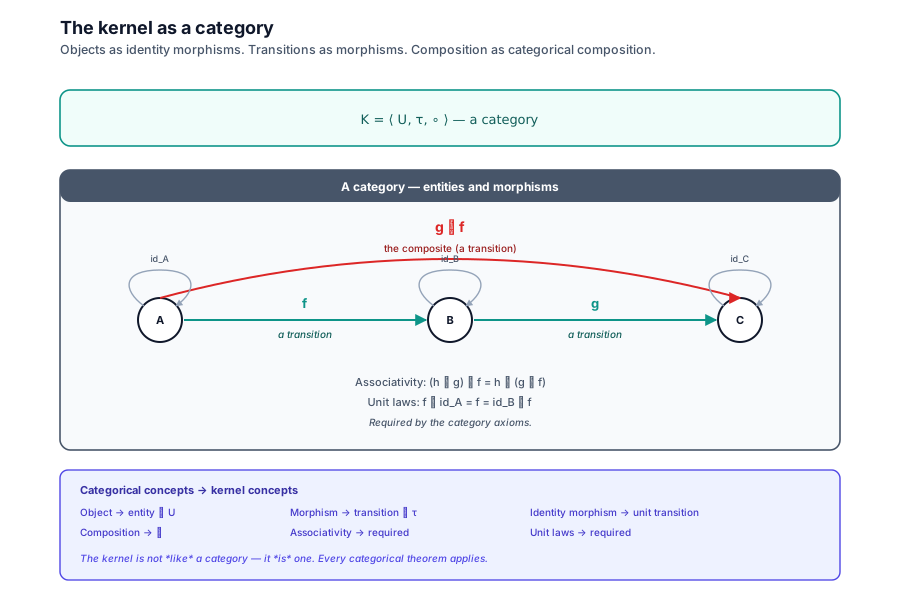
This is precisely the data of a category in the mathematical sense (Mac Lane, 1971):
| Categorical concept | In the kernel |
|---|---|
| Object | An entity |
| Morphism | A transition in |
| Identity morphism | The unit transition, guaranteed to exist |
| Composition | The kernel’s operation |
| Associativity | Required by the kernel |
| Unit laws | Required by the kernel |
The kernel is not like a category, it is one. Every categorical theorem applies.
9.2 Why this matters, sixty years of metatheory for free
Section titled “9.2 Why this matters, sixty years of metatheory for free”A category with the structure above inherits a vast body of existing results:
- Functors (maps between categories preserving structure), the foundation’s elaboration and resugaring algorithms (Chapter 6) are functors between the surface category and the kernel category.
- Natural transformations (maps between functors), the foundation’s projections (different views of one model) are natural transformations.
- Adjunctions (pairs of functors with a universal property) , reification and its inverse form an adjunction between and .
- Limits and colimits (universal constructions), products model conjunction of facts; coproducts model alternative branches in a process.
The Curry–Howard–Lambek correspondence, described next, makes this inheritance concrete for execution.
9.3 The Curry–Howard–Lambek correspondence
Section titled “9.3 The Curry–Howard–Lambek correspondence”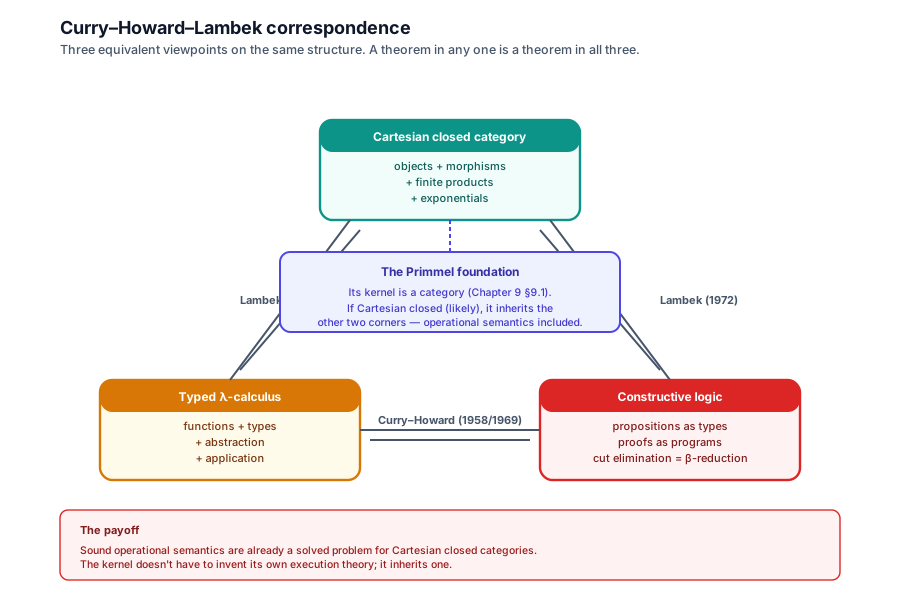
The Curry–Howard–Lambek correspondence is a decades-old, extremely well-established equivalence between three things:
| Side | What it studies |
|---|---|
| Cartesian closed category | Objects and morphisms with finite products and exponentials |
| Typed -calculus | Functions, abstraction, application, types |
| Constructive logic | Proofs as programs, propositions as types |
The correspondence says: a theorem in any one of these is a theorem in all three. A Cartesian closed category is a model of typed -calculus is a model of constructive logic.
What this means for the foundation
Section titled “What this means for the foundation”The foundation’s kernel is a category. If it has finite products (it does, products of value-interfaces are well-defined) and exponentials (it does, transitions between interfaces form an exponential), then it is a Cartesian closed category. By Curry–Howard–Lambek:
This is not metaphor. Anything with the algebraic signature of a Cartesian closed category sits inside a family of structures for which sound operational semantics are already a solved problem in programming language theory.
UML and OOP were never built to satisfy those preconditions. They were built as human documentation conventions first, with execution retrofitted (Executable UML, UML state machine code-gen) as an afterthought that never achieved full fidelity to the diagrams.
9.4 Composition closure, restated
Section titled “9.4 Composition closure, restated”Theorem 1 of Chapter 4 said the kernel is closed under its three operations. Categorically, this is the closure of a category under composition:
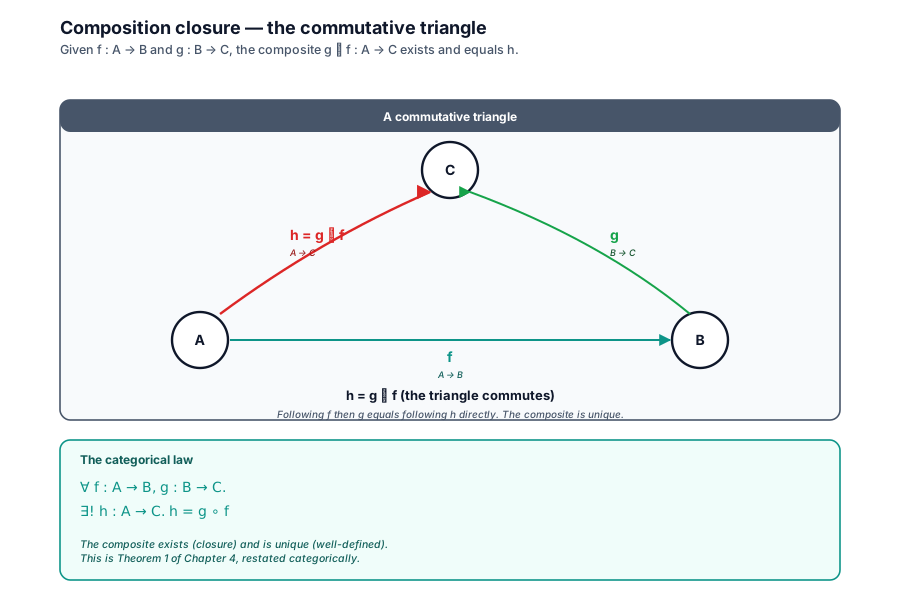
Given morphisms and , the composite exists, and the diagram commutes:
where is the unique morphism making the triangle commute. The composition law of a category is exactly this closure. Theorem 1 is categorical closure, restated for the foundation’s vocabulary.
9.5 Reification as an adjunction
Section titled “9.5 Reification as an adjunction”Closure Rule 3 (§3.9) reifies a transition into an object:
Categorically, is the action of a functor from the category of transitions to the category of objects. The right adjoint goes the other way, given an object, it returns the identity transition.
The adjunction satisfies:
which says: maps from a reified transition to an object correspond naturally to maps from the transition to the identity-of-the-object. This is the categorical statement of “an object is the unit of composition.”
9.6 KerML, independent convergence
Section titled “9.6 KerML, independent convergence”The SysML v2 effort concluded, after two decades of UML’s foundationless metamodel, exactly what the foundation concludes. It built KerML, Kernel Modeling Language, a small kernel language with declarative formal semantics, with SysML v2 as a surface that elaborates into it.
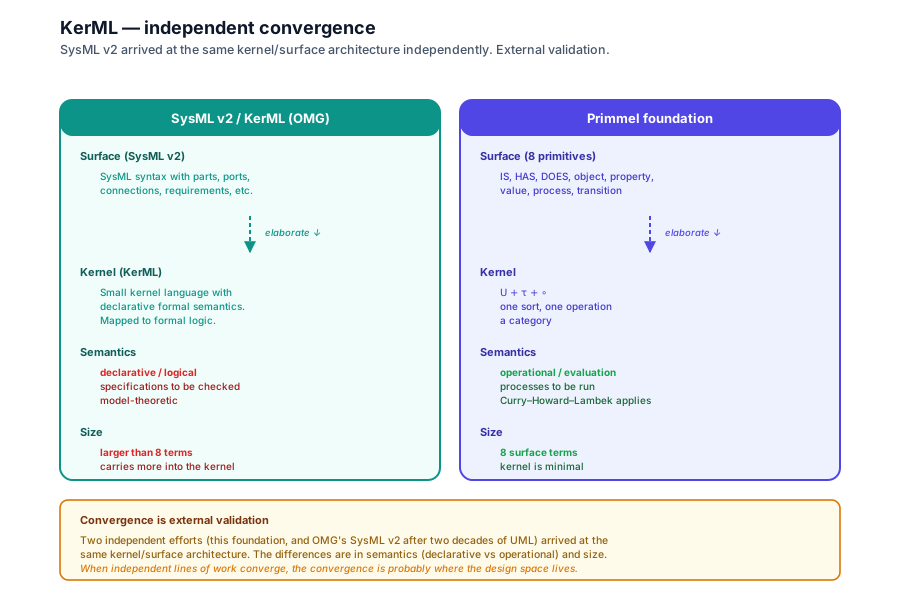
This is the two-level architecture of Chapter 5 arrived at independently by the largest standards body in the field.
Where KerML and the foundation agree
Section titled “Where KerML and the foundation agree”- Both have a kernel + surface split.
- Both define the surface by elaboration into the kernel.
- Both treat the kernel as the trusted base for proof.
Where they differ
Section titled “Where they differ”- KerML’s kernel is declarative/logical (model-theoretic, specifications to be checked). The foundation’s kernel is operational (evaluation-based, processes to be run).
- KerML’s kernel is larger, it carries more of the surface ontology into the kernel, trading minimality for expressiveness in the base layer.
Why the convergence matters
Section titled “Why the convergence matters”It is external validation. The foundation is not idiosyncratic. When independent efforts (this one and SysML v2) converge on the same architecture, that architecture is probably where the design space lives.
9.7 The honest limits
Section titled “9.7 The honest limits”What the categorical foundation does not give us:
- It does not give decidability. The kernel being a category does not mean reasoning over it terminates. OWL’s description logics have decidability proofs; the foundation does not.
- It does not give a tooling ecosystem. Categorical metatheory is rich, but the practical tooling (compilers, debuggers, IDE integrations) still has to be built.
- It does not give a unique foundation. Other categorical formulations are possible (different choices of products, exponentials, functor categories). The kernel is one candidate.
The categorical reading strengthens the foundation’s claims but does not make them absolute. The next chapter (Chapter 10) turns the categorical formalism into practical claims about executability and adoption.
9.8 Where this chapter leaves us
Section titled “9.8 Where this chapter leaves us”- The kernel is a category, Mac Lane’s textbook applies.
- The Curry–Howard–Lambek correspondence gives the kernel operational semantics “for free” (relative to being a Cartesian closed category, which we believe it is).
- KerML’s independent arrival at the same architecture is external validation.
- The honest limits (no decidability, no tooling) are stated.
The next chapter turns this formal foundation into the practical argument: no escape hatch, reification, scale invariance, model = program.
Further reading
Section titled “Further reading”- Mac Lane, S. (1971). Categories for the Working Mathematician. Springer-Verlag, New York.
- Lambek, J. & Scott, P. J. (1986). Introduction to Higher Order Categorical Logic. Cambridge University Press.
- Pierce, B. C. (1991). Basic Category Theory for Computer Scientists. MIT Press.
- OMG (2024). Kernel Modeling Language (KerML). SysML v2 specification, Object Management Group.
Next: Chapter 10, The Executable Ground: the practical case, no escape hatch, reification, scale invariance, model = program.