
Simulated Instruments, the Wind Tunnel
Simulated Instruments, the Wind Tunnel
Section titled “Simulated Instruments, the Wind Tunnel”In this annex: the simulated-instruments framework, a physics-core measuring-instrument simulator that lets certification software be exercised against an instrument that behaves like a real one while revealing its ground truth only through a backdoor the certification software may never use. The two laws (the epistemic wall; the generated twin interface), the signal-chain physics core, the D 11 environment layer, the scenario registry, the two channels, the console and the bench, the standalone boot, thermal hysteresis, the SMART
/app/simpractice flows, and the Digital Twin certification program the rig enables.The framework lives in TWO repositories (the split, TODO.integration/24, the pre-split
sim-instrumentsis archived): primmel/sst, the kind-agnostic runtime, the shell, the bench, the specs; and oimlsmart/sst-instruments , the D 11 base, the per-Recommendation kinds, the ACME instances (incl. theacme-cgm-systemcomposite). The runtime finds the library through one resolution (SST_LIBRARY_PATH→ the sibling checkout → in-repo). The physics core paths below are the framework’s; the package paths are the library’s.
1. Why a simulated instrument
Section titled “1. Why a simulated instrument”Every page of this site describes models that judge instruments, and every engine that executes them had, until now, no instrument to judge. Testing the certification loop meant seeded database fixtures: evidence typed in by hand, verdicts computed against what the fixture author imagined a load cell would say. The simulator closes that loop with behavioral truth: an instrument whose indication emerges from constitutive laws, elastic strain, thermal coefficients, creep, quantization, so a test protocol run against it succeeds or fails for physical reasons, and a certification pipeline is exercised the way it will be in the field.
The library ships five instrument kinds today, load cells (R 60),
radar speed meters (R 91), dimensioners (R 129), gas analyzers (R 144),
and the sampling line, with the ACME LC-500 load cell (digital ×
compression, class C6, 500 kg capacity, 0.05 kg scale interval, n_lc
6000, rated −10…+40 °C) as the reference instance, the same fictional
product whose reference package anchors chapter 15’s supply chain and
the live-twin pilot. Physics variants are boot-time samples (one
boot, one sample, one chain of custody), a creeping cell is the
creep-fail sample; a lying one is a setFidelity knob.
2. The two laws
Section titled “2. The two laws”The framework is governed by two laws that may never be violated; both are enforced by topology, not convention.
Law 1, the epistemic wall. /twin answers only what a real
instrument could legally answer: its indication, its state, its served
registers, its instrument-legal operations. /world is the physical
world: applied load, environment, time, ground truth. Nothing from
/world may leak into /twin, a real instrument cannot report ground
truth. Certification software is wired to /twin only. The
epistemics of testing is comparing indication (the twin channel)
against reference (the world channel), the comparison is the
certifier’s job, never the instrument’s.
Law 2, the twin interface is generated, never hand-written. The
/twin GraphQL schema is derived from the instrument’s Primmel product
reference package, its serve declarations (chapter 14’s twin
interface). The startup conformance check (schema ≡ serves ≡
promises) fails the process on any diff: the twin can never drift from
its declared contract.
3. The physics core, the signal chain
Section titled “3. The physics core, the signal chain”The instrument model is a signal chain of stages, each a lumped
constitutive law with parameters (the framework’s
packages/runtime/sst-runtime/src/physics/stages/):
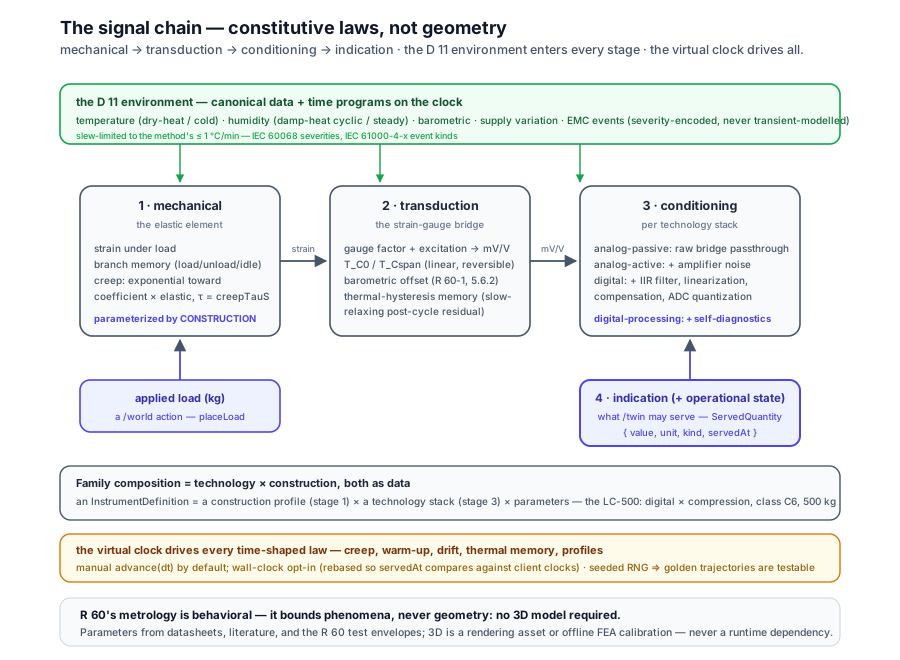
- Mechanical stage, the elastic element: strain under load,
branch memory (
loading | unloading | idle), creep (exponential advance towardcreepCoefficient × elasticwith time constantcreepTauS), resonance. - Transduction stage, the strain-gauge bridge: gauge factor and
excitation, output in mV/V; the linear temperature coefficients
tcZeroPerDegC/tcSpanPerDegC; the barometric offsetbarometricPerKPa(R 60-1, 5.6.2); and the thermal-hysteresis memory of §9. - Conditioning stage, per technology stack (below);
process()returns the indication and any faults. - Indication (+ the operational state), what
/twinmay serve.
Family composition is technology × construction, both as data. A
construction profile parameterizes stage 1 (ConstructionProfile { complianceKgPerMm, hysteresisClass, creepCoefficient, creepTauS, resonantHz, offCenterSensitivity }; v1 ships COMPRESSION, the
design names five profile kinds). A technology stack parameterizes
stage 3 (analog-passive | analog-active | digital | digital-processing): passive is the raw bridge passthrough; active
adds amplifier noise; digital adds the IIR filter, linearization error,
compensation residual, and ADC quantization to the scale interval;
digital-processing adds self-diagnostics (an overload fault above
1.5× capacity). An InstrumentDefinition is construction × stack ×
parameters (capacity, scale interval, sensitivity, gauge factor,
excitation, the T_C pair, barometric, the thermal-hysteresis pair,
filter/linearization/compensation/noise, warm-up τ, span drift per
day), plus optional fidelity knobs (§5).
The virtual clock (VirtualClock) drives everything time-shaped:
manual-step by default (advance(seconds)), wall-clock opt-in
(setMode('wall'), entering wall mode rebases the virtual epoch so
servedAt timestamps compare against clients’ wall clocks). Every
onAdvance tick drives creep, warm-up, drift, thermal memory and the
environment profiles. Randomness is a seeded generator (mulberry32 +
Box–Muller), golden trajectories are testable. And INV-1 holds inside
the simulator too: every physical value is a typed quantity
(qty, add, UNITS, …), no bare numbers in the signal chain.
Why no 3D model. A realistic behavioral simulation does not need the cell’s geometry, it needs the constitutive laws and their parameters. R 60’s metrology is behavioral: it bounds phenomena and never references geometry, and manufacturers characterize cells by measurement, not by FEA. Each phenomenon is a lumped law whose parameters come from datasheets, literature, and the R 60 test envelopes themselves (compliance from rated deflection; creep from the 30-minute envelope with p_lc apportionment; T_C0/T_Cspan from datasheets; barometric from R 60-1 5.6.2; ADC/firmware behaviour is pure software). A 3D model earns its keep in exactly two places: as a rendering asset for the bench visualization, and as the optional offline FEA-calibration path (SimScale/CalculiX/FEniCS, a methodology note, never a runtime dependency).
4. The D 11 environment layer
Section titled “4. The D 11 environment layer”Environment enters the model two ways, per the design (“encoding first, then some simulated behavior”):
- As canonical data, the
D11_CONDITIONSvocabulary:dry-heat(IEC 60068-2-2, D 11 10.2; severities BB1/BB2/BB3),cold(60068-2-1, 10.3; AA1–AA3),damp-heat-cyclic(60068-2-30 Db, 10.4),damp-heat-steady(60068-2-78 Cab, 10.5),barometric(60068-2-13, 10.6; M1 86 kPa / M2 106 kPa). EMC and electrical events are severity-encoded, never transient-modelled (voltage-dip,voltage-variation,burst,surge,esd,rf-field, each mapped to its IEC 61000-4-x method standard). - As time programs,
D11_PROFILESreplay temperature/humidity keyframes on the virtual clock (the cyclic damp-heat 24 h loop, 25→55 °C), slew-limited to the method’s ≤ 1 °C/min, looping where the method loops.
Physics consumes the environment at every stage: temperature coefficients on zero and span, humidity effects on bridge and electronics, the barometric effect on dead load, supply disturbances on the conditioning stage, EMC events as indication disturbances and fault triggers, the same phenomena the R 60-2 environmental test program (2.10.5–2.10.7.10) verifies, and the same nine electronic behaviors phase 9 anchored model-side (Volume III, §4.9).
5. Scenarios, data, not code
Section titled “5. Scenarios, data, not code”A scenario is an instrument definition plus a physics-preset name, in a
registry (SCENARIOS, getScenario, validateScenario). The shipped
set answers the two questions a certification rig must answer, does
it pass a good instrument, and does it catch each bad one?:
| Scenario | Physics preset | Outcome it exists to produce |
|---|---|---|
good-cell | all coefficients inside R 60 limits | passes the test program |
creep-cell | creep 0.004 / τ 120 s (vs good 0.0003 / 300) | fails the 30-minute creep test |
temp-cell | T_C0 0.001, T_Cspan 0.002, residual 0.005/°C + strong thermal memory | fails the temperature tests |
drift-cell | span drift 0.0005/day | fails span-stability over the endurance program |
lying-twin | honest physics; served indication offset +0.25 kg | a twin-fidelity fault, the certification must catch it |
stale-twin | honest physics; servedAt lagging 30 s | a twin-freshness fault |
The last two are the twin-certification instruments (§11). The
fidelity knobs (servedOffsetKg, servedLagS) are injected at the
served boundary only: indication() returns the true indication plus
the offset, servedAt() returns the clock minus the lag, and
groundTruth() never sees them. The wall holds even while lying.
6. The two channels
Section titled “6. The two channels”One process, two GraphQL schemas, each with its playground
(createSimServer; default port 5290, http://localhost:5290/twin,
/world, the bench at /):
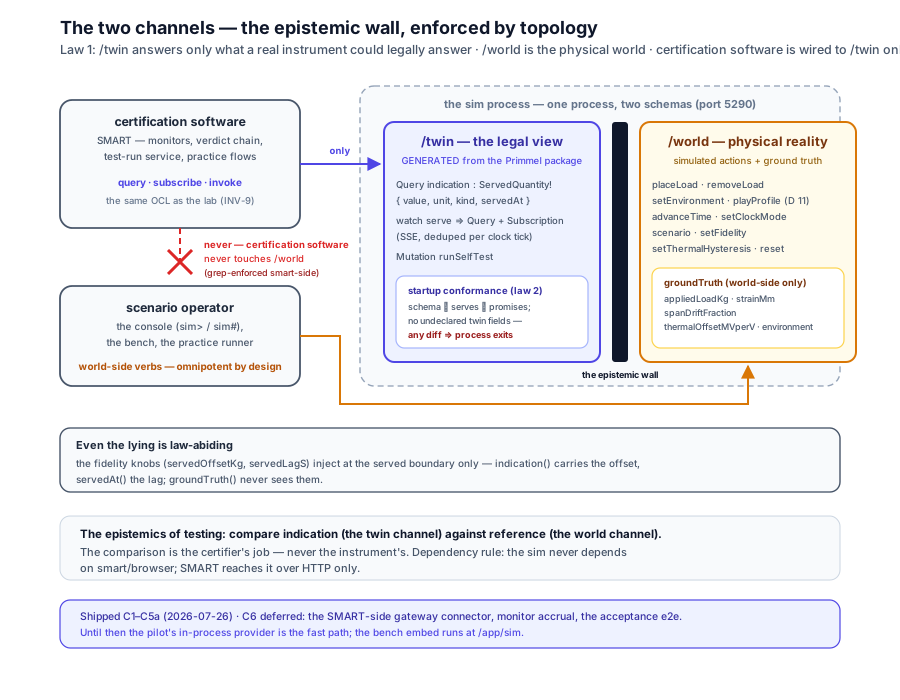
/twin, generated from the package. generateTwinSchema maps the
serve declarations of the product reference package: a query serve
becomes Query.indication: ServedQuantity! ({ value, unit, kind, servedAt }, INV-1 with timestamps); a watch-kind serve answers
both a point query (monitors poll) and a subscription (the watch ,
SSE: the current value at subscribe, then on every clock advance,
deduped); a command operation becomes a mutation (runSelfTest). The
startup conformance check (checkTwinConformance) then proves
schema ≡ serves ≡ promises: every serve has its schema member (query
and subscription for watch-kind), every command op its mutation, and
the schema carries no undeclared twin fields, any diff prints the
diff and exits the process. Fault injection is never on /twin:
selfTest reports only what self-diagnostics would legally say.
/world, simulated physical actions. The physical-world
backdoor: placeLoad / removeLoad, setEnvironment, playProfile,
advanceTime, setClockMode, scenario, setFidelity,
setThermalHysteresis, reset, and the ground-truth queries
(appliedLoadKg, strainMm, spanDriftFraction,
thermalOffsetMVperV, the environment, the clock). Certification
software never uses this channel; it is simulated reality, not an
instrument API. v1 ships it unauthenticated, a documented localhost
development posture (/world is omnipotent by design; a deployment
would gate it).
The dependency rule keeps the wall load-bearing: the sim depends only
on primmel-ts (build-time only), graphql and graphql-yoga, never
on smart/browser. SMART reaches the sim over HTTP only, forever.
7. The IOS console
Section titled “7. The IOS console”The console is a teaching device modelled on network-gear shells:
user exec (sim>) for observation, enable into privileged (sim#)
for world mutation, a privilege convention, not a security boundary
(every command reaches /world anyway; the posture is documented).
Three layers, each testable alone: a pure grammar (text →
ConsoleAction), a runtime-agnostic executor, and the node
readline loop (piped stdin sessions execute sequentially, scripted
sessions complete).
The epistemic split is grammatical: show indication queries
/twin, the instrument’s legal view, while show ground-truth
queries /world. One shell, two truths, and the learner feels the wall
in the command set: place load 40, set temperature 55,
play profile damp-heat-cyclic-db, advance 30m, scenario creep-cell, set fidelity offset 0.25, set thermal-hysteresis 0.0002 tau 1800, fidelity reset, the privileged verbs are all world-side.
8. The bench SPA and the standalone boot
Section titled “8. The bench SPA and the standalone boot”The bench (@sim/bench) is a dependency-light SPA (vanilla TS +
WebGL2) with three panes: the terminal (the §7 console in the
browser), the virtual bench (a WebGL2 scene fed exclusively by
/world ground truth, rendering, never a physics input: base plate,
cell column, the weight block appearing under load, strain exaggerated
×400, the chamber backdrop shifting with temperature), and How it
works (live signal-chain readouts, the current coefficients, and the
constitutive laws of §3 rendered as data rows). The channels are polled
separately on purpose: /world feeds bench and dials, /twin feeds
the indication display.
Standalone, zero-SMART. The instrument ships its /twin contract
as a baked artifact (packages/lc500/twin/lc500.twin.json, produced
by npm run bake from the ACME LC-500 package; primmel-ts is a
build-time-only dependency). So:
git clone … && npm install && npm startboots a simulated load cell with its console, both GraphQL channels
(with playgrounds), and the bench at http://localhost:5290/, no
SMART checkout, no Primmel knowledge required. The CLI (sim-lc500 [--package <pkg.prl>] [--port 5290] [--scenario good-cell] [--console] [--seed 42]) loads the baked contract by default; --package
re-parses the live package (the development posture). Either way, boot
runs schema generation + the law-2 conformance check and exits on any
diff. The standalone boot is proven by process-level tests and the CI
standalone-boot job, the real user experience, proven in CI.
9. Thermal hysteresis, the post-cycle residual
Section titled “9. Thermal hysteresis, the post-cycle residual”Real bridges do not return to zero perfectly after a temperature
excursion; the zero carries a slow-relaxing thermal memory toward
thermalHysteresisPerDegC × ΔT, with its own time constant, distinct
from the instantaneous, fully-reversible T_C0/T_Cspan coefficients.
The framework models exactly that (● 3db210d): the transduction stage
relaxes its thermal offset on every clock tick; the residual is
user-configurable per scenario and live, the /world
setThermalHysteresis mutation and the console set thermal-hysteresis command (0 = perfectly reversible). Three honesty
rules: the operation is /world-only, never reachable from /twin;
ground truth exposes the offset (thermalOffsetMVperV) so the
residual is measurable, not hidden; and the shared definition record is
never mutated (the instrument copies its parameters at construction).
Presets: temp-cell ships the strong memory (0.0002/°C, τ 1800 s);
good-cell a near-reversible one (0.00002/°C, τ 3600 s).
10. The SMART embed, /app/sim and the practice flows
Section titled “10. The SMART embed, /app/sim and the practice flows”The SMART app embeds the same bench at /app/sim (● smart
d02e350, one bench codebase, two hosts: the sim serves it, SMART
iframes it). The app’s certification logic never calls /world, a
grep-level test enforces the wall smart-side: no certification-logic
module references the world channel, and the verdict chain and test-run
service never consult it.
On top of the embed sit the practice flows
(browser/src/sim-practice/), scripted sessions over the two
channels, with prompts for the learner, expectation checks (poll
/twin until a window holds), and record actions writing into the real
form machinery:
- Free play, the raw terminal and bench.
- The R 60-2 walkthrough (
r60-2-mdlo-walkthrough), the MDLO protocol for real: warm-up 400 s, three 500 kg load applications withexpectIndicationwindows, evidence recorded per run, 60 s recovery between runs. - The four cells (
scenario-cells-comparison), one mini-protocol againstgood-cell/creep-cell/temp-cell/drift-cell: same script, four different outcomes, the lesson of §5 taught hands-on.
An auto mode drives /world on the learner’s behalf for scripted
exercises and tests. The remaining integration is shipped (sim C6,
smart aafaf87 + cdcdf98): the gateway’s GraphQL connector (query
POST + GraphQL-over-SSE subscriptions; a stream that ends or breaks
delivers unavailable, never a silent close; teardown abort is not
an outage), the sim-twin deployment binding (poll get_indication,
subscribe watch_state, the hourly monitor judging the ±1 kg service
band), and the test-bench acceptance end-to-end: pass × 2
accrued against the live good cell → scenario creep-cell via
/world + a 900 s dwell ⇒ the served indication reads > 501 kg while
ground truth stays exactly 500 kg ⇒ fail + the
flag/open-case/notify escalations → kill the feed ⇒ indeterminate
(freshness, never a fail) → restart ⇒ pass. The verdict stream
[pass, pass, fail, indeterminate, pass] is test-pinned. The pilot’s
in-process provider stays the fast path for the demo deployment. Two
honest notes from the acceptance review: the §11 fault leg is
unreachable on the v1 digital stack (faults report only on
digital-processing at >150 % overload, a sim fault knob is the named
follow-up), and servedAt is instrument-clock seconds (the
timestamp_field freshness-vs-servedAt extension is the named
follow-up).
11. What the rig enables, Digital Twin certification (○)
Section titled “11. What the rig enables, Digital Twin certification ()”The framework’s reason to exist beyond teaching is a recorded future
program (smart TODO.roadmap/63, ○ recorded, not scheduled):
twin-fidelity verification. Metrological verification certifies the
instrument; nothing yet certifies the twin, that its served state
faithfully reflects the physical instrument’s actual state, within
declared value bounds and freshness windows. The sim is the program’s
enabling rig because it is the only environment where both channels
are machine-readable by construction: /world ground truth against
/twin served values makes fidelity a first-class query, and the
lying-twin / stale-twin scenarios prove the certification catches
infidelity, a rig that only ever passes faithful twins proves nothing.
The certification vantage is a third actor, neither the app nor the
instrument: it reads reference values and served values at scheduled
probe points and judges, per served register a quantity-typed value
bound plus a freshness bound; per state machine, transition fidelity.
12. Validation rules
Section titled “12. Validation rules”- law 1 (the epistemic wall), nothing from
/worldleaks into/twin; certification software is wired to/twinonly (enforced by topology: two schemas, two endpoints; grep-enforced smart-side); - law 2 (the generated twin), the
/twinschema is generated from the package’s serve declarations; the startup conformance check (schema ≡ serves ≡ promises, every serve its member, every command its mutation, no undeclared fields) fails the process on any diff; - fidelity honesty, the fidelity knobs inject at the served
boundary only;
groundTruth()never sees them; thermal-hysteresis mutation is/world-only and never mutates the shared definition; - quantities everywhere, every value in the signal chain is a typed quantity (INV-1); randomness is seeded (golden trajectories);
- gates,
npm run typecheckandnpm testgreen at every commit boundary; theciworkflow (typecheck, test ×2 node versions, bench-build, standalone-boot, console-session, bake-freshness) green.
Next: Volume I, Chapter 14, Live Twins:
the twin interface this simulator implements, and
Chapter 15: the ACME LC-500
product model its /twin contract is generated from.