
Chapter 4, Proofs
Chapter 4, Proofs
Section titled “Chapter 4, Proofs”In this chapter: the three theorems that make the IS–HAS–DOES modelling system a candidate universal descriptive algebra: closure (no operation escapes the four sorts), completeness (every claim-form expressible under the Claim-Form Axiom has a primitive that catches it), extensibility (new content never requires new primitives). Each is stated as a theorem and proved. Read Chapter 2 (Claims and Falsifiability) first, the completeness and extensibility proofs depend on the Claim-Form Axiom stated there.
4.1 What is being proved
Section titled “4.1 What is being proved”Three properties, each stated precisely:
| Property | Informal claim |
|---|---|
| Closure | Every operation of 𝓜 applied to elements of 𝓜 yields an element of 𝓜. |
| Completeness | Under the Claim-Form Axiom, every atomic claim is expressible in 𝓜. |
| Extensibility | 𝓜 extends conservatively: new content is absorbed without new primitives; any proposed new primitive is either redundant or violates the axiom. |
Closure is unconditional, it is a property of the algebra itself. Completeness and extensibility are relative to the Claim-Form Axiom. That relativization is not a weakness; it is the strongest honest claim available (see §4.5 below and Chapter 2 §2.2–2.3).
4.2 Theorem 1, Closure
Section titled “4.2 Theorem 1, Closure”Claim. Every operation of 𝓜 applied to elements of 𝓜 yields an element of 𝓜.
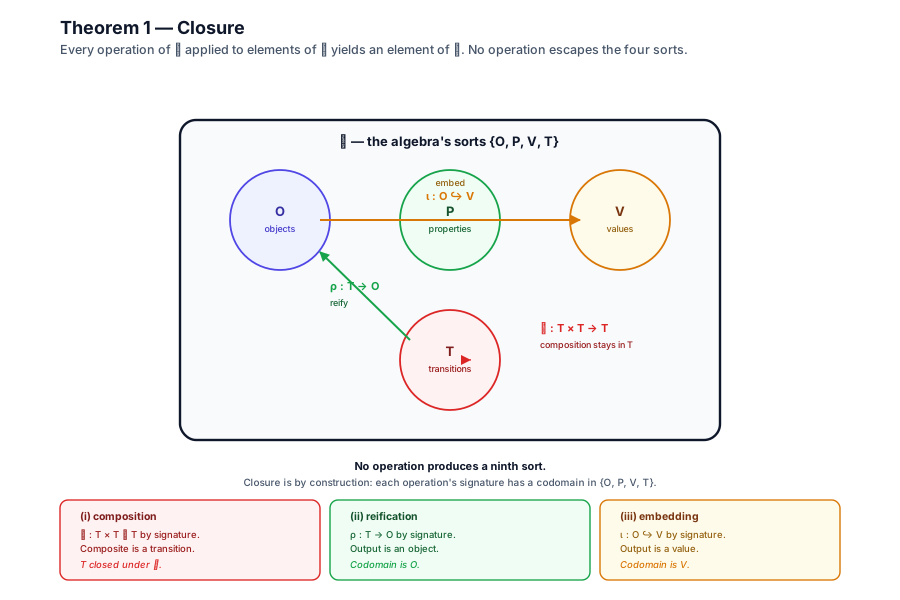
Proof. There are exactly three operations; check each.
(i) Composition.
∘has signatureT × T ⇀ T. Given two transitionst₁, t₂ ∈ Twith compatible interfaces, the compositet₂ ∘ t₁ ∈ Tis a transition by the operation’s signature. SoTis closed under∘.(ii) Reification.
ρhas signatureT → O. Given a transitiont ∈ T, the reificationρ(t) ∈ Ois an object by the operation’s signature. The output is a sort of 𝓜.(iii) Embedding.
ιhas signatureO ↪ V. Given an objecto ∈ O, the embeddingι(o) ∈ Vis a value by the operation’s signature. The output is a sort of 𝓜.The relations (
IS,HAS,DOES) produce truth-claims over existing sorts and generate no new entities. No operation has a codomain outside{O, P, V, T}. Hence no use of the system ever manufactures a ninth sort. ∎
The proof is short because the closure is by construction: each operation’s signature says what it produces, and each signature’s codomain is one of the four base sorts. Closure is the absence of escape hatches in the signature.
4.3 Theorem 2, Completeness
Section titled “4.3 Theorem 2, Completeness”Claim-Form Axiom (restated from Chapter 2 §2.2). Every atomic descriptive claim about an entity is one of three forms: an identity claim (what it is), an attribution claim (what it holds), or a transformation claim (what it does).
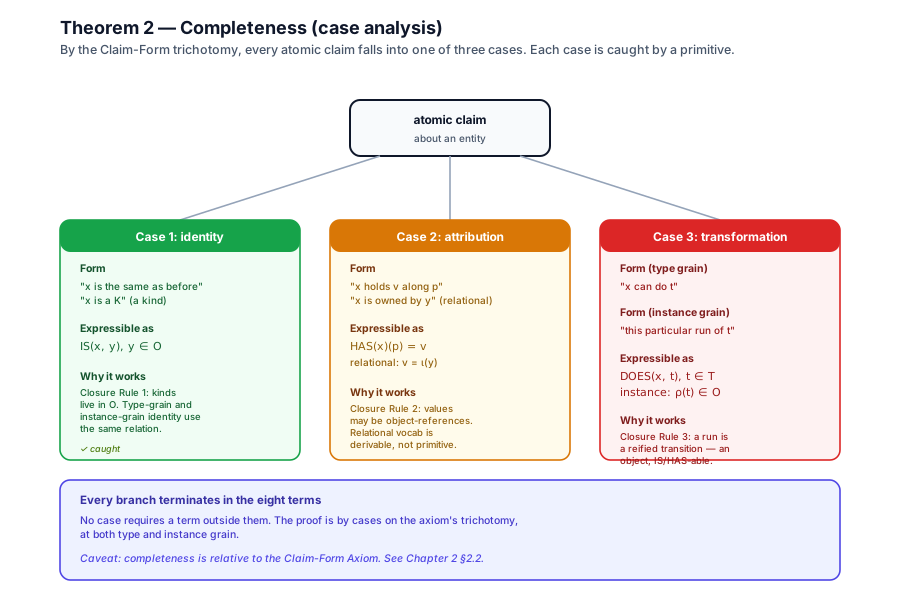
Claim. Under the axiom, every atomic claim is expressible in 𝓜.
Proof. By cases on the axiom’s trichotomy, at both type and instance grain.
Case 1, Identity claims. “x is the same as before” and “x is a K” are both
IS(x, y)withy ∈ O. Closure Rule 1 (§3.7) guarantees that kinds live inO, so type-level identity is caught by the same relation that catches instance-level identity.Case 2, Attribution claims. “x holds value v along property p” is
HAS(x)(p) = v. Relational attributions (“x is owned by y”) are the casev = ι(y)by Closure Rule 2 (§3.8), the value carries an object-reference rather than raw data. Either way, HAS catches the claim.Case 3, Transformation claims.
- At type grain: “x can do t” is
DOES(x, t)witht ∈ T.- At instance grain: “this particular run of t” is
ρ(t) ∈ Oby Closure Rule 3 (§3.9), the run is a reified transition, which is an object, individuated by IS and described by HAS like any object.Every branch of the case analysis terminates in the eight terms; no branch requires a term outside them. ∎
Empirical corroboration
Section titled “Empirical corroboration”The proof is structural, but it is backed by an empirical record. Across the entire design dialogue (reconstructed in Chapter 7), every candidate primitive proposed and examined, STATE, STEP, CAN, RECEIVES, RELATES-TO, BECOMES, TYPE, TIME, reconstructed as a composite of the eight. A vocabulary that stops needing patches has probably closed; “probably” is the strongest claim available, given the Gödel-style limit on self-certification.
4.4 Theorem 3, Extensibility
Section titled “4.4 Theorem 3, Extensibility”Claim. 𝓜 extends conservatively: any new domain content is absorbed without new primitives, and any proposed new primitive is either redundant or violates the Claim-Form Axiom.
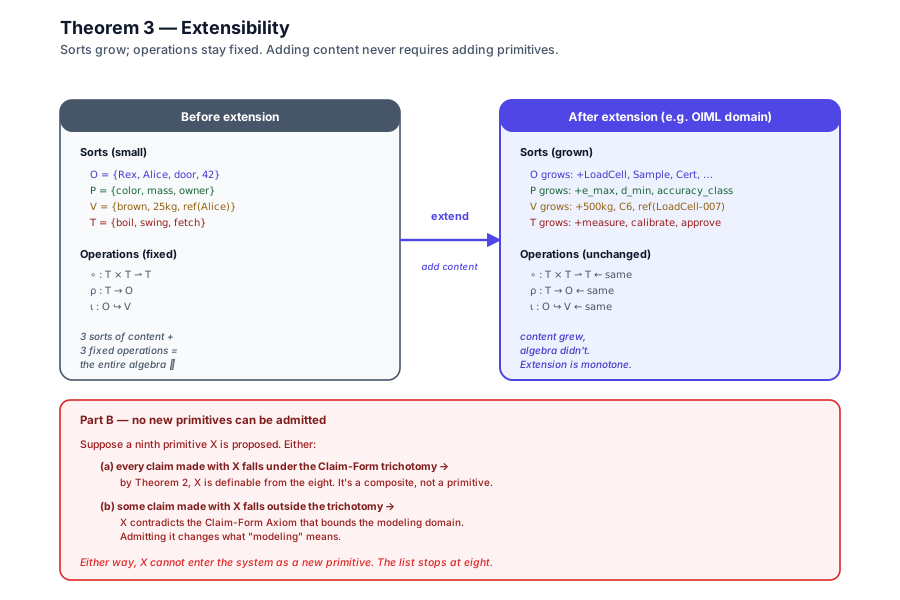
Proof.
Part A, Conservative growth. Extension means enlarging the sorts: new kinds and instances enter
O, new dimensions enterP, new data enterV, new rules enterT. The operations∘, ρ, ιand the relationsIS, HAS, DOESare defined schematically over the sorts, they don’t enumerate members, they prescribe shape. So enlarging a sort changes no definition and invalidates no prior claim. Extension is monotone: every theorem that held before the extension still holds after.Part B, No new primitives. Suppose a ninth primitive
Xis proposed. Either:
(a) Every claim made with
Xfalls under the Claim-Form trichotomy (identity, attribution, transformation). Then by Theorem 2,Xis definable from the eight primitives and is a composite, not a primitive. Adding it as a primitive would be redundant.(b) Some claim made with
Xfalls outside the trichotomy. ThenXis making a descriptive claim of a kind the Claim-Form Axiom says does not exist, which contradicts the axiom that bounds the modeling domain.Xis inadmissible as a primitive because admitting it would change what “modeling” means.Either way,
Xcannot enter the system as a new primitive. ∎
What extensibility buys in practice
Section titled “What extensibility buys in practice”Because the algebra is schematic over its sorts, a new domain (legal
metrology, business process, software build pipelines) enters the
system by populating O, P, V, T with domain content, not by
adding to the algebra. Primmel (Volume I) is one such population; the
OIML metamodel (Volume II) is a further specialization of that
population; an OIML Recommendation (Volume III) is an instance-level
enrichment. The algebra never changes; the content grows.
This is the property that lets the documentation tree claim “the generic basis for Primmel” without overreach: Primmel is one domain encoding; the algebra accepts any number of others.
4.5 What the theorems do not prove
Section titled “4.5 What the theorems do not prove”For honesty (see Chapter 2):
- Closure is unconditional, but it is closure of the algebra , it says nothing about whether a runtime that implements the algebra is itself closed under those operations. A buggy runtime can violate closure in practice while the algebra stands.
- Completeness is relative to the Claim-Form Axiom. If you reject the axiom, the proof falls. We argue (Chapter 2 §2.2) that the axiom is well-motivated, but we cannot prove it.
- Extensibility is monotonicity of the algebra under sort enlargement. It does not say the runtime accepts arbitrary new content at runtime; that is a separate claim about the implementation, treated in Chapter 10.
- No decidability result. Reasoning over an arbitrary model is not guaranteed to terminate. OWL’s description logics have decidability proofs this system lacks (see Chapter 8 §RDF/OWL).
The honest summary: the algebra is closed, complete (relative to a stated axiom), and extensible. It is not decidability-complete, not shipped, and not the only possible foundation. The next chapter that matters is Chapter 7 (Derived Vocabulary), which shows the dialectical record of rival primitives being reduced to composites, the empirical backing for Theorem 2.
Next: Chapter 5, Kernel/Surface Architecture: the deeper result that all eight primitives desugar to a kernel with only entities, transitions, and composition.