
Chapter 13, Model Diff and Lifecycle
Chapter 13, Model Diff and Lifecycle
Section titled “Chapter 13, Model Diff and Lifecycle”In this chapter: editions as lifecycle packaging, orthogonal to the kernel by design, the structural model diff the core owes them, what that diff powers, where versioning relations live, and how INV-8 pins execution to definitions.
13.1 Editions are packagings, not model features
Section titled “13.1 Editions are packagings, not model features”A standard outlives its editions. R 60 exists as 1996, 2000, 2017 and 2021 editions; the subject, the load cell, did not change its nature in those years, only the document did. The kernel takes the consequence seriously:
An ‘edition’ package is an arbitrary packaging used for provenance and lifecycle management, orthogonal to the core, and to be implemented as such.
Two design facts follow. First, the subject models stay timeless: a
Model of a load cell is what it is; it carries no “deprecated” flag, no
“valid from” date, no edition number in its identity. Second, the
package carries the lifecycle: the manifest declares version: '2021'
and the editions: [2021, 2017, 2000, 1996] line
(data/r60/standard.yaml, and identically in
primmel-packages/oiml-r60/package.primmel), and every versioning
relation hangs off that manifest (§13.4).
This orthogonality is what keeps editions cheap. Because an edition is packaging, producing one is a shipped, gated operation (● task 28): pin the content, run the diff, declare the relations, never a rewrite of subject models. And because the content itself is tier-structured (chapter 1), an edition diff reports in the vocabulary the tiers already provide.
13.2 The model diff (●, shipped, task 28)
Section titled “13.2 The model diff (, shipped, task 28)”The one capability the core owes lifecycle management is model diff:
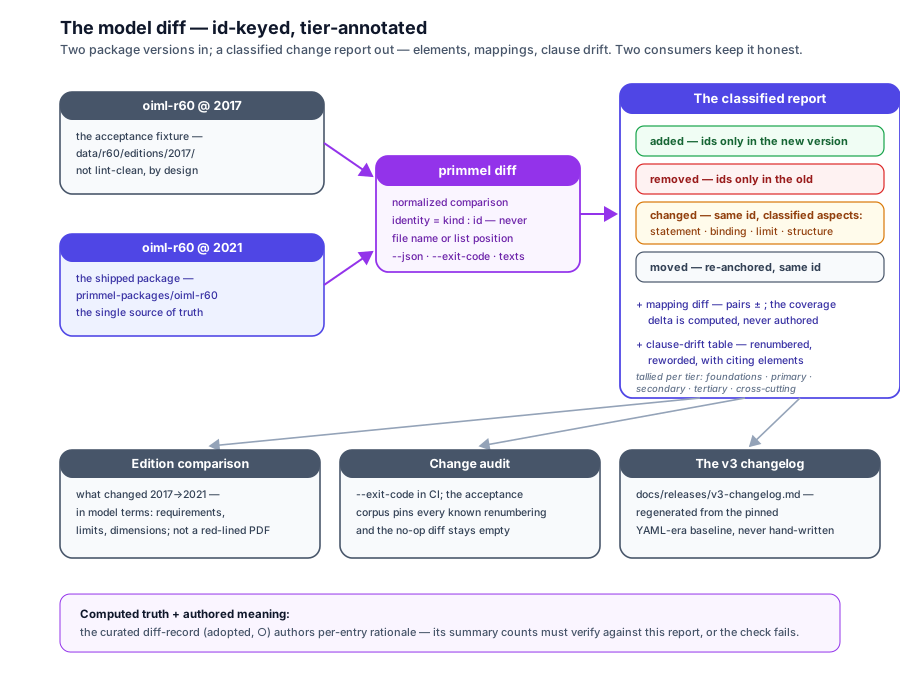
a structural diff between two package versions, shipped as primmel diff <a> <b> (● smart cb5eab6, kernel model-diff.ts /
package-diff.ts, with --json, --exit-code for the change-audit CI
gate, and --compare-texts for the sentence payloads). Not a text diff
of YAML files, a diff of model elements, keyed by id, classified by
tier:
| Change kind | Meaning | Example (an R 60-style revision) |
|---|---|---|
| added | an element id present only in the new version | a new conformance test for a disturbance kind |
| removed | an id present only in the old version | a withdrawn form |
| changed | same id, different content, classified by what changed: statement / binding / limit / structure | limit on /req/metrological/mpe-table re-scoped |
| moved | same id, different anchor or location | a requirement re-anchored to a corrected aspect path |
And, because mappings are first-class (chapter 5), the diff includes a mapping diff: mapping pairs added or removed between the two versions, and the resulting coverage delta, a reference component that drops from full to partial cover because the implementation deleted a mapped process is a computed finding, not a discovered one. A clause-drift table joins the report: renumbered clauses, changed limits, moved provisions, with their citing elements.
Two properties make the diff trustworthy:
- id-keyed, not position-keyed. Renaming a file or reordering a YAML list is not a model change; the diff sees elements, not lines , the same model in a different file layout diffs empty, and a no-op diff of the real package is test-pinned empty. (The cost of this property is the snake_case naming discipline of chapter 11, ids are the diff’s primary key.)
- tier-annotated. Every change reports its tier
(
TIER_BY_FIELD: foundations, primary, secondary, tertiary , processes, entities, registries, state machines, approvals, monitors and passports, cross-cutting), so an edition review reads “secondary: 3 requirements changed limits; tertiary: 1 state machine extended” instead of “47 files touched”.
The diff has two shipped consumers that keep it honest:
- The v3 changelog is generated, not written.
docs/releases/v3-changelog.mdin the platform repo is the output ofprimmel diffre-run over every package against the pinned YAML-era baseline, the narrative one-liners are the only curated content; every other line regenerates (task 31). - The R 60 2017→2021 corpus is the acceptance fixture. The 2017
edition ships as a diff fixture (
data/r60/editions/2017/), and the test kit proves the diff finds every known 2017→2021 renumbering with zero false additions/removals on a no-op diff; the regenerated table isanalysis/clause-drift-r60-2017-2021.txt.
One doctrine rides above the computed diff (adopted from the phase-9
reviewer correspondence, item 4, ○ not yet landed): the curated
diff-record. The computed diff is truth without meaning; an authored
record, per-entry rationale for an edition’s changes, is meaning
without proof. The adopted shape welds them: a model_diff record
whose summary counts are machine-verified against the computed diff
for the pinned pair (a check fails when the authored
summary { added … removed … modified … } disagrees with primmel diff), and whose per-entry rationale is the authored layer. Computed
truth + authored meaning; neither can drift from the other. The R 60
2017→2021 instance is the designated pilot record.
13.3 What diff powers
Section titled “13.3 What diff powers”Three consumers, one computation:
- Edition comparison. “What changed between R 60:2017 and R 60:2021?” is a diff query answered in model terms: these requirements added, these limits changed, this dimension enum extended. A National Member Body reviewing an adoption reads that, not a red-lined PDF.
- Change audit. Between two validation runs of one package, the diff is the audit trail: every added element, every changed binding, every allowlist entry that went STALE (chapter 11), a review artifact generated, not assembled.
- Clause-drift detection. The cross-edition case of chapter 9’s
provenance: the source document renumbers or rewords clauses, and
every provenance edge pointing at a moved fragment lights up. The
running system carries the scar, a form reference
(
form_contains('sample-selection')) predating the R 60-3 form renumbering, recorded in the linker allowlist. Fragment-level provenance (§9.3) plus diff makes that class of breakage a build-time report (“3 fragments renumbered, 1 reworded, these 5 elements cite them”) instead of a linker surprise, shipped as the diff’s clause-drift table over the 2017→2021 corpus (●).
13.4 Versioning relations live on the package
Section titled “13.4 Versioning relations live on the package”Lifecycle relations, supersedes / replaces, validity windows, status, are declared on the package manifest, never inside subject models. The shipped R 60 manifest carries all three:
package { id oiml-r60 kind rec version "2021" editions { 2021 2017 2000 1996 } supersedes { urn:oiml:pub:r:60:2017 } validity { from 2021-01-01 } # window opens; closes when superseded status current # | preview | superseded | withdrawn}Kernel checks C77–C80 validate the facets (●): status vocabulary
(C77), well-formed validity windows (C78), supersedes/replaces
resolution and acyclicity (C79), and the INV-8 execution-side pin
resolving against the manifest’s edition register (C80). The vocabulary
layer already runs exactly this discipline (●): register entries carry
related: - type: supersedes ref: { source: urn:oiml:pub:v:1:2013, id: '0.01' }, a relation between editions of a
thing, recorded outside the thing’s definition. The kernel generalizes
it to packages. The reasons are the tier law’s:
- a subject model that knew its edition would make every
usescomposition edition-coupled, importing a subject would import a lifecycle; - a verdict that cites “R 60” means “R 60 as packaged at version X” , the pin belongs to the evidence record, which is where INV-8 puts it (§13.5), not to the Model;
- a validity window is a fact about the package’s force (a certificate’s validity window, a calibration’s), which is time primitive machinery on Foundations (chapter 6), applied at the manifest.
13.4½ The edition transition, worked (TODO.integration/16)
Section titled “13.4½ The edition transition, worked (TODO.integration/16)”The doctrine end to end, small enough to review in one sitting. A new
edition is an ENTIRELY NEW model with node relationships back to
its predecessor; an implementation model ADDS references to the
new edition to declare compliance, evidence accrues, the old claim
never mutates. The worked pair lives in the kernel’s fixtures
(primmel-ts/test/fixtures/edition-transition/, gated by
edition-transition.test.ts):
r60-demo-2021/ the fictional 2021 baseline — a full small model (one subject, five attributes, one behavior, four requirements), honestly labeled fictionalr60-demo-2027/ the 2027 successor — the SAME model shape with three honest changes, and supersedes { urn:…:2021 }acme-dlc/ the demo product — map_profile to EACH edition (compliance-as-references)The three changes, exactly what the diff prints
(primmel diff r60-demo-2021 r60-demo-2027, pinned in the test):
elements: +2 -0 ~4 >0 (8 unchanged) + attributeDefinitions warm_up_recorded (ADDED) + requirements /req/technical/warm-up-record (ADDED clause) ~ requirements zero-return — statement (0.5 → 0.25 intervals) ~ requirements warm-up-time — statement (30 → 15 min + record) ~ attributeDefinitions warm_up_time / subjects DemoLoadCellCompliance-as-references. The product carries one map_profile
per edition, r60-demo-2021-map.prl is never edited when the
successor lands; r60-demo-2027-map.prl is ADDED beside it (with the
added clause’s new reference). The auditor reads each edition lens
independently, never a merged claim (the multi-standard projection’s
own rule, §16). The pair lints clean: the successor’s supersedes
resolves and is acyclic (C79), its register carries both editions and
its version is the newest (C77), and the product’s maps resolve
(C81/C21/C24, mapping only, never an import edge).
The checklist for a real edition
Section titled “The checklist for a real edition”- Author the new edition as a new package, a full model, never a mutation of the old one; the old package stays untouched on record.
- Link it,
supersedes { <the predecessor's URN> }, theeditionsregister carrying both,versionthe newest (C77/C79 keep you honest). - Mark every change with provenance, the changed/added clauses
carry the edition’s own
sourcecites; the diff must print exactly them and nothing you did not mean to change. - Pin the drift,
primmel diffof the pair in a test (the unexpected-change tripwire). - Add, never edit, the implementations’ references, each implementation that complies ADDS a map profile to the new edition (the old profile stands); a requirement whose tolerance tightened is exactly what the re-judgment window (INV-5/INV-8) exists for.
13.5 INV-8, version pinning at execution
Section titled “13.5 INV-8, version pinning at execution”Lifecycle would be archaeology without the execution-side pin. INV-8: every definition executed in test execution is version-pinned in the TestReport, a run records which method version it executed; a report records which requirement editions it answers. Together with the definition/instance split (chapter 3) this yields the re-execution guarantee:
- INV-5 says re-evaluation requires no re-testing, judgments are functions of (definitions, evidence);
- INV-8 says the evidence names the definitions it answers, so after an edition change, the engine knows exactly which reports can be re-judged against the new limits and which cannot.
The pin is of definitions, not values: a Sample still resolves its
attributes by delegation through Family ← Group ← Model ← Sample
(INV-10), and the report records which version of the definitions
those resolutions drew on. Copying the values into the report would be
the data-rot move INV-10 forbids; pinning the versions is the
auditable alternative. The twin era inherits the pin unchanged:
monitor-emitted evidence (chapter 14) is a time series of verdicts,
every entry carries the same definition pins (definition: { monitor, version, standard_id }), and window re-judgment re-runs a stored
verdict-stream window against new limits, from the snapshots alone,
the twin never re-queried, re-judged verdicts appended marked, never
rewritten (● task 34, smart 90ff7c8), so a fleet’s year of continuous
verdicts re-judges against a new edition exactly as a lab report does.
13.6 Grammar sketch (illustrative v3 syntax)
Section titled “13.6 Grammar sketch (illustrative v3 syntax)”diff oiml-r60@2017 -> oiml-r60@2021 { added [ /cc/electronic/emc-susceptibility (secondary, test) ] removed [ /form/legacy-annex-c (secondary, form) ] changed [ /req/metrological/mpe-table : limit ] moved [ /req/technical/software : re-anchored model.parameters -> model.software ] mappings { added [ lab-sop-7 -> /cc/metrological/repeatability ] removed [ lab-sop-3 -> /cc/legacy ] coverage_delta { /req/metrological : full -> full ; /req/legacy : partial -> no cover } } clause_drift [ R60-3#2.1.7 reworded — cited by 2 elements ]}
edition oiml-r60@2021 of oiml-r60 { pin content@2021 # arbitrary packaging over unchanged subjects diff oiml-r60@2017 -> oiml-r60@2021 declare { supersedes urn:oiml:pub:r:60:2017 ; validity { from 2021-01-01 } }}13.7 Validation rules
Section titled “13.7 Validation rules”supersedes/replacestargets resolve to published package versions; the supersedes graph is acyclic, a package cannot supersede itself through a chain (● C79);- a
validitywindow is well-formed time (Foundations primitives) and windows of a superseding chain do not contradict (● C78); thestatusfacet stays in its vocabulary (● C77); - a diff report’s
added/removed/changed/movedsets partition the element space of the two versions, nothing both added and removed, nothing changed without a classified aspect (●, the partition holds by construction: an id is added, removed, or shared, and a shared id is unchanged, moved, or changed with the aspects listed); - coverage deltas in a mapping diff are computed (chapter 5’s calculus), never authored, an authored delta that disagrees is an error (●; the curated diff-record doctrine extends the same law to authored summaries: machine-verified against the computed diff, ○ not yet landed);
- every executed definition in a workspace record carries a version pin resolving to a package version (● INV-8, kernel check C80); an unpinned run fails admissibility at the report gate.
13.8 Summary
Section titled “13.8 Summary”- Editions are arbitrary packagings for provenance and lifecycle , orthogonal to the core; subject models stay timeless.
- Model diff is structural: id-keyed, tier-annotated, classified
(added/removed/changed/moved), including the mapping diff with its
coverage delta and the clause-drift table, shipped as
primmel diff(● task 28), with the v3 changelog and the R 60 2017→2021 corpus as its two keeping-honest consumers. - One diff computation powers edition comparison, change audit
(
--exit-code), and clause-drift detection across editions; the curated diff-record doctrine (computed counts + authored rationale) is the adopted ○ next step. - Versioning relations (supersedes/replaces, validity windows, status) live on the package manifest, validated by C77–C80, the vocabulary registers already run the pattern; the kernel generalizes it.
- INV-8 pins executed definition versions in the evidence, which with INV-5 makes re-evaluation after an edition change exact, no re-testing, no archaeology; the monitor era’s window re-judgment rides the same pins (● task 34).
Next: The OIML Core Metamodel, on the OIML SMART site: the kernel specialized for legal metrology, the measurement vocabulary, the subject chain, the six modules.