
Chapter 6, Algorithms
Chapter 6, Algorithms
Section titled “Chapter 6, Algorithms”In this chapter: the five algorithms that bridge the Tier 0 kernel and the Tier 1 surface of Chapter 5. Elaboration desugars Tier 1 statements into kernel triples. Resugaring projects kernel triples back to surface vocabulary for display. Reification (ρ) turns a transition into an object. Evaluation is the runtime protocol that applies a transition to an input. State-location (σ) identifies where an execution currently stands in a composed process.
These are first-class content, not implementation details. The runtime executes them; the interchange format must preserve enough information for each to be invertible or replayable.
6.1 The five algorithms at a glance
Section titled “6.1 The five algorithms at a glance”| Algorithm | Signature | Purpose |
|---|---|---|
| elaboration | Tier 1 statement → kernel triple | Lower author intent to the executable substrate |
| resugaring | kernel triple → Tier 1 statement | Display kernel state in surface vocabulary |
| reification (ρ) | transition t → object ρ(t) | Make a rule bearable as an object |
| evaluation | (t, input) → (new state, output) | Apply a transition to its input |
| state-location (σ) | execution e → (process, current-node, I, O) | Locate where an execution currently is |
Each algorithm has a formal signature, a prose description, and a diagram. Together they form the operational contract between the surface language and the kernel runtime.
6.2 Elaboration, Tier 1 to Tier 0
Section titled “6.2 Elaboration, Tier 1 to Tier 0”The lowering pass. Takes a surface statement in the eight-primitive vocabulary and produces the equivalent kernel triple.
elaborate : Tier1Statement → KernelTriple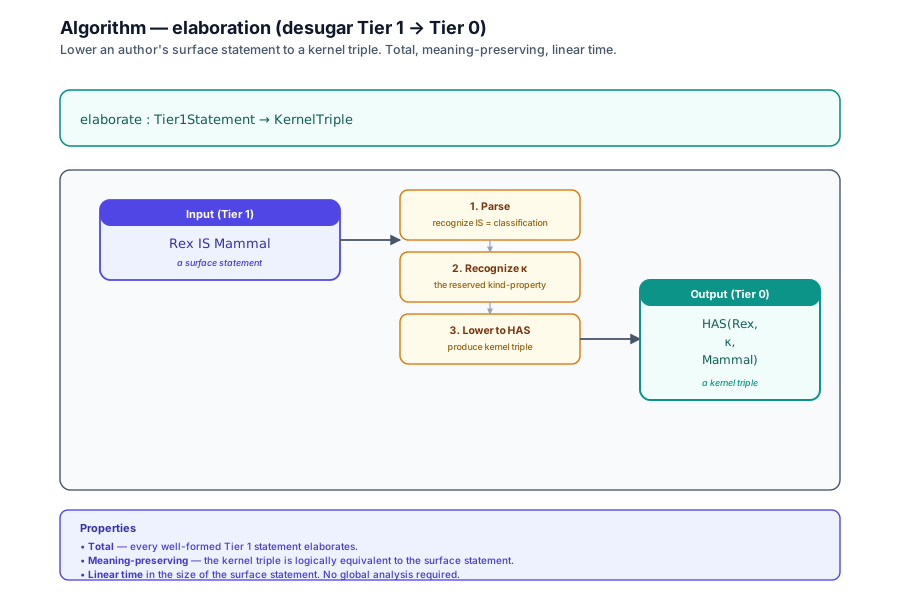
Input (Tier 1):
Rex IS MammalSteps:
- Parse, recognize
ISas the classification relation. - Recognize the reserved property
κ(kind). - Lower to a HAS-fact in the kernel.
Output (Tier 0):
HAS(Rex, κ, Mammal)Properties:
- Total, every well-formed Tier 1 statement elaborates.
- Meaning-preserving, the kernel triple is logically equivalent to the surface statement.
- Linear time in the size of the surface statement.
The desugaring rules are tabulated in Chapter 5 §5.8. Each rule is a local rewrite; no global analysis is required.
6.3 Resugaring, Tier 0 to Tier 1
Section titled “6.3 Resugaring, Tier 0 to Tier 1”The inverse projection for display. Takes a kernel triple and, if it matches a known desugaring pattern, projects it back to surface vocabulary.
resugar : KernelTriple ⇀ Tier1Statement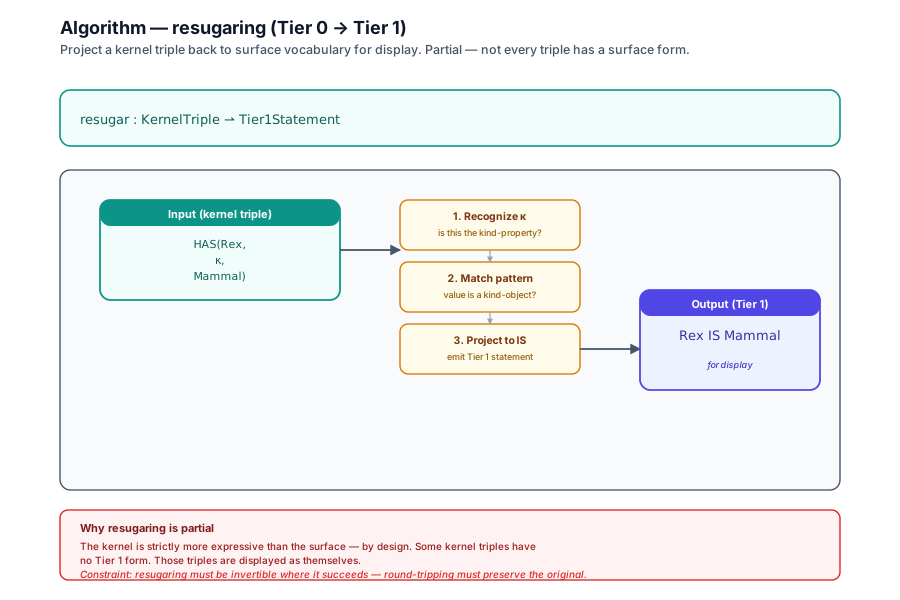
Input (kernel triple):
HAS(Rex, κ, Mammal)Steps:
- Recognize
κas the reserved kind-property. - Recognize the value
Mammalas a kind-object. - Project to the surface form.
Output (Tier 1, for display):
Rex IS MammalWhy this matters:
- Error messages should speak the user’s vocabulary. “identity morphism incompatible with composition unit” is a failure of the architecture; it should say “this object cannot bear that property.”
- Introspection (queries against the running model) should return Tier 1 statements, not raw kernel triples.
- Round-tripping (serialize → deserialize → display) requires the projection to be invertible.
Constraint: resugaring is partial, not every kernel triple has a surface form. The kernel is strictly more expressive than the surface (by design, the kernel is the trusted base; the surface is sugar). Triples with no surface form are displayed as themselves.
6.4 Reification, the ρ map
Section titled “6.4 Reification, the ρ map”The move that turns a transition (a rule) into an object (a thing that can bear facts).
ρ : T → O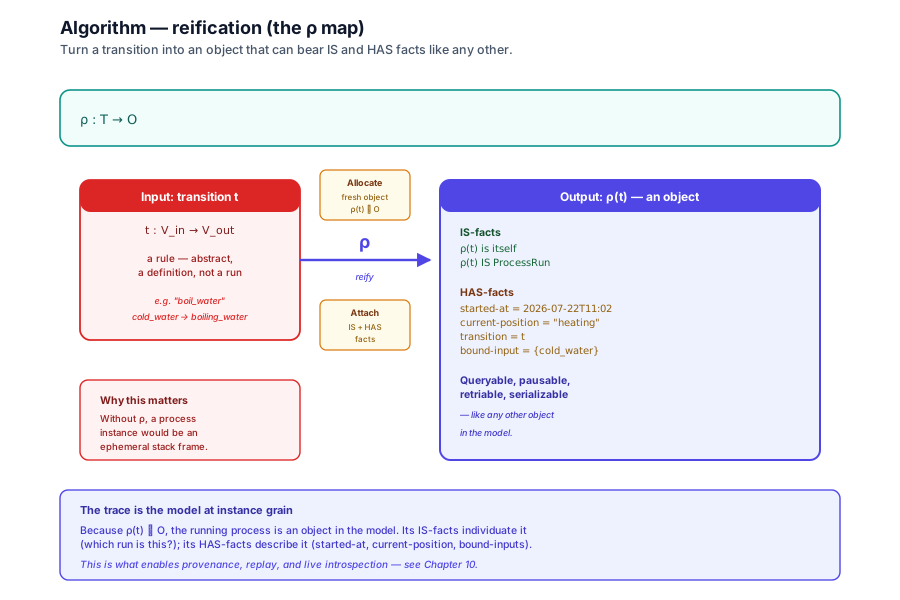
Input: a transition t with signature V_in → V_out.
Steps:
- Allocate a fresh object
ρ(t)inO. - Attach an IS-fact:
ρ(t)is itself (the identity claim). - Attach HAS-facts:
started-at = <timestamp>,current-position = <initial-node>,transition = t.
Output: an object ρ(t) that represents the transition t and
can be queried, paused, retried, serialized like any other object.
Why this matters: without reification, a “process instance” would be an ephemeral stack frame that only the runtime can observe. With reification, the running process is an object in the model, and the trace is the model at instance grain. This is what enables provenance, replay, and live introspection, see Chapter 10 §10.3.
6.5 Evaluation, the runtime protocol
Section titled “6.5 Evaluation, the runtime protocol”How a transition fires. Takes a transition and a bound input, produces a new state and an output.
eval : T × V_in → V_out × O-state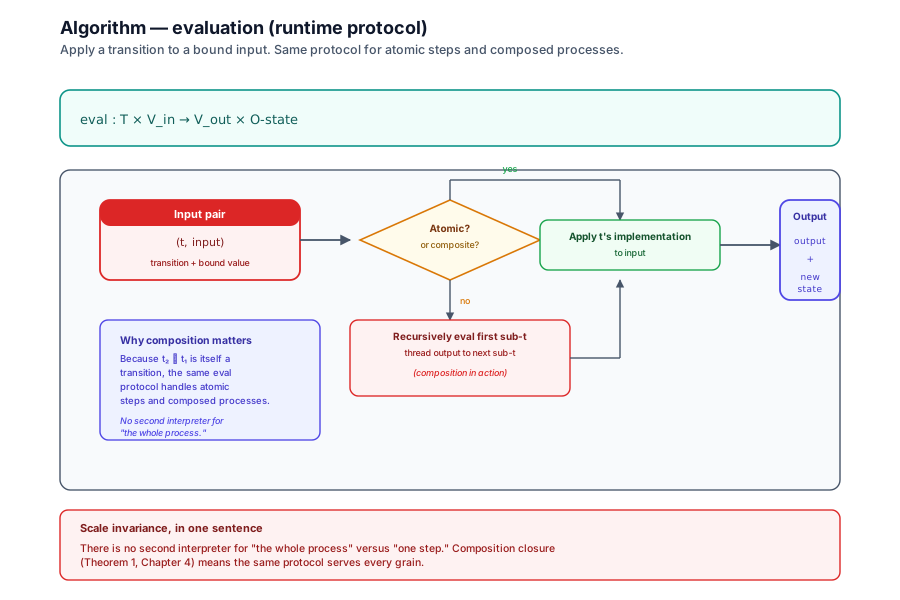
Input: (t, input) where t : V_in → V_out is a transition and
input ∈ V_in is a bound input value.
Steps:
- Validate the input against
t’s declared interface (V_in). - If
tis atomic, applyt’s implementation to the input. - If
tis composite, recursively evaluate the first sub-transition with the input, then thread the output into the next sub-transition (composition in action). - Bind the result to the output interface (
V_out). - Update the reified process’s
current-positionHAS-fact (if any).
Output: (output, new-state) where output ∈ V_out and
new-state reflects the new position in the composition.
Why composition matters here: because t₂ ∘ t₁ is itself a
transition, the same eval protocol handles both atomic steps and
composed processes. There is no second interpreter for “the whole
process” versus “one step.” This is the scale-invariance result
(Chapter 10 §10.4).
6.6 State-location, the σ function
Section titled “6.6 State-location, the σ function”Identifies where a particular execution currently stands in a composed process.
σ : Execution → (process, current-node, bound-inputs, bound-outputs)Often abbreviated:
σ(e) = (p, t_i, I_i, O_i)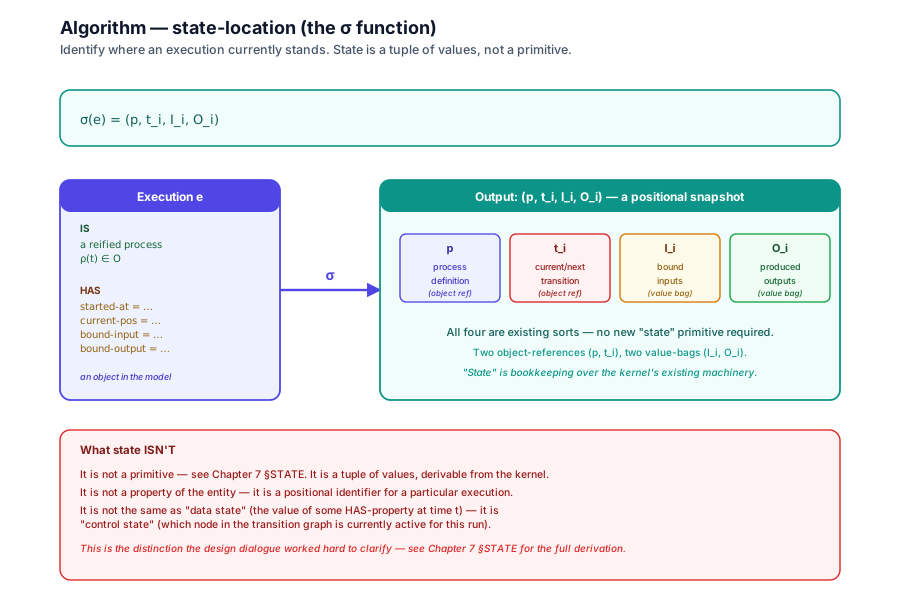
Input: an execution instance e (a reified process plus its
runtime context).
Steps:
- Read the process definition
pfrome’s IS-facts. - Read the
current-positionHAS-fact, this ist_i, the currently active (or next) transition. - Read the bound input values
I_ifor the current transition. - Read the bound output values
O_iproduced so far.
Output: (p, t_i, I_i, O_i), a full positional snapshot.
Why this matters: this is what “state” means in this system. It
is not a separate primitive; it is a tuple of values, two of which
are object-references (the process p and the current transition
t_i), and two of which are value-bags (I_i, O_i). The whole
“state” is bookkeeping over the kernel’s existing sorts, see
Chapter 7 §STATE for the full
derivation.
6.7 The contract these algorithms form
Section titled “6.7 The contract these algorithms form”The five algorithms form the operational contract between the surface language (Primmel, Volume I) and the kernel runtime (the platform annex). For the foundation’s claims to hold in practice:
-
Elaboration must be total and meaning-preserving. Every well-formed Tier 1 statement lowers; the lowering preserves semantics.
-
Resugaring must be invertible where it succeeds. Triples that came from a Tier 1 statement must round-trip back to that statement.
-
Reification must produce objects that bear IS and HAS like any other. No special-casing, a process instance is an object, subject to the same machinery.
-
Evaluation must respect composition. The same protocol handles atomic transitions and composed processes; no second interpreter for “the whole.”
-
State-location must be a tuple of values. No special “state” primitive, the location is
(p, t_i, I_i, O_i), all of which are existing sorts.
A conforming runtime implements these five algorithms correctly and nothing more. Everything else is definition rather than implementation. This is the small trusted base property, see Chapter 10 §10.6.
6.8 Where these algorithms live downstream
Section titled “6.8 Where these algorithms live downstream”- Elaboration is the Primmel compiler’s lowering pass (Volume I, chapter 11, validation).
- Resugaring is the platform’s query layer (platform annex).
- Reification is the process-instance factory (Volume I, chapter 4, processes).
- Evaluation is the runtime executor (platform annex).
- State-location is the live-twin introspection API (Volume I, chapter 14, live twins).
Each of these is one concrete implementation of an algorithm defined here. The definitions in this chapter are the contract; the implementations are downstream.
Next: Chapter 7, Derived Vocabulary Proofs: the six retired terms (STATE, STEP, CAN, RECEIVES, RELATES-TO, BECOMES) reconstructed as materialized views.