
Chapter 5, Kernel/Surface Architecture
Chapter 5, Kernel/Surface Architecture
Section titled “Chapter 5, Kernel/Surface Architecture”In this chapter: the deeper result that the eight primitives of Chapter 3 are not irreducible. They desugar to a Tier 0 kernel with only entities, transitions, and composition, a category in the mathematical sense. The eight primitives remain useful as a Tier 1 surface vocabulary that elaborates into the kernel. This two-tier architecture is the same one SysML v2 / KerML arrived at independently (see Chapter 8); the foundation is operational where KerML is declarative.
5.1 The two-tier architecture
Section titled “5.1 The two-tier architecture”Chapter 3 proved the eight-term system is closed, complete, and extensible. So why go deeper?
Because the eight terms are not equally fundamental. Three of them (OBJECT, VALUE, IS) are special shapes that the other five already produce on their own. Pushing the reductions through yields a kernel with one sort (entities) and one operation (composition of transitions) , a category. The eight-term surface then becomes syntactic sugar that elaborates into the kernel without residue.
This is the same move mathematics made when category theorists invented the arrows-only formulation: objects are not a separate sort, they are identity morphisms. The reduction is mathematically equivalent, strictly smaller in primitive count, and practically unused in daily work, because human reasoning wants to say “this is an object” and “this is a map” as different thoughts, even when the math doesn’t require the distinction.
The right architecture is therefore two-tier: a small kernel that proves closure, completeness, and extensibility once, and a richer surface that carries the distinctions human authors rely on. Elaboration is the formal seam between them.
5.2 Tier 0, the kernel
Section titled “5.2 Tier 0, the kernel”The kernel has one sort and one operation:
U — a universe of individuated entitiesτ : U ⇀ U — a (partial) transition relation∘ : τ × τ ⇀ τ — composition (when interfaces match)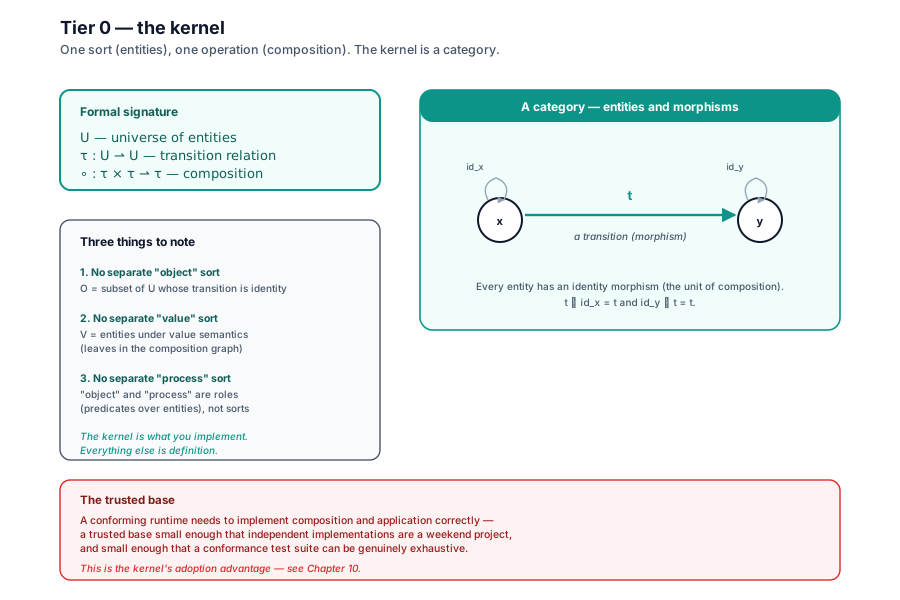
That is the whole kernel. Three things to note:
- No separate “object” sort. What Chapter 3 called
Ois just the subset ofUwhose transition is the identity (see §5.4). - No separate “value” sort. What Chapter 3 called
Vis just entities interpreted under value semantics, leaves in the composition graph (see §5.5). - No separate “process” sort. What Chapter 3 called
TandPROCESSare roles played by entities (“has a non-trivial transition” vs “has the identity transition”).
The kernel is a category: entities are objects, transitions are morphisms, composition is categorical composition, and identity morphisms exist for every entity by definition (see Chapter 9).
5.3 Tier 1, the surface (the eight primitives)
Section titled “5.3 Tier 1, the surface (the eight primitives)”The eight primitives of Chapter 3 are the surface vocabulary authors actually use:
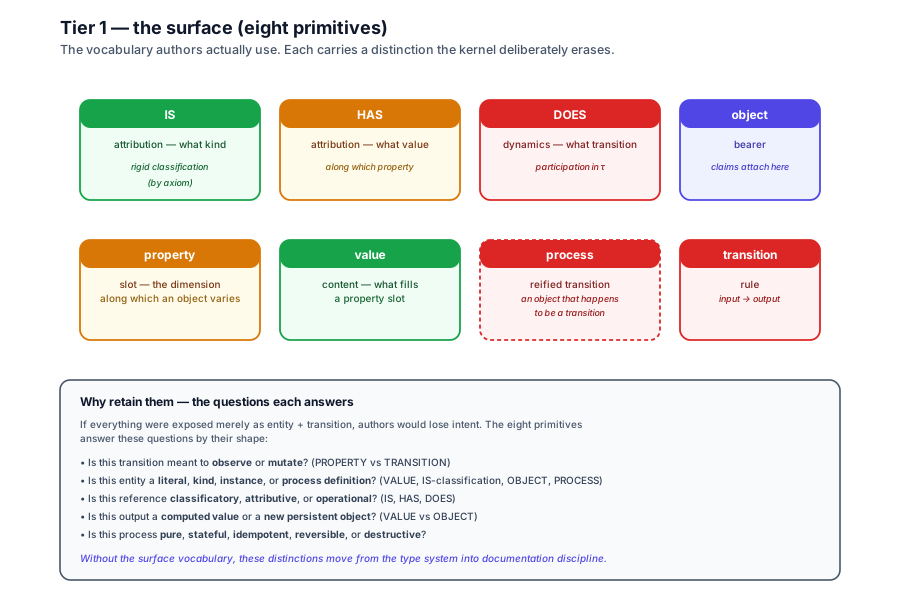
| Primitive | Surface role |
|---|---|
IS | attribution, what kind |
HAS | attribution, what value along which property |
DOES | dynamics, what transition |
object | bearer, the thing claims attach to |
property | slot, the dimension along which an object varies |
value | content, what fills a property slot |
process | reified transition, a transition treated as an object |
transition | rule, input → transform → output |
These are not redundant; each carries a distinction the kernel deliberately erases (identity vs. content equality, rigid vs. mutable classification, bearer vs. borne). Authors write in Tier 1; the compiler lowers to Tier 0.
5.4 Object as identity morphism
Section titled “5.4 Object as identity morphism”The first reduction. Chapter 3 treated OBJECT as a sort. The kernel identifies it with the identity morphism on the entity:
Object(x) ⟹ id_x : x → x (where id_x ∘ id_x = id_x)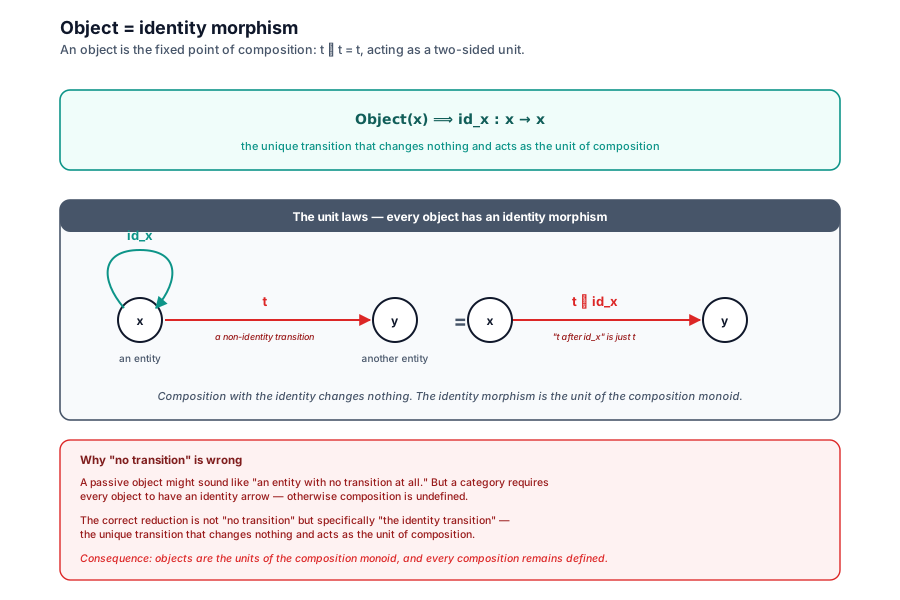
This is the standard arrows-only formulation of category theory. An
“object” is whatever morphism acts as a two-sided unit for
composition: t ∘ id = t and id ∘ t = t for every transition t
that touches it.
Why “no transition” is wrong. You might think a passive object is an entity with no transition at all. But a category requires every object to have an identity arrow, otherwise composition is undefined. The correct reduction is not “no transition” but specifically “the identity transition”, the unique transition that changes nothing and acts as the unit of composition.
What this buys. Objects no longer need a separate sort. They are the fixed points of composition. Every categorical theorem about identity morphisms applies.
5.5 Value as transition from terminal
Section titled “5.5 Value as transition from terminal”The second reduction. Chapter 3 treated VALUE as a sort V with an
embedding ι : O ↪ V. The kernel identifies a value with a transition
from the terminal object:
Value(a) ⟹ a : 1 → A (where 1 is the terminal object)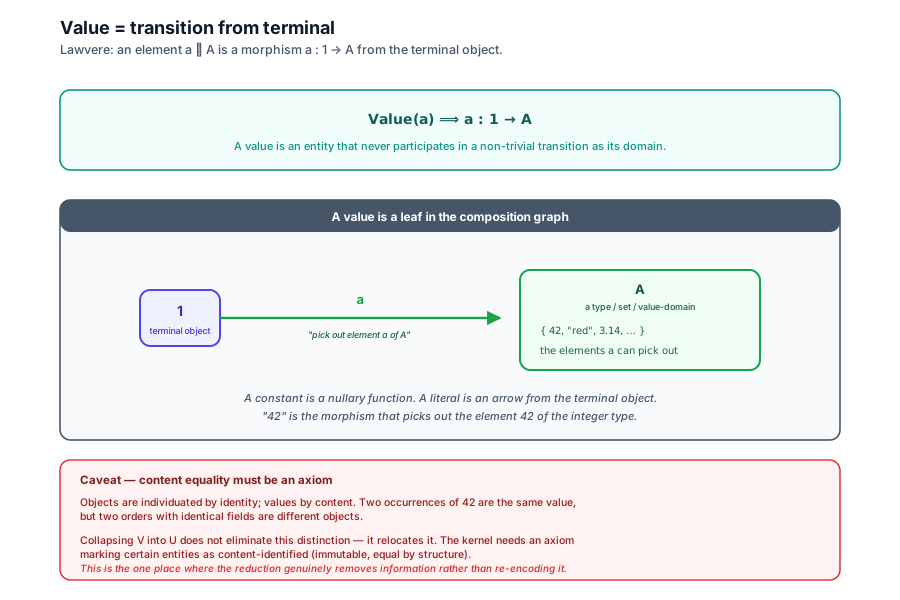
This is Lawvere’s treatment of elements as arrows from a terminal object, standard category theory.
A value is an entity that never participates in a non-trivial transition as its domain. It’s a leaf in the composition graph rather than a hub. Constants are nullary functions; literals are arrows from 1.
Caveat, content equality. Objects are individuated by identity;
values by content. Two occurrences of 42 are the same value, but two
orders with identical fields are different objects. Collapsing V
into O does not eliminate this distinction, it relocates it. The
kernel needs an axiom marking certain entities as content-identified
(immutable, equal by structure). This is the one place where the
reduction genuinely removes information rather than re-encoding it.
5.6 IS as classification property
Section titled “5.6 IS as classification property”The third reduction. Chapter 3 treated IS as a primitive relation
IS ⊆ O × O. The kernel replaces it with a distinguished property:
IS(x, k) ⟹ HAS(x, κ, k) (where κ is a reserved property)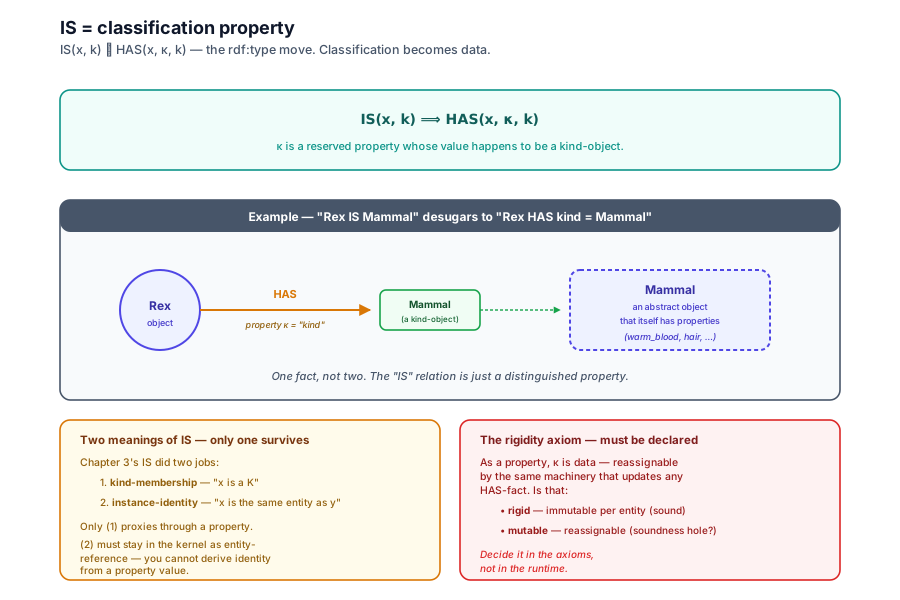
This is the RDF move: rdf:type is not structural machinery, it is
an ordinary predicate that happens to be distinguished by convention.
Classification becomes data.
Two meanings of IS, only one survives the reduction. Chapter 3’s IS did two jobs: identity (which entity is this?) and kind-membership (what kind?). Only the second proxies through a property. The first , individuation, must remain in the kernel as entity-reference. You cannot derive identity from a property value without presupposing the very identity you’re trying to derive.
The rigidity axiom. As a property, κ is data, reassignable by
the same machinery that updates any HAS-fact. That is either a feature
(dynamic reclassification, which OO handles badly) or a soundness hole
(a transition typed against kind k executing on something no longer
of kind k). The reduction forces you to declare whether κ is
rigid (immutable per entity) or mutable (reassignable). Decide
it in the axioms, not in the runtime.
5.7 PROPERTY as projection transition
Section titled “5.7 PROPERTY as projection transition”The fourth reduction (going one step further than Chapter 3 stated
explicitly). A property p can be read as an accessor transition:
p : O → V (the function that takes a bearer to its value)So car HAS color = red becomes color(car) = red, applying the
color transition to the car entity yields the red entity.
This creates a deep symmetry: reading a property is executing a transition. A stored property is a lookup transition; a computed property is an ordinary calculation. Both share the same interface.
But properties may need relational semantics, not every property is a total, single-valued function. The general form is:
p : U → P(U) (a transition into the powerset — multivalued)A functional property is the constrained special case |p(x)| ≤ 1 for
all x.
5.8 The desugaring map (full)
Section titled “5.8 The desugaring map (full)”Putting all four reductions together, each Tier 1 primitive has a definable Tier 0 equivalent:
| Tier 1 (surface) | Tier 0 (kernel) |
|---|---|
OBJECT(x) | id_x : x → x |
VALUE(a) | a : 1 → A (with content-identity axiom) |
IS(x, k) (kind-membership) | HAS(x, κ, k) |
IS(x, y) (instance identity) | kernel-level entity reference |
PROPERTY(p) | projection transition p : O → V |
HAS(x, p, v) | p(x) = v (a point in the graph of p) |
DOES(x, t) | t is a transition in the kernel; x participates |
TRANSITION(t) | t ∈ τ |
PROCESS(p) | ρ(t) ∈ U (already Rule 3, no change) |
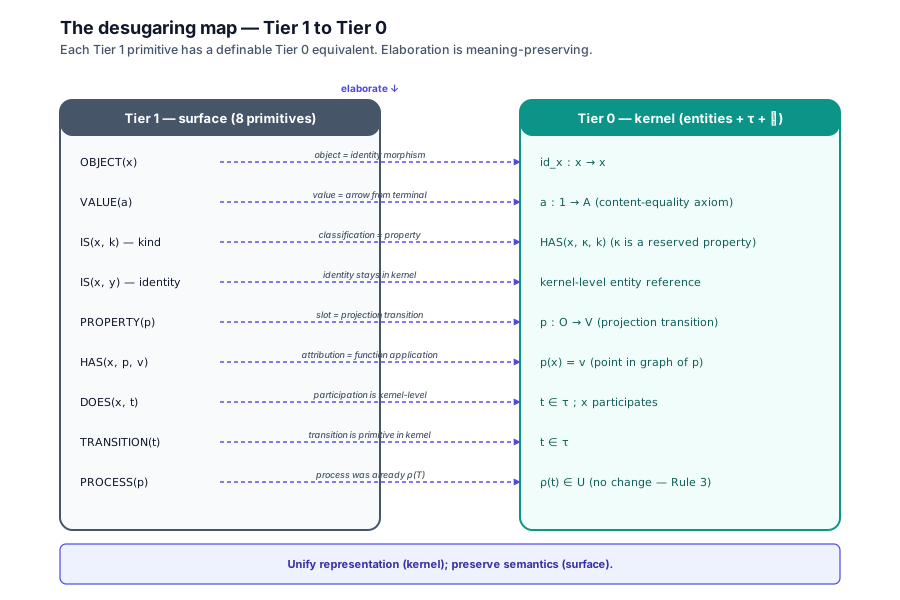
The kernel is strictly smaller (one sort, one operation) while the surface retains all eight primitives. The seam between them is elaboration (Tier 1 → Tier 0) and resugaring (Tier 0 → Tier 1). Chapter 6 treats both as first-class algorithms.
5.9 Three hidden costs (resolved explicitly)
Section titled “5.9 Three hidden costs (resolved explicitly)”The reduction is sound and well-precedented, but it forces three decisions the eight-term formulation left implicit. State them in the axioms, not in the runtime.
Value identity
Section titled “Value identity”Objects are individuated by identity; values by content. The kernel
needs an axiom marking certain entities as content-identified
(immutable, equal by structure). Without it, two 42s could be
different entities, which contradicts what “value” means.
Rigidity of kind
Section titled “Rigidity of kind”If κ (the classification property) is mutable, a running model could
reclassify itself mid-execution. Declare whether κ is rigid
(immutable per entity, sound but inflexible) or mutable (flexible
but a potential soundness hole). The eight-term formulation decided
this silently by making IS structural.
Circularity of the mutual embedding
Section titled “Circularity of the mutual embedding”Chapter 3 had two embeddings running in opposite directions:
ρ : T → O (reification) and ι : O ↪ V (embedding). With OBJECT
and VALUE collapsed into U, these embeddings dissolve, there is
one sort, and “object” and “process” are roles (predicates over
entities: “has identity transition only” vs “has non-trivial
transition”), not categories requiring maps between them. The ρ map
becomes trivial: it was only needed because the sorts were separate.
5.10 Why retain the eight primitives
Section titled “5.10 Why retain the eight primitives”Reduction at the kernel level does not imply reduction at the human level. If everything were exposed merely as an entity and a transition, authors would lose important intent:
- Is this transition meant to observe or mutate?
- Is this entity a literal, kind, instance, or process definition?
- Is this reference classificatory, attributive, or operational?
- Is this output a computed value or a new persistent object?
- Is this process pure, stateful, idempotent, reversible, or destructive?
The eight primitives answer these questions by their shape, saving authors from re-stating them in comments. They are derived but valuable abstractions, like variables and classes in a language that compiles to a tiny instruction set.
5.11 The right principle
Section titled “5.11 The right principle”Unify representation; preserve semantics.
Not: because two things can be represented alike, they mean the same thing.
The kernel unifies representation (one sort, one operation). The surface preserves semantics (eight primitives carrying distinctions authors rely on). Elaboration is meaning-preserving. The runtime executes only the kernel; the interchange format can be defined at either level (kernel for minimality, surface for readability, or both with elaboration as the bridge).
5.12 What this changes about Chapters 3 and 4
Section titled “5.12 What this changes about Chapters 3 and 4”The eight-term algebra 𝓜 (Chapter 3) and its three theorems (Chapter 4) are still valid, but they are now surface-level results. They hold because the kernel holds, and the kernel is simpler:
- Closure (Chapter 4 Theorem 1) holds because the kernel’s one
operation
∘is closed under composition by definition. - Completeness (Chapter 4 Theorem 2) holds relative to the Claim-Form Axiom, which is a surface-level statement about how humans describe entities.
- Extensibility (Chapter 4 Theorem 3) holds because the kernel is
schematic over its universe
U, adding entities changes nothing about the operations.
The kernel is the trusted base. A conforming runtime needs to implement composition and application correctly; everything else is definition rather than implementation.
Next: Chapter 6, Algorithms: elaboration, resugaring, reification, evaluation, and state-location as first-class content.