
Chapter 6, Data and values
Chapter 6, Data and values
Section titled “Chapter 6, Data and values”In this chapter: the value layer beneath every tier, where records live (registries) versus how values are shaped (data classes), the five ways a variable obtains its value, the QuantityValue contract that makes INV-1 enforceable, tables and dimension-keyed profiles, and the time primitives every lifecycle depends on.
The previous chapters modelled things: subjects, processes, mappings.
This chapter models what they carry, values: the 500 kg of e_max,
the 20 ± 2 °C of a reference condition, the 0.5 × p_LC of an MPE tier.
If values are untyped, un-homed, or baked into prose, everything built
on them, constraints, derivations, verdicts, inherits the rot. Every
value concept has one canonical definition point; every use references it.
6.1 Registries and data classes
Section titled “6.1 Registries and data classes”Primmel separates two data constructs that untyped modellers conflate:
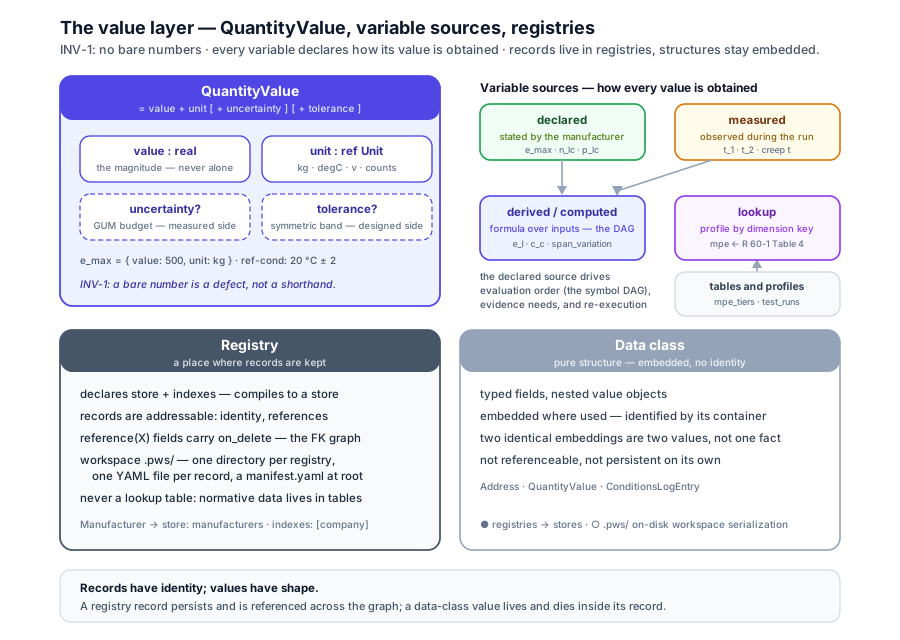
- A data class is a pure structure, a record shape with typed
fields, nested value objects, no independent existence. An
Address, aConditionsLogEntry, aQuantityValue: embedded where used, meaningless apart from their container. - A registry is a place where records are kept. It declares a record class, a store, and the indexes records are found by. A registry’s records are addressable: they have identity, other records reference them, and they persist across sessions.
The running system encodes this directly. The entity classes of
data/r60/entities/ declare their persistence inline:
- name: Manufacturer store: manufacturers indexes: [company]At build time each such class compiles to one IndexedDB store with the
declared indexes (browser/build/data-types-codegen.ts → the store
manifest). Classes may share a store behind a discriminator ,
IssuingAuthority and TestLaboratory extend Organization and live
together in the organizations store, indexed by kind. Records link
by typed references: a reference(X) field carries an on_delete
edge, the FK graph is declared on the class, not reconstructed.
The workspace is where registry records live on disk. A .pws/
directory (Primmel Workspace) holds one subdirectory per registry,
one YAML file per record, and a manifest.yaml pinning the model
version (○, the running system keeps records in IndexedDB; .pws/
is the v3 on-disk packaging). It is the third model kind of chapter 1:
it speaks for the evidence.
The discipline that falls out of the distinction:
- Identity lives in registries only. A data-class instance is identified by its containing record; two identical embeddings in two records are two values, not one shared fact.
- References target registries only.
reference(Manufacturer)resolves into themanufacturersstore; nothing references “an address somewhere inside some record”. - A registry is never a lookup table. Records are runtime facts; lookup data (MPE tiers, run counts) is model content and lives in tables (§6.5).
6.2 Measurement variables and their sources
Section titled “6.2 Measurement variables and their sources”Every quantity that flows through testing and evaluation is a declared variable, and every variable states how its value is obtained , its source. The taxonomy is closed; five values cover every case:
| Source | The value comes from… | R 60 example |
|---|---|---|
declared | a statement by the manufacturer or applicant, a rating, not an observation | e_max, n_lc, p_lc |
measured | direct observation by the test operator during a run | t_1, t_2 (test temperatures), creep-test t |
derived | a formula over other variables, evaluated bottom-up | e_l = (avg indication − reference) / conversion_factor_f |
computed | evaluated by the engine in the run’s calculation context | v_min = (e_max − e_min) / (n_lc × f); mpc = lookupMPE(d_max, accuracy_class, p_lc) |
lookup | a table or profile keyed by classification dimensions | mpe from the R 60-1 Table 4 tiers |
● The source taxonomy is live in both places variables are declared:
the symbol registry (data/r60/specification/symbols.yaml, four of
the five) and conformance-test variables (data/schemas/cc.yaml, all
five, with derivation: declared for derived/computed).
Source typing is not documentation; it drives the machinery:
- Evaluation order. Derived and computed variables form a
dependency DAG (chapter 7): the engine evaluates
conversion_factor_fbeforee_l; declared and measured values are the leaves. - Evidence requirements. A
measuredvariable demands a recorded observation; adeclaredone a subject-graph value (model.parameters.e_max,sample.test_context.d_max); alookupone its table and key dimensions. - Re-execution. Verdict re-evaluation (INV-5) replays derivations over stored leaves only, a source that cannot be replayed or re-read is a modelling error.
6.3 QuantityValue: the INV-1 contract
Section titled “6.3 QuantityValue: the INV-1 contract”INV-1: no bare numbers. Every physical quantity in a Primmel model
is a QuantityValue:
QuantityValue = value + unit [ + uncertainty ] [ + tolerance ]- value + unit are inseparable.
500 kgis a value;500is a defect. The attribute registry values parameters exclusively through QuantityValue maps,model.parameters.e_maxis{ value: 500, unit: kg }, never a raw number. - tolerance marks the symmetric band of a specified value, the
designed side of the duality: the reference-condition entry
{ value: 20, unit: degC, tolerance: 2 }ofdata/r60/model/conditions.yaml. Tolerance belongs to conditions and ratings, not to measurement results. - uncertainty marks the dispersion of a measured value (§6.4) , the observed side. The two never merge: a tolerance states what the design promises, an uncertainty what the measurement supports.
The unit register (● data/r60/value-types.yaml) is layered:
SI base (kg, m, s, K, A), SI derived (N = kg⋅m/s²),
non-SI accepted (degC, min, g, t, kPa, %RH), and domain
units, R 60’s v (verification interval), counts,
dimensionless. A rec package extends the register by adding
domain units; it never redefines SI entries.
Above units sit quantity kinds (●
data/schemas/quantity-kinds.yaml): the closed registry mapping every
unit to its kind, mass (kg, g, t), verification_interval (v),
temperature (degC), dimensionless, ratio (%), and committed
domain kinds (voltage-ratio for mV/V, volume-fraction for ppm).
The kind, not the unit string, is what coherence checking compares:
quantity-coherence rejects a verification_interval observable
against a mass limit outright (the R 60 “F2” defect class), while a
dimensionless literal adopts the other side’s kind. Units tell you how
to print; kinds tell you what may be compared.
6.4 Measurement uncertainty and traceability
Section titled “6.4 Measurement uncertainty and traceability”A measured QuantityValue may carry a MeasurementUncertainty budget,
GUM-shaped: Type A components (statistical analysis of repeated
observations), Type B components (other means, certificates,
specifications), combined into a standard uncertainty with its
coverage factor (◐, the form layer declares uncertainty budgets on
equipment and measurement fields, e.g. the weights form at k = 2).
Uncertainty is data, not prose, because it participates in validity:
- Reference-equipment budgets are ceilings a run must respect.
R 91-2 (4.5, 5.2) caps the reference speedometer’s expanded
uncertainty at 0.6 km/h below 100 km/h and 0.6 % above, piecewise
tiers with exactly the MPE-tier shape, encoded as tier-mode profiles
(
{ min, max?, factor, mode: absolute|relative }) and evaluated through the same lookup machinery (engine-context.tsuncertaintyBudgetAt). ● - Certified reference materials (R 144’s certified gas mixtures)
carry certified value + uncertainty; constraints bound to the
evidence (
U:MPE ≤ 1:3) are machine-checked before the limit, and a violation invalidates the run. ● (specification/reference-materials.yaml)
Uncertainty links every measured value to its traceability chain: the unbroken sequence of calibrations from the working instrument up to a reference standard, the weights’ OIML R 111 class, the CGM’s certificate. The chain is modelled as records, each carrying its validity window (§6.6), so “traceable” is a queryable graph property (◐, equipment and calibration records are modelled; the chain as a first-class vocabulary class lands with the core measurement module, Volume II).
6.5 Tables and profiles
Section titled “6.5 Tables and profiles”Normative lookup data, R 60-1 Table 4’s MPE tiers, the per-class run
counts, the IEC 61000-4 EMC severities, is modelled as data, never
baked into OCL. Two complementary shapes live in
data/r60/specification/tables.yaml:
- A table is a class schema plus rows: typed, named columns with
units, and row data.
mpe_tiersdeclares columnsaccuracy_class | load_min (v) | load_max (v) | limit_factorand twelve rows;test_runsfour. A table answers “the row where …”. - A profile is a dimension-keyed binding:
profiles.mpe_tiershasdimension: accuracy_class,unit: v, and abinding:mapping each dimension value to its tier list,C: [{min: 0, max: 500, factor: 0.5}, …, {min: 2000, factor: 1.5}]. A profile answers “for this classification, the bound value is …”.
Lookup semantics are defined, not conventional: the first tier with
min ≤ load < max wins (missing max unbounded), and the MPE value
is factor × p_lc. The same mechanism instantiates per-class
repetition, R 60’s test_runs profile is why class A/B cells get 5
load applications and C/D 3.
The anchoring rule applies to numbers inside expressions (§1.4):
typing 0.5 * p_lc into a requirement limit is the tell, the 0.5 is
a table cell, and the requirement must reference the lookup
(lookupMPE(load, accuracy_class, p_lc)), so a corrected row
re-judges every dependent verdict without an expression edit.
Chapter 7 returns to the lookup functions.
6.6 Time primitives
Section titled “6.6 Time primitives”Time is Foundations-layer content: nothing in the subject anchors it,
everything references it. Three primitive value types (●
value-types.yaml: date, datetime, duration) plus the
structures built on them:
- Periods, an interval with start and end; the process vocabulary’s timer events (chapter 4) fire on durations and deadlines (◐, recurrence for re-verification cycles is planned).
- Validity windows, the period for which a record holds: certificates, calibration records, accreditations. “Currently valid” is a computed predicate, not a status flag that drifts (◐).
- Edition pinning, every definition executed in a run is version-pinned in the test report (● INV-8), so a later edition re-judges history explicitly instead of silently. Chapter 8 treats editions as lifecycle; chapter 13 the diff machinery.
- Served values and freshness windows, a live twin serves its HAS
values with timestamps: a value without a time is not evidence, and
every
servebinding declares itsfresh_withinwindow, how old a value may be before it stops meaning anything. Past the window the value is stale, and stale degrades the verdict toindeterminate, never a silent pass (○, the monitor’s freshness step, chapter 14, §14.5).
6.7 Grammar sketch (illustrative v3 syntax)
Section titled “6.7 Grammar sketch (illustrative v3 syntax)”# ── a registry: a place where records are kept ──────────────registry Manufacturer { store manufacturers indexes [company] fields { id : string shall company : string shall address : reference(Address) shall on_delete restrict created : datetime shall }}
# ── a data class: pure structure, embedded ──────────────────data_class QuantityValue { value : real unit : ref Unit uncertainty : MeasurementUncertainty? # GUM budget, measured side tolerance : real? # symmetric band, specified side}
# ── measurement variables with source typing ────────────────variable e_l { notation "E_L" unit v kind observable source derived derive { inputs [conversion_factor_f] ocl{ (avg_indication - reference_indication) / conversion_factor_f } }}variable mpe { notation "MPE" unit v source lookup calculation mpe }
# ── a table and its dimension-keyed profile ─────────────────table mpe_tiers { columns { accuracy_class : string load_min : number unit v load_max : number unit v limit_factor : number } rows [ ["C", 0, 500, 0.5], ["C", 500, 2000, 1.0], ["C", 2000, null, 1.5] ]}profile mpe_tiers { dimension accuracy_class unit v binding { C: tiers(mpe_tiers, "C") }}6.8 Validation rules
Section titled “6.8 Validation rules”- every stored class declares its
store; shared stores declare the discriminator;reference(X)targets a registered class (●); - every QuantityValue carries
value+unit; the unit resolves in the unit register, a bare number is an INV-1 error, not a coercion; - every unit maps to exactly one quantity kind; comparisons are
kind-coherent (
quantity-coherence, ●); unmapped units are warnings; extending the kind registry is a metamodel decision; - a
derived/computedvariable declares its derivation; alookupvariable declares its table and key dimensions (◐, links resolved); - profile bindings key only on declared dimension values; a binding
key outside its
dimension’s values is an error (●); - time values match their ISO 8601 patterns; a validity window’s end is not before its start.
6.9 Summary
Section titled “6.9 Summary”- A registry is a place where records are kept (store + indexes,
referenceable); a data class is pure structure, identified by its
container. The workspace
.pws/is registries on disk. - Every variable declares its source, declared, measured, derived, computed, lookup, and the source drives evaluation order, evidence requirements, and re-execution.
- INV-1: no bare numbers. QuantityValue = value + unit, plus tolerance on the designed side and GUM uncertainty on the measured side.
- Normative numbers live in tables and dimension-keyed profiles; expressions reference lookups, never restate constants.
- Time is first-class: date/datetime/duration, periods, validity windows, and edition pinning (INV-8).
Next: Chapter 7, Expressions: OCL as the one rule language, stereotypes, binding, and the table functions.