
Chapter 7, Derived Vocabulary Proofs
Chapter 7, Derived Vocabulary Proofs
Section titled “Chapter 7, Derived Vocabulary Proofs”In this chapter: the dialectical record. Six candidate primitives were proposed during the system’s design, STATE, STEP, CAN, RECEIVES, RELATES-TO, BECOMES. Each was examined, reduced to a composite of the eight primitives of Chapter 3, and retired. This chapter is the formal reconstruction of those reductions, the empirical backing for Chapter 4 §4.3 Theorem 2’s completeness proof.
Each section follows the same structure: (1) the proposal as originally stated, (2) the counterexample or reduction, (3) the materialized-view reconstruction as a composite, (4) the argument that retires the candidate.
7.1 The pattern
Section titled “7.1 The pattern”Every candidate primitive turned out to be the same finding, restated in a new location: it was a materialized view of the primitives, kept around for convenience but owing nothing ontologically.
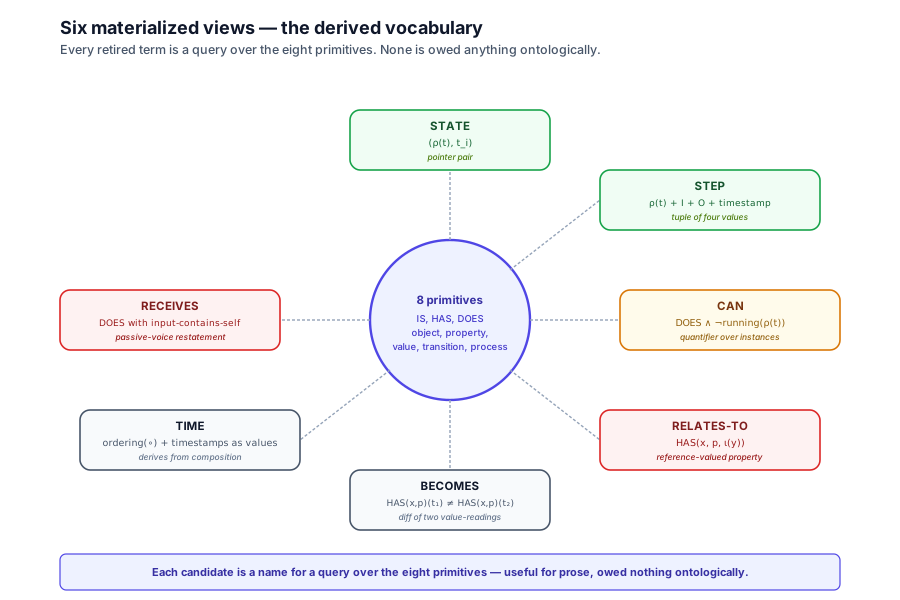
The pattern: someone proposes a new bucket. We test it by asking “could this be restated using only the eight primitives?” If yes, the new bucket is sugar, not a primitive. So far, every candidate has been sugar. The empirical record is the strongest argument for the system’s completeness (Gödel-style: we cannot prove completeness from inside, but we can show every attack so far has failed).
7.2 STATE, a positional identifier, not a property
Section titled “7.2 STATE, a positional identifier, not a property”The proposal
Section titled “The proposal”“What about STATE? A kettle is currently boiling. Surely that’s a different kind of fact from a slow-changing property like mass.”
The reduction
Section titled “The reduction”The word “state” was doing two different jobs, conflated:
-
Data state, the current value of a property (temperature = 100°C). This is just
HAS(x)(temperature) = 100, a value-reading at a moment. No new primitive needed. -
Control state, which node in the transition graph is currently active for a particular run (e.g. “paused before step 4”). This is a pointer into the process’s structure, not a property of the entity.
Only the second reading was the live contender. And even it reduces:
The materialized view
Section titled “The materialized view”STATE(e) = (instance-identity, current-node-address) = (ρ(t), t_i)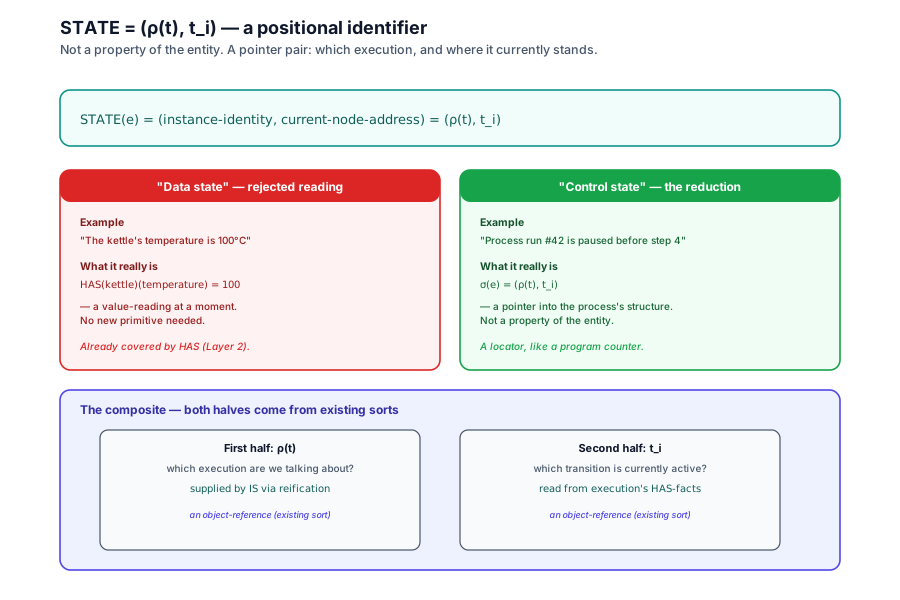
A state is a pair of values: the instance-identity (which execution
are we talking about, supplied by IS via reification ρ(t)) and the
current-node-address (which transition is currently active, supplied
by reading the execution’s HAS-facts). Both are existing sorts. STATE
adds no new content of its own.
Why this is bookkeeping, not ontology. A state is a positional identifier for an execution, like a program counter. It tells you where to resume. It does not describe the entity, it locates a run within a graph of transitions.
The argument that retires it. “State is therefore not an independent substance or behavior. It is a secondary execution locator.” The phrasing “secondary” is precise, STATE exists because we surface it for querying, not because it carries new content.
7.3 STEP, a single firing of a transition
Section titled “7.3 STEP, a single firing of a transition”The proposal
Section titled “The proposal”“A transition is a rule. But each individual firing of that rule , with specific inputs and outputs, at a specific time, is a step. Don’t we need a STEP primitive?”
The reduction
Section titled “The reduction”A step is exactly a transition materialized as one countable, addressable instance. Same shape as STATE, both are “internal to DOES, surfaced for addressability.”
The materialized view
Section titled “The materialized view”STEP = ρ(t) + bound-input + bound-output + timestamp = (process-instance, I_i, O_i, t)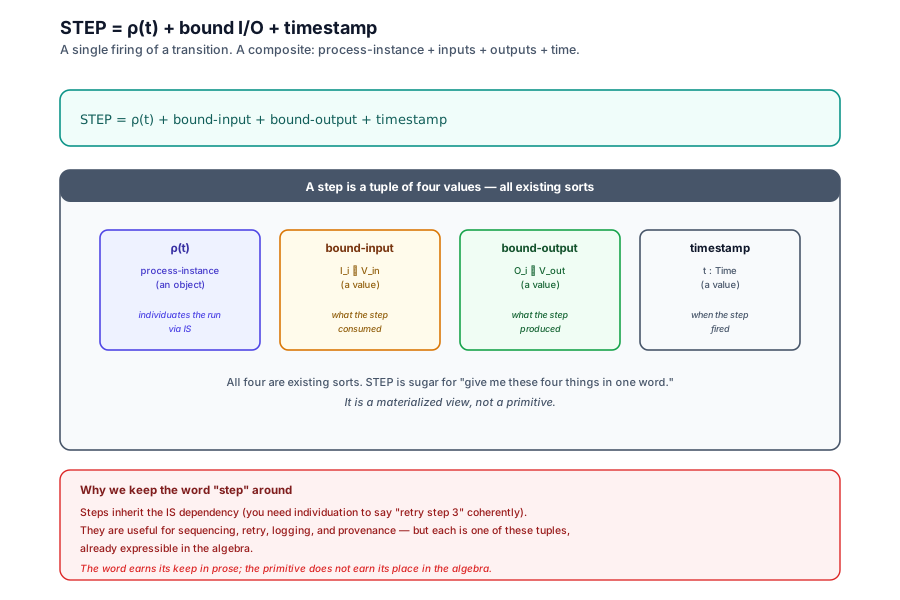
A step is a composite: a reified transition (an object), plus the input value it consumed, plus the output value it produced, plus the time it fired. All four are existing sorts. STEP is sugar for “give me a tuple of these four things in one word.”
Why this matters operationally. “Retry step 3” requires individuating step 3 across attempts, which is the same individuation problem objects have, solved by IS. Steps inherit the IS dependency; they don’t introduce a new sort.
The argument that retires it. “STEP is to DOES what STATE was to DOES, an internal unit promoted to an addressable field, for engineering convenience, not ontological necessity.”
7.4 CAN, a transition defined but not instantiated
Section titled “7.4 CAN, a transition defined but not instantiated”The proposal
Section titled “The proposal”“A bird can fly, whether or not it is currently flying. That sounds like a distinct category from DOES.”
The reduction
Section titled “The reduction”CAN is a modal operator on DOES: it strips the actualization commitment. “Can fly” is “flies” minus the tense. Same verb, no particular firing.
The materialized view
Section titled “The materialized view”CAN(x, t) ≡ DOES(x, t) ∧ ¬running(ρ(t)) (i.e., transition t is defined for x, but no instance of ρ(t) is currently executing)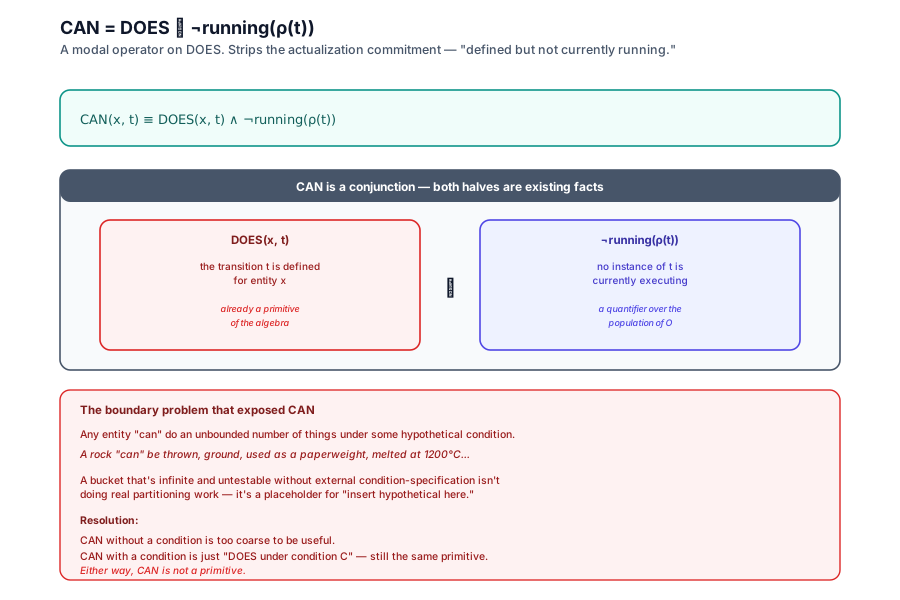
CAN is not a new primitive, it’s a quantifier over reifications of
t. The transition is in the model (DOES(x, t)); no instance of
it is currently running (¬running(ρ(t))). That’s a fact about the
population of O, not a new sort.
The boundary problem that exposed it. “Any entity ‘can’ do an unbounded number of things under some hypothetical condition (a rock ‘can’ be thrown, ground, used as a paperweight, melted at 1200°C…). A bucket that’s infinite and untestable without external condition-specification isn’t doing real partitioning work.”
CAN without a condition is too coarse to be useful; CAN with a condition is just “DOES under condition C”, still the same primitive.
7.5 RECEIVES, DOES from the other end
Section titled “7.5 RECEIVES, DOES from the other end”The proposal
Section titled “The proposal”“The door is pushed by the wind. That’s RECEIVES, passive reception of an action. Different from DOES, surely?”
The reduction
Section titled “The reduction”RECEIVES is DOES with the grammatical voice flipped. “X pushes Y” and “Y receives a push from X” describe the identical event, only the subject/object assignment changed.
The materialized view
Section titled “The materialized view”RECEIVES(y, x, t) ≡ DOES(x, t) ∧ input(t) includes y (i.e., x does t, and y is in the input of t)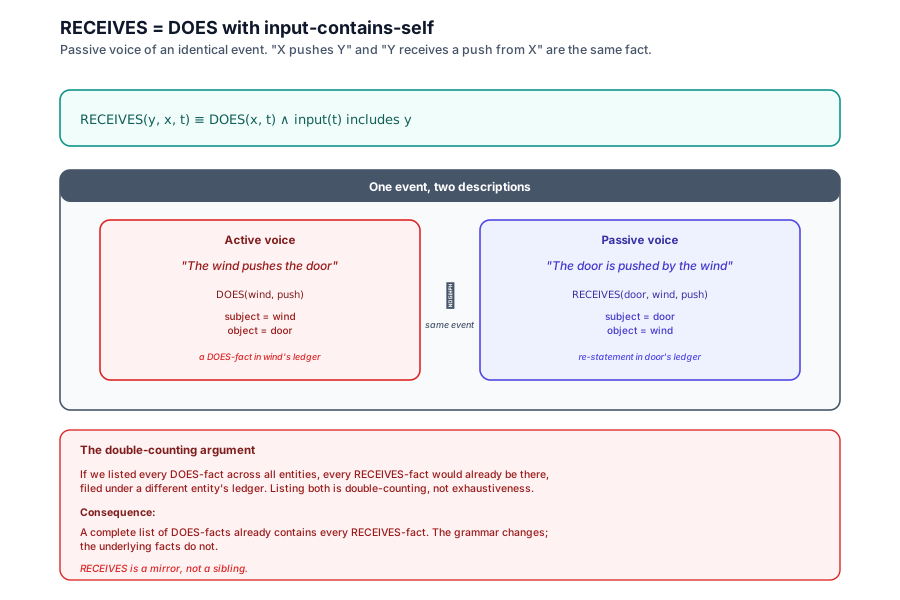
RECEIVES adds no new content, it’s a re-statement of an existing DOES-fact from a different viewpoint. If we listed every DOES-fact across all entities, every RECEIVES-fact would already be there, filed under a different entity’s ledger. Listing both is double-counting, not exhaustiveness.
The double-counting argument that retires it. “If RECEIVES statements are just DOES statements with the subject and object swapped, then RECEIVES doesn’t add new content to a MECE tree, it’s a mirror, not a sibling.”
7.6 RELATES-TO, HAS with an object-valued value
Section titled “7.6 RELATES-TO, HAS with an object-valued value”The proposal
Section titled “The proposal”“Things stand in relations to other things. Alice is part of the team. The door is adjacent to the wall. That’s a different kind of fact from HAS.”
The reduction
Section titled “The reduction”RELATES-TO is HAS where the value happens to be a reference to
another object. Closure Rule 2 (§3.8) already permits this, ι : O ↪ V.
The materialized view
Section titled “The materialized view”RELATES-TO(x, y) ≡ HAS(x, p, ι(y)) for some property p (i.e., x has a property whose value refers to y)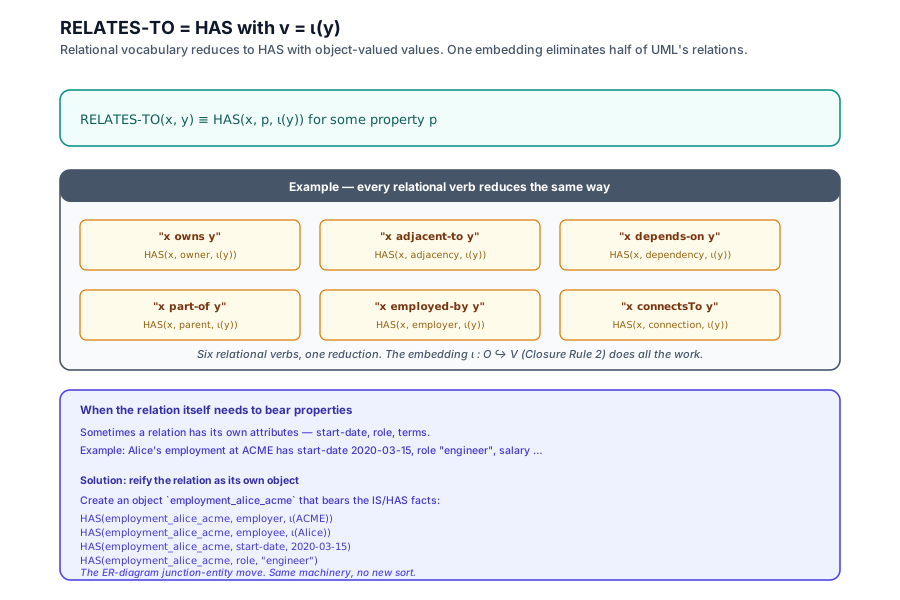
Specific instances:
- “owns” →
HAS(x, owner, ι(y)) - “adjacent to” →
HAS(x, adjacency, ι(y)) - “depends on” →
HAS(x, dependency, ι(y)) - “part of” →
HAS(x, parent, ι(y)) - “employed by” →
HAS(x, employer, ι(y))
All relational vocabulary reduces to HAS with an object-valued value.
One embedding (O ↪ V) eliminates half the relational vocabulary of
UML.
When relations need their own facts. If the relation itself needs to bear properties (start-date, role, terms), reify it as its own object, the ER-diagram junction-entity move. Same machinery, no new sort.
The argument that retires it. “RELATES-TO just generalizes the relation’s direction and kind (adjacency, dependency, membership) , a difference of degree, not of logical kind.”
7.7 BECOMES, a diff across two value-readings
Section titled “7.7 BECOMES, a diff across two value-readings”The proposal
Section titled “The proposal”“Things change over time. A caterpillar becomes a butterfly. The door becomes closed. That’s BECOMES, the temporal delta.”
The reduction
Section titled “The reduction”BECOMES is not a fact about an entity at all. It is a comparison across two facts: the entity’s state at time t₁ and its state at time t₂. You get it free the instant you have timestamped value-readings and a subtraction operation.
The materialized view
Section titled “The materialized view”BECOMES(x, p, t₁, t₂) ≡ HAS(x, p)(t₁) ≠ HAS(x, p)(t₂) (i.e., the value of x's property p differs between two timestamps)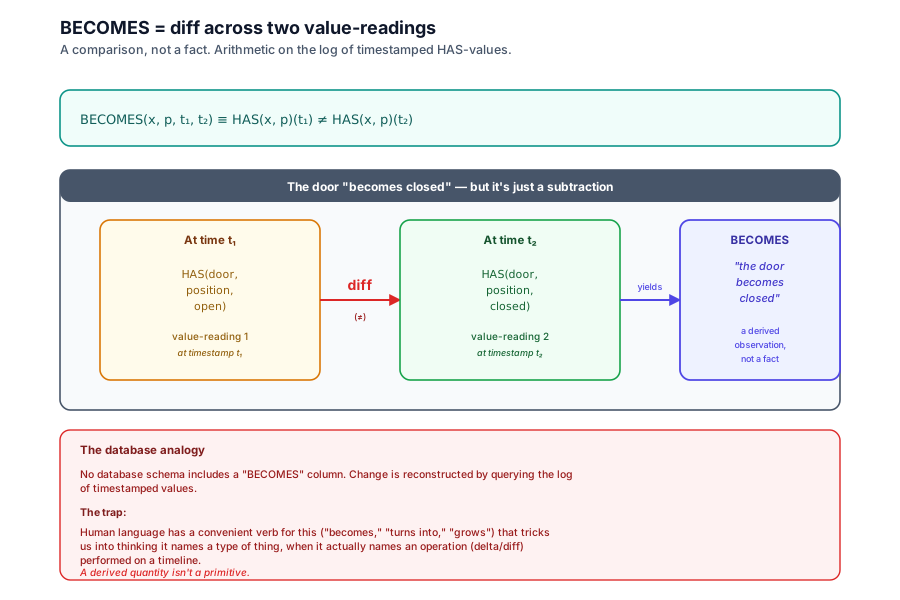
The database analogy. No database schema includes a “BECOMES” column. Change is reconstructed by querying the log of timestamped values. The fact that human language has a convenient verb for this (“becomes,” “turns into,” “grows”) tricks us into thinking it names a type of thing, when it actually names an operation (delta/diff) performed on a timeline.
The “becomes-different-kind” objection. What about a caterpillar becoming a butterfly, where the entity’s very classification shifts? Two cases:
- Identity persists (it’s one organism whose life-stage changes): “life stage” is a HAS-property with STATE. Not BECOMES.
- Identity changes (the old IS-claim expires, a new one holds): this is a DOES-event whose effect is the IS-claim replacement. Still no BECOMES primitive.
Either way, BECOMES is not needed.
The argument that retires it. “There is no third fact hiding between the two snapshots that needs its own category. Calling BECOMES ‘the delta operator on STATE’ is an admission of this: a derived quantity isn’t a primitive.”
7.8 TIME, ordering from composition
Section titled “7.8 TIME, ordering from composition”The bonus reduction. TIME was not one of the original candidates
Section titled “The bonus reduction. TIME was not one of the original candidates”but it falls out for free once BECOMES is killed.
TIME = ordering imposed by transition composition + timestamps as values attached via HAS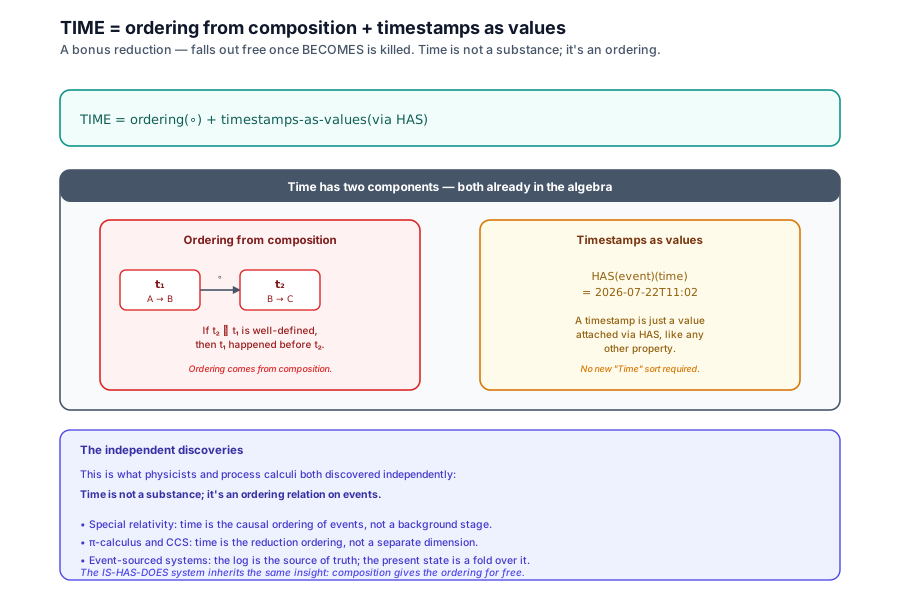
Time is not a separate sort. If t₂ ∘ t₁ is the composite of two
transitions, then t₁ happened before t₂, the ordering comes from
composition. Timestamps are just values attached via HAS, like any
other property.
This is what physicists and process calculi both discovered independently: time is not a substance, it’s an ordering relation on events.
7.9 The general pattern
Section titled “7.9 The general pattern”Looking across all six reductions:
| Candidate | What it tried to be | What it actually is |
|---|---|---|
| STATE | a fourth primitive | (ρ(t), t_i), a pointer pair |
| STEP | a fifth primitive | ρ(t) + I_i + O_i + timestamp, a tuple |
| CAN | a modal primitive | DOES with ¬running(ρ(t)), a quantifier |
| RECEIVES | a passive primitive | DOES with input-contains-self, a voice flip |
| RELATES-TO | a relational primitive | HAS with v = ι(y), an object-valued value |
| BECOMES | a temporal primitive | HAS(x, p)(t₁) ≠ HAS(x, p)(t₂), a diff |
| TIME | a temporal substrate | ordering from composition + timestamps as values |
Every candidate is a materialized view, a name for a query over the eight primitives. Each is useful for prose; none is owed anything ontologically.
7.10 What this means for the algebra
Section titled “7.10 What this means for the algebra”The eight-term algebra of Chapter 3 is empirically complete in a sense stronger than its proof of Theorem 2: across the entire design dialogue, every proposed ninth primitive was reduced. The dialogue did not select for “easy” candidates, the hardest ones (STATE, BECOMES) got the most attention and still collapsed.
This is the empirical evidence for Chapter 2 §2.2’s Claim-Form Axiom. We cannot prove the axiom, but we can exhibit the record of every attempt to violate it.
The next attack surface, if any, is the discovery of a genuine fourth claim-form: an atomic descriptive claim that is neither identity, nor attribution, nor transformation, and cannot be reduced to any of them. So far, no such claim has been found.
Next: Chapter 8, Comparative Analysis (Phase 3): how the system compares to OPM, OOP, UML, BPMN, EXPRESS, RDF/OWL, Petri nets, and SysML v2 / KerML.