
Chapter 10, Multilinguality
Chapter 10, Multilinguality
Section titled “Chapter 10, Multilinguality”In this chapter: why Primmel tags human-readable content with ISO 24229 spelling codes rather than BCP 47 language tags, what a spelling code is made of, and the machinery as shipped, the kernel
textconstruct and rule C89, the vendored register snapshot and linker rule R43, the English-first migration of every tree, per-string rendering selection, and the translation workflow, closed by the acceptance proof that nothing the reader sees has changed.
10.1 The problem: a language tag is not a writing system
Section titled “10.1 The problem: a language tag is not a writing system”Standards are multilingual artifacts. OIML publishes in English and
French; members translate; manufacturers romanize names; certificates
travel across scripts. The industry’s default answer, a BCP 47 tag like
zh-Hans or sr-Latn, classifies the string: this is Chinese,
simplified script. It cannot say the thing a standards pipeline
actually needs: which system produced this written form, and which
rules reproduce it. “Romanized” is not a system; Wade-Giles and Pinyin
both are, and they disagree.
Primmel adopts ISO 24229 instead. BCP 47 is explicitly a non-goal (chapter 1’s rejected patterns); the concepts document states it flatly: all human-readable strings are spelling-coded per ISO 24229, and BCP 47 is not used.
10.2 ISO 24229 in five minutes
Section titled “10.2 ISO 24229 in five minutes”Three standards answer three orthogonal questions:
| Standard | Question | Examples |
|---|---|---|
| ISO 639 | what language? | eng, fra, zho, ara |
| ISO 15924 | what script? | Latn, Cyrl, Hani, Arab |
| ISO 24229 | which conversion system? | un:ara-Arab:Latn:2017, iso:cyrl:latn:9-1995 |
A spelling system is the combination of the first two, a language
in a script: ara-Arab, bel-Cyrl, fra-Latn. It may carry an
optional country code (uzb-Arab-AF, Uzbek in Arabic script as used in
Afghanistan) and an optional extension (ind-Latn-pre1972, the
pre-1972 orthography). The script element is mandatory: a bare
ara is not a spelling system, because Arabic is written in more than
one script.
A conversion system code names a registered system that converts one spelling into another, in four colon-separated segments:
bgnpcgn : zho-Hani : Latn : 1979 titular source target identifying(authority) (spelling) (spelling) (version/year)The titular segment names the managing authority (un, icao,
alalc, din, iso; var when none is identifiable; a zz- prefix
for user-assigned codes). The register is authoritative, maintained
under ISO 19135 procedures: entries have a lifecycle (proposed, stable,
deprecated, withdrawn), and an assigned code is reserved forever, never
reused. Two comparison rules matter to every author, because the linker
enforces them (§10.5): codes compare case-insensitively
(iso:cyrl:latn:9-1995 ≡ ISO:Cyrl:Latn:9-1995) but
punctuation-exactly, the register-normal form strips the titular’s
punctuation, so bgnpcgn:zho-Hani:Latn:1979 resolves and the
display-form BGN-PCGN:… does not.
The property Primmel buys: a code is resolvable to concrete rules.
iso:cyrl:latn:9-1995 does not describe the output, it names the
system whose published rules produce the output, for any Cyrillic text,
auditably.
10.3 Every human-readable string is a content set (●, shipped, task 25)
Section titled “10.3 Every human-readable string is a content set (, shipped, task 25)”The rule of the chapter, shipped: every human-readable string in a
model is spelling-coded. That means names, definitions, statements,
notes, and certificate text, everything a human reads, never OCL,
never identifiers, never snake_case attribute ids (those are machine
keys, chapter 11’s naming discipline, and stay single-spelling by
design).
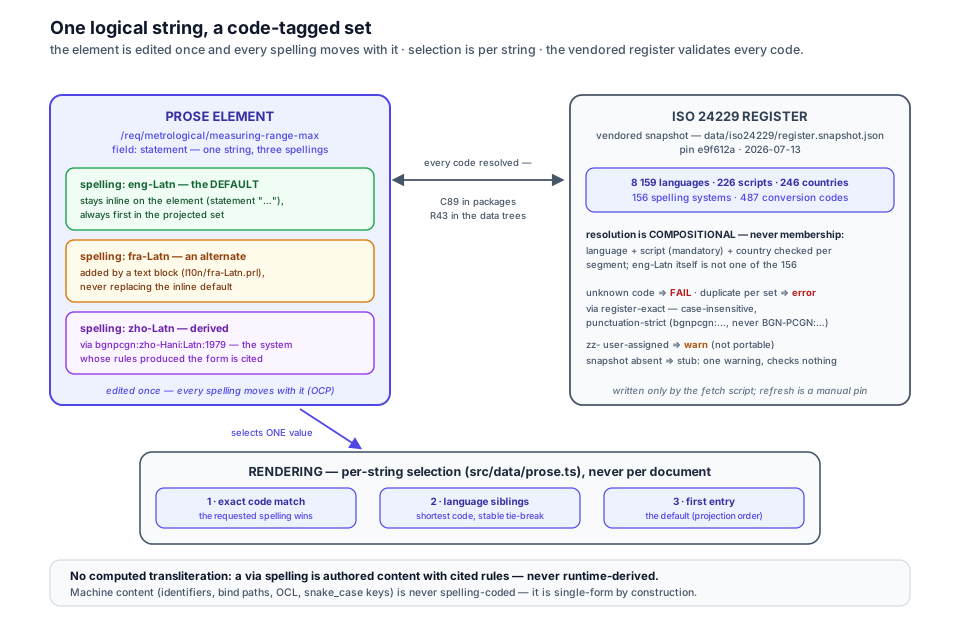
A model carries one logical string with per-spelling values ,
a content set. In the data trees the set is the long-standing
localized pair-list, now with full codes (the 18 AJV schemas of
§10.5 union every prose field as oneOf [string, localizedString], the
plain string surviving as transitional shorthand for the default
spelling):
statement: - spelling: eng-Latn # the package default — always first value: "The value of the largest load applied to a load cell during test … shall not be greater than E_max." - spelling: fra-Latn value: "La valeur de la plus grande charge … ne doit pas excéder E_max." - spelling: zho-Latn via: bgnpcgn:zho-Hani:Latn:1979 # a derived spelling cites its system value: "…"Two values, one string, or three, or one. The statement is one model
element; the spellings are facets of it, not copies of it. This is the
same definition/instance discipline as everywhere else in the kernel:
edit the element once, and every spelling of it moves together; add a
spelling and no consumer of the others is disturbed (OCP). A via code
enters when a spelling was derived rather than authored, the Latin
rendering of a zho-Hani name cites the rules that produced it,
exactly the passport-catalogue problem ISO 24229 exists to solve.
The Primmel package is the source of truth for every set: the default
spelling’s value stays inline on the element (statement "…"), and
alternate spellings are authored in text blocks (§10.5), the
projection emits the set, default first (§10.10).
This extends a practice the terminology layer already runs. The
glossarist registers (viml-2022, vim-2012 in the sibling
../vocab/datasets/ repo) store each concept as per-language
localized concepts keyed by language code (language_code: eng /
fra), one writing system per entry. That keying is a spelling
discipline in embryo, the registers never needed to name the script,
because every entry happens to be Latin-script. Task 25 (● smart
94c8751, merged 8de8f4d) generalized the model’s key from that
bare language code to the full ISO 24229 spelling code and, the actual
content of this chapter, extended the practice from names to all
prose: a definition, a note, a certificate sentence gets exactly the
same treatment as a designation. The upstream registers themselves keep
their bare-language keys; the model’s codes are the superset keying.
10.4 The register, vendored and pinned (●)
Section titled “10.4 The register, vendored and pinned ()”Validation needs the register, and the build cannot depend on a live
external service. The platform therefore vendors a pinned snapshot
of the public ISO 24229 register at
data/iso24229/register.snapshot.json (smart 94c8751, the same
pattern A as the OpenCDD snapshot of §12.4):
| key | count (pin e9f612a, 2026-07-13) | source in the mirror |
|---|---|---|
languages | 8 159 (ISO 639 alpha-3) | src/data/code-names.json |
scripts | 226 (ISO 15924) | src/data/code-names.json |
countries | 246 (ISO 3166-1 alpha-2) | src/data/countries.ts |
spelling_systems | 156 registered spellings | dist/data/register.jsonld |
conversion_systems | 487 conversion codes | dist/data/register.jsonld |
The snapshot is written only by the fetch script
(browser/scripts/fetch-iso24229-snapshot.ts, npm run snapshot:iso24229), which records the mirror’s git HEAD, commit date
and retrieval date in the _snapshot header; refreshing the pin is a
manual, auditable act. It is not a standard tree, no
standard.yaml, no part in the SSOT byte contract.
One shape fact decides the validation design: spelling codes validate
compositionally, never by membership. eng-Latn, the platform’s
own default, is not one of the 156 registered spelling systems; a
membership check would reject the platform’s every string. Resolution
therefore decomposes the code and checks each segment against the
pinned lists: the language against ISO 639, the (mandatory) script
against ISO 15924, the country against ISO 3166-1 when present.
Conversion codes resolve against the 487-entry register list,
case-insensitively but punctuation-exactly.
Stub discipline: when the snapshot is absent, the linker emits ONE warning and checks nothing, never a failure. The mirror is a refresh-time dependency only; the vendored file is what the gates read.
10.5 The machinery: C89, R43, and the projection fixpoint (●)
Section titled “10.5 The machinery: C89, R43, and the projection fixpoint ()”Three layers make the content set real, each with its own gate:
-
The kernel
textconstruct + C89 (● primmel-ts14cf10d, 912/912). Alternate spellings of one prose field are authored astext /req/metrological/measuring-range-max.statement {spell fra-Latn "La valeur de la plus grande charge …"spell zho-Latn via bgnpcgn:zho-Hani:Latn:1979 "…"addressed
<element-id>.<field>; the default spelling’s value stays inline on the element, atextblock never replaces it, it adds spellings. Kernel rule C89spelling-code-wellformedis the syntax layer: the manifest’sdefault_spellingand declaredspellingsparse (script mandatory), everytextblock addresses an existing element’s prose field, everyspellcode parses with no duplicate per set, the default’s value is never re-stated in a block, and everyviaparses (zz-user-assigned codes warn). The kernel stays register-free by design, it validates shape; register resolution is the consumer’s vendored-snapshot discipline. -
Linker rule R43
spelling-code-resolve(● smart94c8751, renumbered3b7b467). The number is a merge artifact worth recording: the rule was built as R42, but task 61’sstate-machine-integrityhad landed as R42 first, and the collision surfaced at merge, the spelling rule shipped as R43. R43 walks every YAML file of every tree collecting{spelling, value}sites and resolves each code compositionally against the snapshot: unknown codes fail (a bogusqqq-Latn,eng-Qqqqoreng-Latn-QQis an error, not a warning); two values for one code in one set are a duplicate-per-set error (keyedsetPath + code, the same code across different sets is fine); aviamust resolve register-exact (case-insensitive, punctuation-strict,alalc:…fails againstala-lc:…);zz-codes warn (user-assigned, not portable); and an absent snapshot degrades to the one-warning stub of §10.4. -
The projection, both directions.
prl-to-yamlemits the content set at 112 prose sites (proseSet/prose/proseList+ text-block alternates), default first; the inverseyaml-to-prlunwraps the default back inline and re-emits alternates astextblocks, and fails loudly on alternates at a nested, non-addressable address, never silently dropping a spelling. The alternates fixpoint (spelling-round-trip.test.ts, 5/5) proves atextblock survives PRL → YAML → PRL byte-clean, andnpm run test:ssotholds the whole contract byte-clean in both directions on every build.
10.6 The migration: English first, every tree (●)
Section titled “10.6 The migration: English first, every tree ()”Task 25 shipped the machinery, not translations, pass 1 tagged every
prose family in the four recs and their composed layers, English source
content → eng-Latn sets:
- all 19 package manifests declare
default_spelling eng-Latn(the only manifest diff: one line each); - 978 legacy bare-
engsites recoded toeng-Latn, values byte-preserved: 548 indata/oiml-r129.legacy/(28 files) + 401 indata/oiml-r144/(26 files) + 29 in the module skeletons (6 files) , 60 files exactly; - certificate text and identity slots tagged: R 60’s 14 promise statements + 14 certificate labels, the certificate-template labels (R 91 12 / R 129 7 / R 144 9), and R 60’s identity slots (5 labels + 5 definitions);
- zero bare
spelling: engremains indata/**, 8 338eng-Latnsites across 291 files.
Sets per tree (generated + hand-authored), from the migration census
(docs/spelling-codes.md):
| tree | sets | top fields |
|---|---|---|
| r60 | 2 955 | label 993, description 634, definition 336, name 280, true/false_label 194, term 85, title 76, statement 74, purpose 62 |
| r91 | 1 142 | description 318, name 246, definition 129, term 70, purpose 64, method 64, statement 57 |
| r129 | 836 | label 212, description 165, name 139, definition 57, statement 45, title 43, term 39 |
| r144 | 1 171 | description 498, name 186, definition 80, title 70, action 52, note 51, label 43 |
| core | 422 | description 371, label 22, statement 10 |
| oiml-cs | 212 | description 135, name 35, statement 34 |
| iso-iec-17000 | 85 | term 36, definition 36, note 13 |
| iso-iec-17025 | 198 | description 99, name 35, statement 33 |
| iso-iec-17065 | 199 | description 93, name 33, statement 31 |
| iso-iec-17067 | 108 | description 52, name 23, statement 22 |
Deliberately not tagged in pass 1, each with its reason on record:
the element-level source_discrepancy facet’s summary/rationale
(provenance-conflict metadata, not element prose, the corpus-level
discrepancy records are tagged), term-level language "en" (a term
metadata tag consumed by the RDF export, not a string’s spelling, its
retirement is follow-up), alternate designations (alt: /
abbreviations:, cross-reference lookup keys), and template-hard-coded
chrome (print-component boilerplate, app UI labels, code, not data;
the identical-English baseline of §10.9 pins them).
10.7 Rendering: selection by code (●)
Section titled “10.7 Rendering: selection by code ()”Rendering never prints a language; it selects by spelling code, per
string, at model load (browser/src/data/prose.ts):
- an exact match on the requested code wins;
- otherwise the language siblings, any entry whose language
segment matches, shortest code first with a stable tie-break (this is
what lets legacy bare-
engdata render identically under theeng-Latndefault); - otherwise the first entry, the projection’s ordering law makes that the package’s default spelling;
- selection is per string, never per document, a certificate may
print the instrument designation in
zho-Hani, its romanization inzho-Latnwith the conversion code cited, and the legal text ineng-Latn, from one content set.
Two honesty notes on the chain. It ends at step 3, there is no
computed transliteration: a converted spelling is authored content
whose via cites the rules that produced it, never a rendering the
runtime derives. And per-string selection is what makes multilingual
rendering auditable: every printed string traces to (element, spelling
code[, system code]), the same provenance reflex as chapter 9, one
axis over.
The app wiring around the selector is small and total
(useLanguage.ts, model-cache.ts, AppHeader.vue,
certificate.service.ts): the user’s spelling persists in localStorage
(oiml-smart-language, default eng-Latn); the model cache is keyed
(standardId, language), no cross-language poisoning, and clears on
language change; the header switcher offers the codes present in the
loaded data (the default first); and the certificate service resolves
promises, labels and rows through the same selector, so a certificate
and a page can never diverge on a string. The selector carries 26
specs, including the four-recs eng-Latn ≡ eng property.
10.8 The translation workflow
Section titled “10.8 The translation workflow”Pass 1 shipped no translations; the workflow below is how they arrive
(the full operator version lives in docs/spelling-codes.md). What may
be translated, and what stays source-language:
- Names, notes, descriptions, guidance, titles, labels, freely translatable. Add the translation as another entry of the content set.
- Definitions, translatable, with provenance kept: a translated
definition of a normatively-defined term carries the source’s wording
beside it (the default spelling stays first; the translation is an
additional
spellentry). - Normative statements (requirement
statement, conformancepurpose/method), the ORIGINAL language text is normative and always stays in the set as the default-spelling entry; any translation is added alongside it, never instead of it. Rendering in another language is a per-string selection (§10.7), so the normative text remains one selection away. - Never spelling-coded (machine content): identifiers,
bind:paths, OCL expressions,snake_caseattribute/field ids, enum values, procedure-step ids, footnote markers, acceptance-criterion ids, table column keys, theviacodes themselves.
Authoring a translation is six steps, all gated:
- Do not edit the normative files. Translations ship in their own
.prlfile(s), the package convention isl10n/<spelling>.prl(e.g.l10n/fra-Latn.prl). A translation never touches the file carrying the default-spelling source. - Address the string:
text <element-id>.<field>, C89 errors on an unresolvable address or a non-prose field. - One
spellper code per set, two values for one code are a duplicate (C89/R43); use an extension code for genuine variants (ind-Latn-pre1972). - Declare the spelling on the manifest: extend the package’s
spellings { … }set (the default staysdefault_spelling eng-Latn). The switcher’s options come from the codes present in the loaded data. - Converted spellings cite their system register-exact:
spell zho-Latn via bgnpcgn:zho-Hani:Latn:1979 "…". - Regenerate (
npm run gen:data), then the gates:npm run validate(R43 resolves the new codes),npm run test:ssot(the inverse projection emits yourtextblocks back).
10.9 The acceptance: byte-identical English (●)
Section titled “10.9 The acceptance: byte-identical English ()”The migration’s contract was: the reader notices nothing. It is proven mechanically, twice over:
- all 44 pages byte-identical English post-migration, the render baseline recorded pre-change, then compared on two independent servers (the reviewer’s own instance and the main repo’s already- running one); the only DOM excluded before capture is the language switcher itself, and normalization masks only ISO timestamps and whitespace. The property now rides the e2e suite as the render-baseline leg (the suite’s 55th test).
- certificates byte-equal 5/5 (
certificate-promises-snapshot.test.ts) , the seeded real-certificate flows print exactly what they printed before the recode, and the coverage summary is identical modulo timestamp.
That is the OCP claim of §10.3 made measurable: every string became a set, and not one rendered byte moved.
10.10 Grammar sketch (the shipped contract)
Section titled “10.10 Grammar sketch (the shipped contract)”package oiml-r60 { id oiml-r60 kind rec … default_spelling eng-Latn # every shipped manifest declares it (19/19)}
# the default spelling stays inline on the element:requirement /req/metrological/measuring-range-max { statement "The value of the largest load applied to a load cell during test … shall not be greater than E_max."}
# alternates arrive in their own file (l10n/fra-Latn.prl) and never# replace the inline default:text /req/metrological/measuring-range-max.statement { spell fra-Latn "La valeur de la plus grande charge appliquée à une cellule de pesée … ne doit pas excéder E_max." spell zho-Latn via bgnpcgn:zho-Hani:Latn:1979 "…" # derived, system cited}and the YAML projection the platform consumes (a plain string stays legal shorthand for the default spelling):
statement: - spelling: eng-Latn # the default — always first value: "The value of the largest load applied to a load cell during test … shall not be greater than E_max." - spelling: fra-Latn value: "La valeur de la plus grande charge … ne doit pas excéder E_max." - spelling: zho-Latn via: bgnpcgn:zho-Hani:Latn:1979 value: "…"10.11 Validation rules
Section titled “10.11 Validation rules”- every spelling code parses: ISO 639-3 alpha-3 (terminological) language code + ISO 15924 script (mandatory) + optional ISO 3166-1 country + optional extension, a bare language code is an error (C89 in packages; R43 fails it in the data trees);
- every code resolves compositionally against the vendored snapshot
, language, script and country each in the pinned lists; membership
in the 156 registered spelling systems is NOT required (
eng-Latnitself is unregistered); - every
viaresolves register-exact, case-insensitive, punctuation-strict (bgnpcgn:…, neverBGN-PCGN:…);zz-user-assigned codes validate with a warning and are not portable; - one value per code per set, two
eng-Latnvalues for one string is a duplicate error (keyedsetPath + code), not a variant; use an extension code to distinguish; - the default spelling’s value stays inline on the element; a
textblock that re-states it, addresses a dangling element, or names a non-prose field is a C89 error; - the projection emits every set default-first; the alternates fixpoint (PRL → YAML → PRL byte-clean) is test-pinned, and nested non-addressable alternates fail loudly;
- snapshot absent ⇒ stub: ONE warning, nothing checked, never a failure;
- machine content is never spelling-coded: identifiers, bind paths,
OCL, and
snake_casekeys are single-form by construction.
10.12 Summary
Section titled “10.12 Summary”- Language tags classify; ISO 24229 codes resolve to concrete writing
and conversion rules. Primmel uses the latter, never BCP 47 (●
shipped, task 25, smart
94c8751/ kernel14cf10d). - A spelling system = ISO 639 language + ISO 15924 script (+ country, + extension); script is mandatory. A conversion system code = titular : source spelling : target spelling : identifying segment, compared case-insensitively but punctuation-exactly.
- Every human-readable string is a content set, one logical string,
per-spelling values, conversion codes cited where a spelling was
derived; the default stays inline, alternates arrive in
textblocks, and 18 schemas union every prose field. - The register is vendored and pinned (
e9f612a, 2026-07-13, 8 159 languages / 226 scripts / 246 countries / 156 spelling systems / 487 conversion codes); C89 checks syntax in packages, R43 resolves compositionally in the trees, unknown codes fail, duplicates fail,zz-warns, absent snapshot stubs. - The migration recoded every tree English-first (19 manifests, 978
legacy sites byte-preserved, zero bare
eng), and the acceptance proved it invisible: 44/44 pages byte-identical on two servers, certificates byte-equal 5/5. - Rendering selects by code, per string, exact → language siblings → the default first entry, with no computed transliteration; the translation workflow keeps normative originals in the set, always.
Next: Chapter 11, Validation: schemas, the model
linker, primmel check, coverage audits, and the authoring pitfalls
catalog.