
Chapter 10, The Executable Ground
Chapter 10, The Executable Ground
Section titled “Chapter 10, The Executable Ground”In this chapter: the positive case for the foundation. After Chapter 8 surveyed how every other methodology stops, this chapter shows what becomes possible when nothing stops. Four properties: (1) no escape hatch, behavior is inside the model all the way down; (2) reification collapses the meta/object distinction; (3) scale invariance, one construct at every scale; (4) specification equals implementation. The chapter closes with the adoption lesson that ties it together.
These are the practical claims. They are conditional on a conforming runtime (see Chapter 6 for the contract); where the implementation falls short, the algebra is the reference.
10.1 No escape hatch
Section titled “10.1 No escape hatch”Every mainstream methodology has a place where the model ends and opaque text begins. In OO that place is the method body. In UML it is the action label. In BPMN it is the task name. The foundation has no such place.
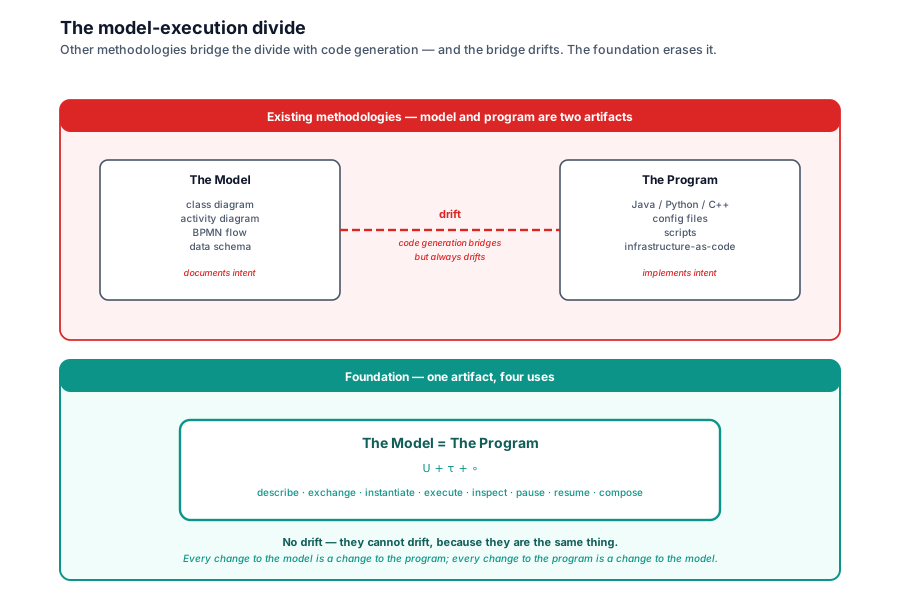
A transition has a transform that is not an opaque body, it decomposes into smaller transitions, by the same composition operator, terminating in whatever atomic transitions the runtime provides. There is no point at which the system says “and here, code happens.”
Why this matters
Section titled “Why this matters”The model and the implementation become one artifact. They cannot drift out of sync because they are the same thing. Every change to the model is a change to the program; every change to the program is a change to the model.
This is the dream that Model-Driven Architecture (MDA) chased for twenty years and lost. MDA’s answer was code generation: transform the model into a second artifact (Java, C#) which then becomes the real system and immediately begins to drift. Code generation concedes the model/implementation gap and tries to bridge it. A direct runtime erases it.
10.2 Reification, the meta/object distinction collapses
Section titled “10.2 Reification, the meta/object distinction collapses”Closure Rule 3 (§3.9) reifies a transition as an object:
This does something no mainstream methodology does natively: it makes every process instance a first-class object that bears IS-facts and HAS-facts with the same machinery as any other object.
The industries that exist because others lack this
Section titled “The industries that exist because others lack this”Consider what industries exist because other systems lack reification:
- Reflection APIs, to inspect a running program’s structure from inside the program.
- Aspect-oriented programming, to inject behavior at join points without modifying source.
- Distributed tracing (Jaeger, OpenTelemetry), to reconstruct what happened across a distributed system after the fact.
- Process mining, to discover processes from event logs.
- Application performance monitoring (APM), to observe running behavior.
All of these are multi-billion-dollar efforts to reconstruct after the fact what provides by construction: the ability to point at a running behavior and ask what it is, what it holds, where it stands.
In OO vs in the foundation
Section titled “In OO vs in the foundation”In OO, a method invocation is not an object in the model, it is an ephemeral stack frame you can only observe by instrumenting the runtime from outside.
In the foundation, “this particular run of this particular process” is an object the moment it exists, individuated by IS, queryable by HAS, with no instrumentation layer, because the model never distinguished between the description of behavior and the record of behavior. The trace is the model at instance grain.
10.3 The MOF tower collapses
Section titled “10.3 The MOF tower collapses”
UML rests on a four-layer tower:
- M0, running instances
- M1, models (the UML diagrams you write)
- M2, the UML metamodel (hundreds of metaclasses)
- M3, MOF (Meta-Object Facility), which describes M2, and then awkwardly, describes itself.
This tower exists because UML’s kinds are not UML’s objects, you need a separate language level to talk about the language.
How the foundation dissolves the tower
Section titled “How the foundation dissolves the tower”Closure Rule 1 (§3.7), kinds are objects, demolishes the tower. The system describes itself with its own eight terms. A property is an object. A transition-type is an object. The model of the modelling system is just more model.
Precedent
Section titled “Precedent”Smalltalk gestured at this with metaclasses. RDF gestured at it with
rdf:type rdfs:Class. But both did it as a local trick within one
layer. In the foundation it is a closure rule of the whole algebra,
which means the system is reflexively complete: there is no
meta-level left over that requires a different vocabulary.
This is a property MOF explicitly tried to achieve and only achieved by fiat (declaring M3 self-describing) rather than by construction.
10.4 Scale invariance, one construct at every scale
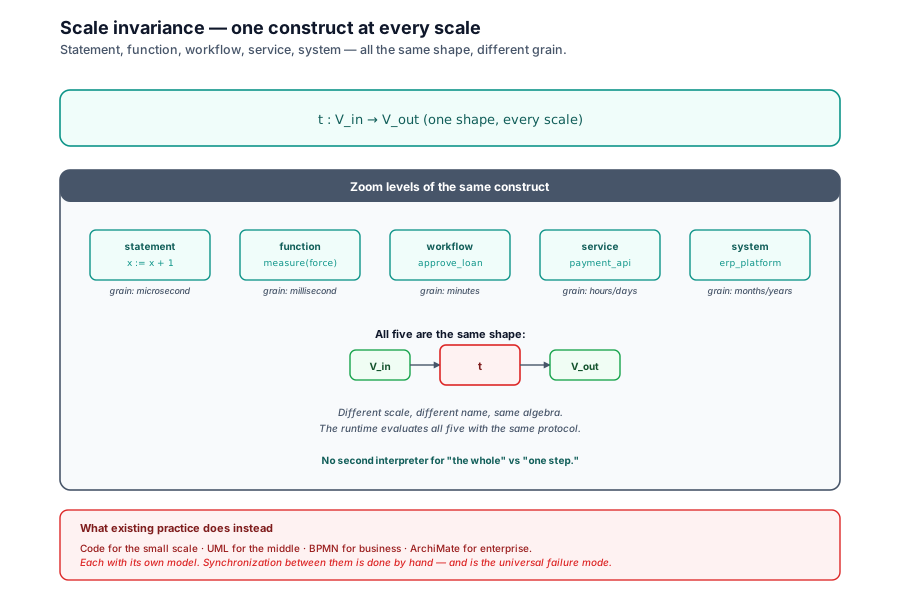
Section titled “10.4 Scale invariance, one construct at every scale”Because is itself a transition, the same construct serves as statement, function, workflow, service, and enterprise process, differing only in grain.
What existing practice does instead
Section titled “What existing practice does instead”Existing practice fragments scale:
- Code for the small scale (statements, functions)
- UML for the middle scale (classes, components)
- BPMN for the business scale (tasks, flows)
- ArchiMate for the enterprise scale (capabilities, value streams)
Each with its own notation, its own tooling, and, critically, its own model that must be kept consistent with the others by hand. The synchronization problem between a company’s BPMN diagrams and its actual codebase is not a tooling gap; it is a structural consequence of using different formalisms at different scales.
What scale invariance dissolves
Section titled “What scale invariance dissolves”Scale invariance dissolves the problem at its root: zooming in on a process reveals transitions in the same algebra, so there is nothing to synchronize. There is one artifact viewed at different magnifications.
10.5 Specification equals implementation
Section titled “10.5 Specification equals implementation”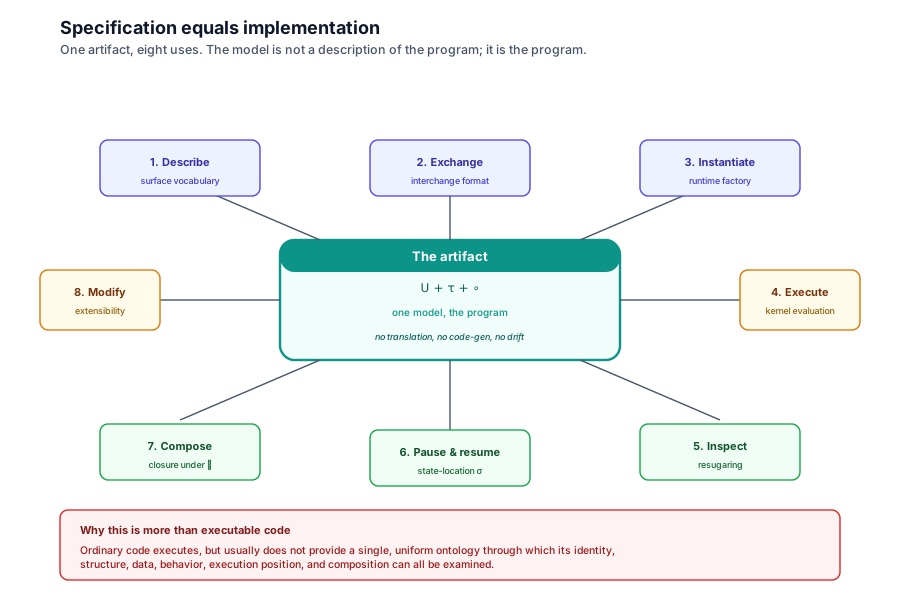
If a runtime executes this algebra directly, evaluation as function application over , sequencing as , instantiation as , then the model is not a description of the program. The model is the program.
The four uses that become one
Section titled “The four uses that become one”The same object, property, value, process, and transition definitions are used to:
- Describe the system (surface vocabulary)
- Serialize and exchange the system (interchange format)
- Instantiate the system (runtime)
- Execute the system (kernel evaluation)
- Inspect the running system (resugaring)
- Pause and resume processes (state-location σ)
- Compose larger processes (closure under ∘)
- Modify the system (extensibility, Chapter 4 Theorem 3)
That is more than executable code. Ordinary code executes, but usually does not provide a single, uniform ontology through which its identity, structure, data, behavior, execution position, and composition can all be examined.
Every theorem acquires operational force
Section titled “Every theorem acquires operational force”- Closure (Theorem 1) means the runtime can never encounter an entity it cannot represent.
- Completeness (Theorem 2) means anything describable is buildable.
- Extensibility (Theorem 3) means the deployed system grows by adding content to , , , without redeploying primitives. Schema evolution and behavior evolution become the same monotone operation.
10.6 The adoption lesson
Section titled “10.6 The adoption lesson”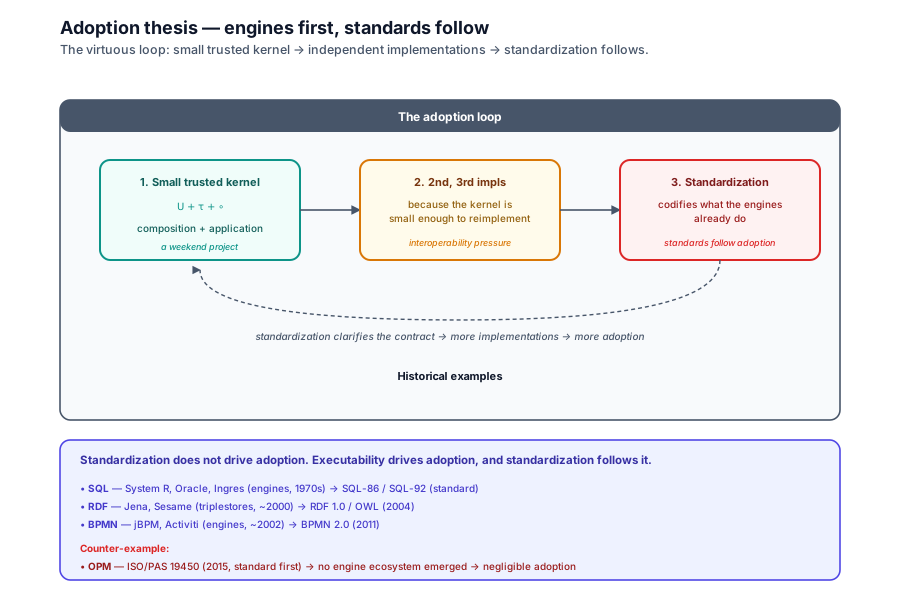
Standardization does not drive adoption. Executability drives adoption, and standardization follows it.
- SQL was adopted because engines existed (System R, Oracle, Ingres), and the standard codified interoperability among them.
- RDF was adopted because triplestores existed (Jena, Sesame, Stardog), and the standard codified interchange.
- BPMN was adopted because engines existed (Camunda, Flowable, jBPM), and the standard codified execution semantics (loosely).
In every case, the engines came first. The standard followed.
OPM went the other way
Section titled “OPM went the other way”OPM acquired the ISO document first (and only a PAS) with no executable semantics and a single-vendor toolchain. Adoption never came, because there was nothing to run and no second implementation to interoperate with.
The foundation’s path
Section titled “The foundation’s path”The foundation’s conforming-runtime trusted base is small enough that independent implementations are a weekend project rather than a consortium effort. A conformance test suite can be genuinely exhaustive. That is how the second and third implementations arise , and their existence is what a standard is for.
The adoption strategy: ship the kernel, ship a reference runtime, ship a conformance suite. Standardization follows.
10.7 The honest position, what is not yet earned
Section titled “10.7 The honest position, what is not yet earned”For all the positive case above, the foundation is not yet:
- Adopted. Its adoption record is “to be earned” (see positioning matrix in Chapter 8 §8.10).
- Standardized. There is no ISO/IEC/OMG standard for the foundation.
- Widely implemented. The Primmel language and platform annex are one implementation; we need second and third implementations from independent parties to test the algebra’s claims.
- Tooling-rich. Compilers, debuggers, IDE integrations, profilers , all the things OOP and UML built over thirty years, remain to be built.
These are not weaknesses of the algebra, they are properties of the project’s current state. The algebra is closed, complete (relative to the axiom), and extensible. Whether the project earns adoption depends on execution from here.
10.8 What this chapter established
Section titled “10.8 What this chapter established”- The foundation has no escape hatch (behavior is inside the model all the way down).
- Reification collapses the meta/object distinction, no MOF tower.
- Scale invariance gives one construct at every scale.
- Specification equals implementation.
- Adoption-via-executability: engines first, standards follow.
The next chapter (Chapter 11) returns to falsifiability, what is not proven, where the system could break, and what future work remains.
Next: Chapter 11, Open Questions.