
Chapter 3, Instantiation
Chapter 3, Instantiation
Section titled “Chapter 3, Instantiation”In this chapter: the definition/instance split, why a Sample is an instance of a Model, how attribute resolution delegates through the subject chain, and how the same duality recurs for every model kind in the language.
3.1 Definition and instance
Section titled “3.1 Definition and instance”A Primmel model has two planes:
- the definition plane, what kinds of things exist and what is true of them by design: subject types, attribute definitions, processes, requirements, forms;
- the instance plane, the individual things that exist and what they exhibited: this sample, this run, this filled form, this verdict.
The split is not bookkeeping hygiene; it is what makes evaluation re-executable. A verdict is a function of (definitions, evidence). If definitions and instances were fused, if the requirement restated the instrument’s values, if the report carried its own pass/fail, then re-judging against a new limit would require reconstructing the past. With the planes apart, re-evaluation needs no re-testing: pin the definition versions, keep the evidence, recompute the judgment.
3.2 The subject chain
Section titled “3.2 The subject chain”The primary subject is not one class but a chain of definition levels, anchored in the vocabulary of legal metrology:
ModelFamily (VIML 4.02) ──has many──▶ ModelGroup ──has many──▶ Model (VIML 4.06, "type") │ instantiates ▼ Sample (VIML 4.09)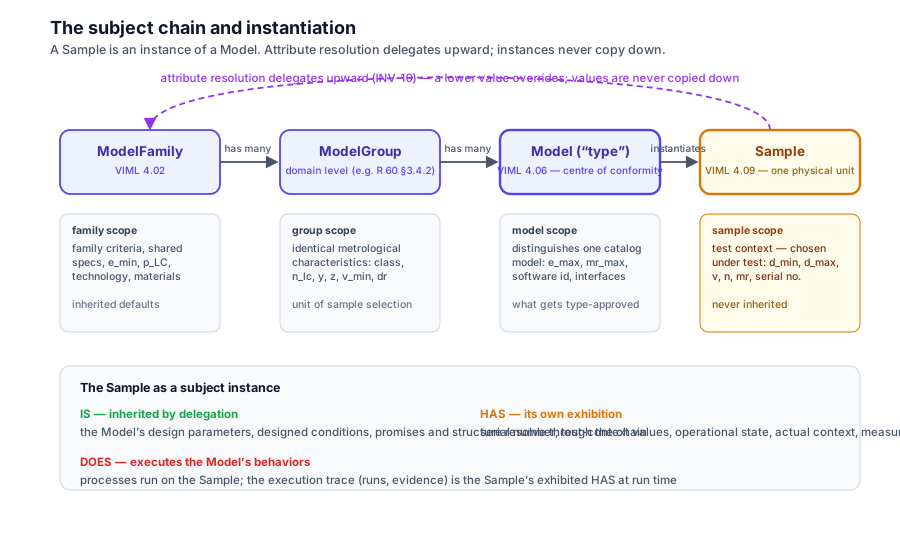
- ModelFamily, instruments of one manufactured type sharing design features and metrological principles, possibly differing in some performance characteristics, as defined in the Recommendation. Carries inherited defaults.
- ModelGroup, not a VIML level: the Recommendation’s own intermediate grouping (R 60’s “load cell group”, §3.4.2), models with identical metrological characteristics; the unit of sample selection. Omit it when the Recommendation defines no such level.
- Model, the “type”: the definitive model of which all elements affecting metrological properties are suitably defined. The centre of conformity: Recommendations target it, samples instantiate it, type approval certifies it, never an individual unit.
- Sample, one physical unit, a specimen of an identified Model. Tests run on it, verdicts judge it, and type conformity is established across samples.
Each definition level has a scope discipline: every attribute is declared with the level at which its value is stated (family / group / model / sample), and the linter rejects a value stated at the wrong level (a sample value for a model-scope attribute, or inheritance of a test-dependent attribute).
3.3 Sample: the canonical instance
Section titled “3.3 Sample: the canonical instance”A Sample is an instance of a Model, and because a Sample is itself a subject, the anatomy answers what instantiation means per question:
- IS, inherited by delegation. The Sample carries its Model’s
identity aspects, design parameters, designed conditions, promises,
structure, resolved through the chain, not copied. Ask a sample for
its
E_maxand you get the model’s design value, unless the sample’s own record overrides it (rare, and visible). - HAS, its own exhibition. Serial number, test-context values
(sample-scope attributes such as
d_min,d_max,v,n), its operational state, its actual environmental context, its measured characteristics. This is the plane tests write into. - DOES, the Model’s behaviors, executed on it. A test process runs on the Sample; the execution trace (the run, the evidence records) is the Sample’s exhibited HAS at run time.
One line to remember: the Model is what is certified; the Sample is what is tested; the chain is what makes the two commensurable.
One last instance shape belongs here: the live twin ○, a Sample whose anatomy is served, instantiation extended from a record into a service (chapter 14). The delegation rules above are untouched; only the answering moves online.
3.4 Delegation (INV-10)
Section titled “3.4 Delegation (INV-10)”Attribute resolution along the chain:
resolve(sample, attr): if attr is sample-scoped: return sample.test_context[attr] # never inherited if attr has value on sample: return sample.parameters[attr] if attr has value on model: return model.parameters[attr] if attr has value on group: return group.parameters[attr] if attr has value on family: return family.parameters[attr] else: undefined → error (closed under reference)Three laws:
- Upward resolution, a value not set locally resolves to the nearest enclosing level that sets it.
- Lower override, a value set at a lower level shadows the inherited one (deliberate, visible in the data).
- Never copied down, values live at one level only; copying a family value onto every model is the classic data-rot move and is forbidden.
3.5 The uniform duality
Section titled “3.5 The uniform duality”Instantiation is not specific to subjects. The same definition ⇒ instance duality recurs across every model kind:
| Definition plane | Instance plane | Instance is… |
|---|---|---|
| Model | Sample | a physical unit of the type |
| process definition | process execution (TestRun) | one run of the process on one sample |
| Form | FormInstance | one filled record of the schema |
| artifact definition | artifact instance | one produced output |
| AttributeDefinition | Parameter (valued attribute) | the value of the attribute on one subject level |
| requirement | Verdict | the judgment of that requirement for one sample, not an instance, but a re-executable function of the requirement + evidence |
| certificate template | Certificate | one issued artifact |
| product reference model ○ | live twin ○ | one served instance of the manufacturer’s product model, imported abstractly or integrated live (chapter 15) |
Two discipline rules follow:
- Definitions and instances never mix in one element. A model file
declares definitions; instances live in the workspace (
.pws/) or inexamples/seed data. (The single sanctioned exception: seed instances shipped for testing, segregated.) - Every instance is version-pinned to its definitions (INV-8): a run records which method version it executed; a report records which requirement editions it answers.
3.6 Where instances live
Section titled “3.6 Where instances live”Definitions are authored in .prl packages. Instances are produced by
execution and stored in the workspace (.pws/): one store per
registry, one YAML file per record, a manifest at the root. The store
schema is compiled from the entity classes (registries are places;
chapter 6), so the workspace is always exactly as structured as the model
demands, no more, no less.
3.7 Grammar sketch (illustrative v3 syntax)
Section titled “3.7 Grammar sketch (illustrative v3 syntax)”subject LoadCellModel extends MeasuringInstrumentModel { is { design_parameters { e_max : mass scope model } } has { attributes { d_min : mass scope sample } }}
instance LC-500-001 of LoadCellModel { has { attributes { serial_number "001" } test_context { d_min 0.02 kg, d_max 400 kg } }}3.8 Validation rules
Section titled “3.8 Validation rules”- every instance’s
ofreference resolves to a definition in scope; - every value on an instance is declared at the correct scope;
- a sample-scoped attribute is never resolved by inheritance;
- every instance carries its definition version pins;
- chain integrity: sample → model → (group →) family references resolve and are acyclic.
3.9 Summary
Section titled “3.9 Summary”- Definition and instance are two planes; keeping them apart is what makes judgments re-executable.
- The subject chain (Family → Group → Model → Sample) is the primary definition ladder; the Model is the centre of conformity, the Sample the canonical instance.
- Delegation (INV-10): resolve upward, override downward, never copy.
- The duality is uniform: process → run, form → instance, artifact definition → instance, attribute definition → valued parameter.
Next: Chapter 4, Processes: abstract and executable processes, the step vocabulary, executors, state, and evidence.