
Chapter 14, Live Twins and Continuous Compliance
Chapter 14, Live Twins and Continuous Compliance
Section titled “Chapter 14, Live Twins and Continuous Compliance”In this chapter: why a certificate that freezes time is not enough, what a live twin is, how a product’s model becomes its passport, and how the Compliance Engine runs the standard next to the product , forever. This is the chapter where the whole frame starts breathing.
14.1 The problem: certificates freeze time
Section titled “14.1 The problem: certificates freeze time”Think about what a certificate actually says. A load cell gets type approval: on a Tuesday, in a laboratory, five samples of one model behaved within tolerance. The certificate is true, about that Tuesday, those samples, that lab. Then the product ships ten thousand units.
Over the next ten years: firmware updates change the indication pipeline. Production drifts. A unit is installed next to a furnace. Another is dropped. The certificate knows none of this. The market’s trust in the product rests on a photograph of the past.
Everyone in the chain feels the gap:
- the manufacturer can’t prove their product stayed good, only that it once was;
- the user (the factory that bought the cell) can’t show their measurements are trustworthy today;
- the regulator checks compliance by raids and paperwork, years apart;
- the auditor reconstructs history from PDFs and emails.
The gap is not anyone’s fault. It is structural: the standard was checked once because checking was expensive, manual, and offline.
14.2 The idea in one paragraph
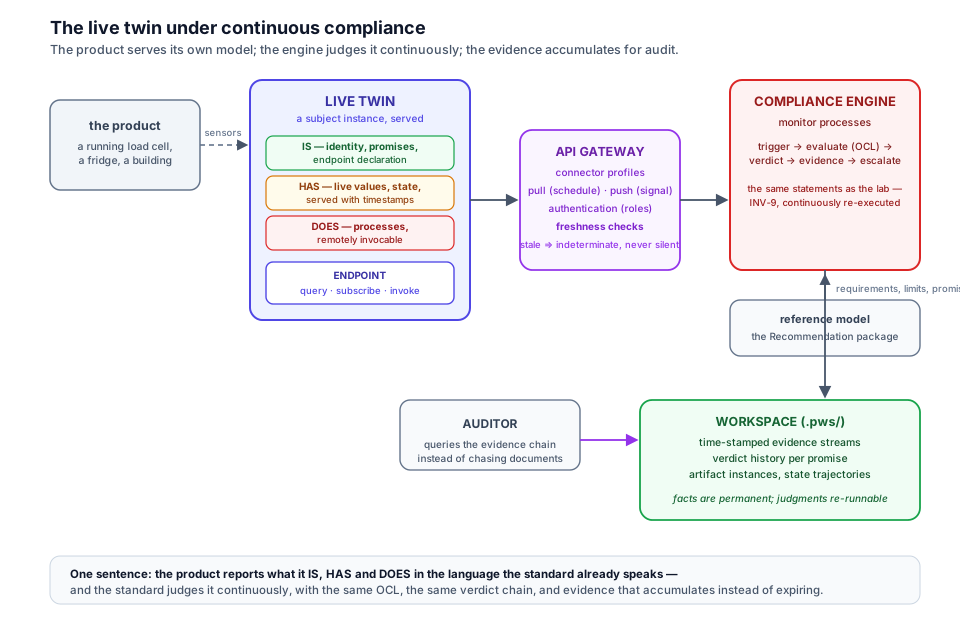
Section titled “14.2 The idea in one paragraph”The product reports what it IS, HAS and DOES, in the same language the standard is written in. The standard judges it continuously, with the same OCL, the same verdict chain, and evidence that accumulates instead of expiring.
Three capabilities make it real, and each will get its turn below:
- the live twin, the product, serving its own model and state;
- the model-native passport, the product’s model is its passport (the EU’s Digital Product Passport, answered natively);
- the Compliance Engine, the standard, executed continuously against the live twin, producing evidence for audit.
14.3 The live twin
Section titled “14.3 The live twin”Chapter 3 defined instantiation: a Sample is an instance of a Model, inheriting by delegation, exhibiting its own values. A live twin is what happens when that instance is switched on:
A live twin is a subject instance whose anatomy is served. Its provider runs it; the world can query it.
Anatomy of the twin, in the frame’s own terms, no new anatomy needed, only plumbing to serve it:
- IS, the twin’s identity, and it is the passport. Metadata, provenance, structure, design parameters, designed conditions, promises. Ask the twin “what are you?” and it answers from its model. One IS-level addition: the endpoint declaration, “this product offers this interface” is part of the type definition, like a marking or a software identification.
- HAS, the twin’s exhibition, served live. Attributes, dimensions, operational state, characteristics, environmental context, artifact instances, bound to endpoint operations and served with timestamps. A value without a time is not evidence; the freshness semantics of §14.5 turn that into a rule.
- DOES, the twin’s processes, invocable. “Run your self-test.” “Report your warm-up state transition.” Process characteristics (drift, response times) stream as live telemetry.
The twin is served by its provider, the manufacturer, or the owner-operator of the deployed unit. And here is the ecosystem point that makes it more than a gadget: the twin is a served instance of a model that someone else can integrate into theirs. Chapter 15 develops the full supply chain; the one-line version is that the manufacturer’s product model, the twin’s type, is itself mapped to the Recommendation, so conformance composes.
The full twin and the governed projection. A manufacturer’s digital twin of their own product can be arbitrarily rich, physics simulation, diagnostics telemetry, event history, production data. That is the full twin, and nothing a Recommendation says constrains it. But what the Recommendation governs is a projection of it, and the projection is itself declared, mapped, and derived:
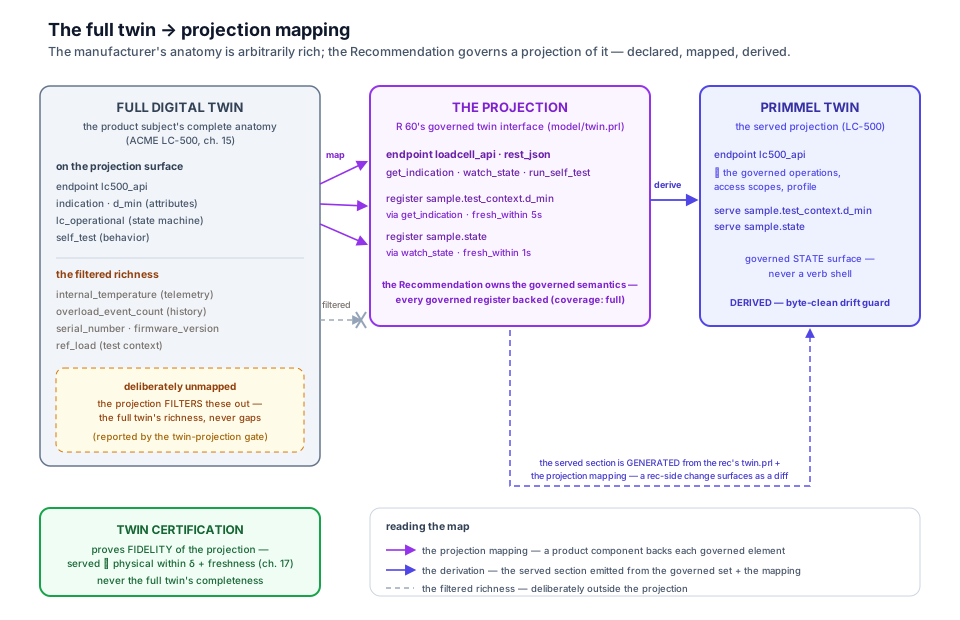
- What the device IS, the full twin: the manufacturer’s complete representation, any shape. The LC-500’s subject anatomy (chapter 15) carries internal-temperature telemetry, an overload event history, and production data alongside the metrological attributes.
- What the standard GOVERNS, the projection: the Recommendation
declares the governed twin interface (the endpoint, the served
registers, the freshness windows, R 60 does,
model/twin.prl), and the product’s projection mapping proves every governed register is backed by a product component (the coverage calculus, chapter 5). The richer anatomy is deliberately unmapped, the filtered richness the projection leaves behind, never a gap. - What certification PROVES, fidelity of the projection: the served values are true within the declared tolerance and freshness (chapter 17), never the full twin’s completeness. Completeness against what?
So the Primmel twin is a governed state projection, not a command interface, you read what the standard governs from it. And because the governed semantics belong to the Recommendation, the product’s served twin section is derived from the Recommendation’s declaration plus the projection mapping, never hand-mirrored: a change to the governed set surfaces as a diff in the product package, where a mirrored copy would have drifted silently (the twin-projection drift guard, TODO.v2/16).
14.4 The integration language: endpoint, serve, connectors
Section titled “14.4 The integration language: endpoint, serve, connectors”A twin that can’t be queried is a photo. The integration language is three small primitives:
endpoint (IS-level), the subject’s declared API surface:
endpoint lc500_api { operation get_indication { kind query serves indication } operation watch_state { kind subscribe serves state } operation run_self_test { kind invoke does self_test } access { public: [get_indication] registered: [watch_state] authority: [run_self_test] } profile rest_json}Operations have a kind, query (pull a current value),
subscribe (push on change), invoke (trigger a process), and a
payload schema (QuantityValue, per INV-1, always with unit and
timestamp). Access scopes name who may call what.
serve (HAS-level), the binding from an aspect to an operation:
serve sample.test_context.d_min via get_indication { fresh_within 5s }Freshness is part of the binding: the engine must know how old a value may be before it stops meaning anything.
Declaration vs binding. A Recommendation ships the twin
DECLARATION, the endpoint, the served aspects, the operational state
machine, and the serve capabilities with their fresh_within windows
(what CAN be served and how fresh it must be; R 60 does,
model/twin.prl). The live BINDING, the gateway integration that
actually serves values, is deployment content (model/gateway.yaml in
the consuming package). A declared-but-unbound serve gates nothing: an
offered capability is not an outage, verdicts stay untouched until a
deployment binds the operation (AGENTS.d/12, TODO.roadmap/49).
Connector profiles, protocol bindings declared per endpoint:
rest_json, mqtt, opc_ua, file_drop (for batch/plugin sources).
The model is protocol-neutral; profiles bind protocols. This is what
keeps “a live twin” from meaning “a REST API and nothing else”.
14.5 The monitor: continuous compliance
Section titled “14.5 The monitor: continuous compliance”The Compliance Engine is the tertiary tier plus the gateway and the monitors, run as a service. A monitor is a continuous process:
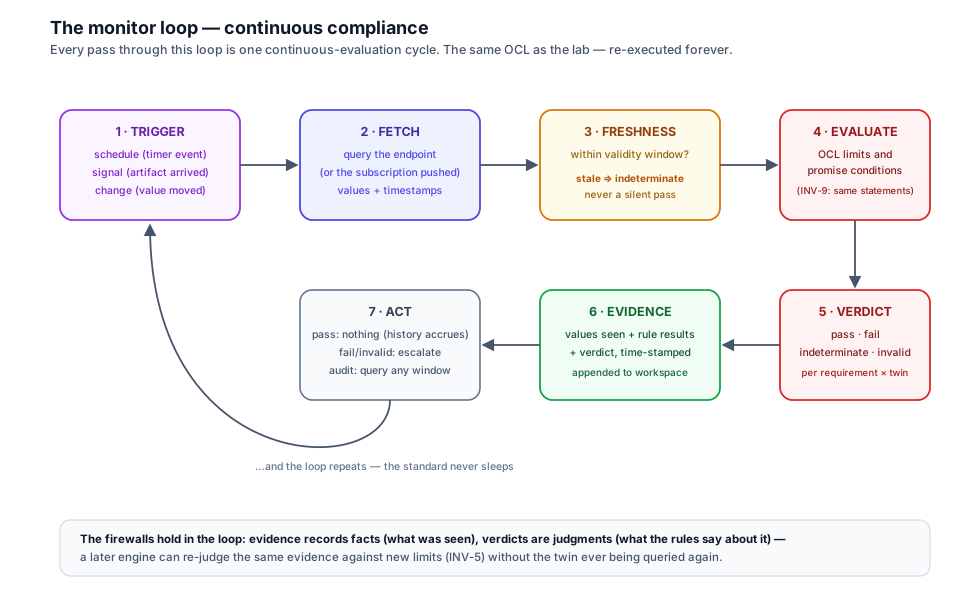
Walk the loop once, slowly, every step exists for a reason:
- Trigger. Something says check now: a timer (every hour), a signal (an artifact arrived), a change (a watched value moved). Without triggers, “continuous” has no clock.
- Fetch. The engine queries the endpoint, or receives the push from a subscription. Values arrive with timestamps.
- Freshness. Every value is checked against its validity window.
A stale value does not fail the product, it degrades the
verdict to
indeterminate. Why not fail? Because a network outage is not a metrological event. And why not pass? Because silence is not evidence. Stale ⇒ indeterminate, never a silent pass. - Evaluate. The requirement’s OCL limit and the promise’s conditions run over the fresh values, the same statements the lab used (INV-9). No second dialect for “online mode”.
- Verdict.
pass · fail · indeterminate · invalid, per requirement × twin. Invalid still means “the setup was wrong” (preconditions), fail means “the product was wrong”. - Evidence. Values seen, rule results, verdict, timestamps , appended to the workspace. Facts only; permanent.
- Act. Pass: nothing happens, history accrues, and that is the deliverable. Fail/invalid: escalation (notify, flag the certificate, open a case). Audit: query any time window.
The firewalls hold inside the loop: evidence is fact, verdict is judgment, and a later engine can re-judge the same evidence against new limits (INV-5) without asking the twin anything.
14.6 The model-native Digital Product Passport
Section titled “14.6 The model-native Digital Product Passport”The EU is mandating, regulation by regulation, that products carry a Digital Product Passport: a structured digital record of identity, composition, compliance and sustainability data, reachable through a data carrier on the product, with a unique identifier, access control, persistence, and APIs, the ESPR (EU 2024/1781) and CEN/CENELEC JTC24’s eight standard areas.
Most industries will answer with a document: a database row per product, PDFs attached, compliance typed in by hand. A document can drift from the product. It can be filled optimistically. It knows nothing the claimant didn’t type.
The Primmel answer is model-native:
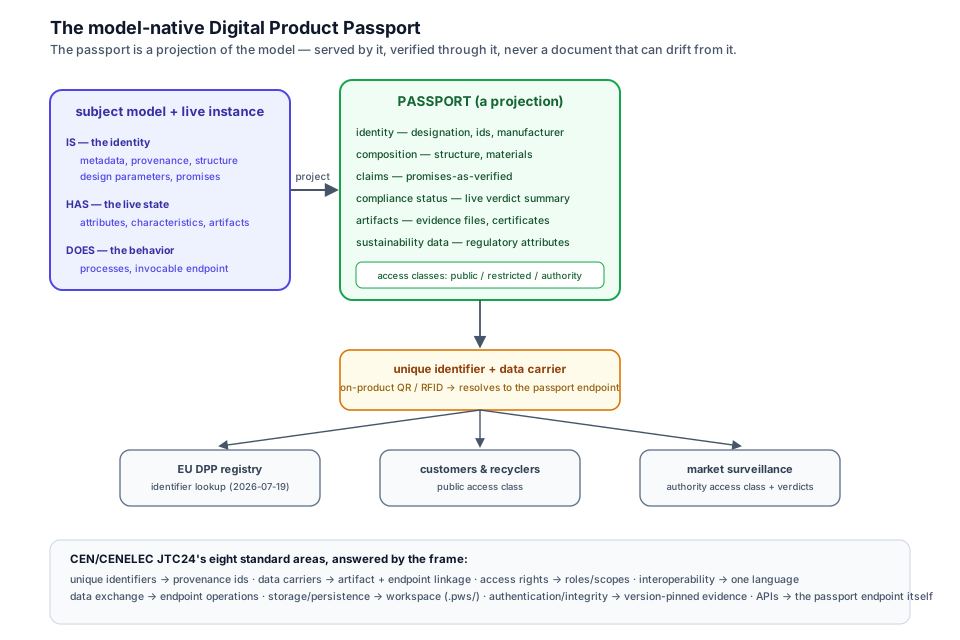
The passport is a projection of the product’s subject model plus its live instance state, generated from the model, served by the endpoint, verified through the engine. It cannot drift from the model because it is the model.
Map the JTC24 areas and the frame answers each: unique identifiers → provenance ids; data carriers → artifact/endpoint linkage; access rights → roles and access scopes; interoperability → one language; data exchange → endpoint operations; storage/persistence → the workspace; authentication/integrity → version-pinned evidence; APIs → the passport endpoint itself.
Two modes, matching chapter 15’s supply chain: the abstract passport, point-in-time, as-certified, for a buyer doing design-time integration, and the live passport, continuously verified, for a regulator watching the fleet.
Shipped (task 35, ● smart 244ea47). The passport is no longer a
design sketch. The kernel’s passport construct declares it on the
product model, upi { pattern … level … } (the ESPR model/batch/item
levels), the carrier facet (the QR payload resolves to the passport
endpoint URL), and per-class content classes, linted by the catalog
trio C86 content-resolves, C87 access-leak, C88 upi-scheme
(chapter 11). The projection engine (browser/src/data/passport.ts)
builds both modes, abstract pins a version; live requires the
computed verdict-stream read, never a fabricated status, and projects
per access class fail-closed: public output carries only public
entries (C87 is the lint, the engine is the enforcement). Serving:
GET /passport/<upi>.json?class=public|restricted|authority plus the
public rendered view; the registry feed GET /passport/registry.json
is the one-way outward projection, deliberately a stub (no auth, no
push, §12.5). The ACME LC-500 pilot declares
public { identity composition promises_as_verified } and
authority { live_compliance_status }, artifacts and
sustainability deliberately absent, nothing honest behind them yet ,
and its passport serves at /passport/upi:acme:lc500 (the pilot,
§14.9). And the JTC24 alignment above is not prose alone: the
machine-checkable half is authored data, data/r60/evaluation/ r60-to-dpp.prm, the R 60 → JTC24 mapping on the .prm primitive with
the coverage gate (an area neither mapped nor named is a silent gap and
fails), with docs/dpp-jtc24-alignment.md in the platform repo as the
human-readable record, kept current as JTC24 publishes.
14.7 The API gateway for implementation models
Section titled “14.7 The API gateway for implementation models”The oldest piece of this story is 2021: the PAS 2060 plugin. An
organization’s implementation model (their carbon-neutrality operations)
needed data from outside, a building model in IFC, meters, reports.
The plugin mechanism fed external data into the model’s measurement
variables, and validate_measurement ran over it, the guide’s own
words: “use a plugin to collect measurement data and run measurement
validation tests continuously.”
The v3 gateway generalizes that pattern into the connector layer of §14.4: external sources bind to the implementation model’s registers , domain models (IFC and friends), APIs, file drops, streams, with authentication by role, freshness windows on every binding, and stale⇒indeterminate semantics. Continuous compliance for management standards (a QMS watching its own KPIs) uses exactly the same machinery as a metrology engine watching a load cell. One gateway, both families.
14.8 Who runs what
Section titled “14.8 Who runs what”- Twin provider (manufacturer, or the unit’s owner-operator): runs the live twin and its endpoint. Speaks for the product.
- Engine operator (issuing authority, regulator, market surveillance, or the manufacturer for self-monitoring under third-party audit): runs the Compliance Engine against the reference model. Speaks for the standard.
- Auditor: queries evidence chains instead of chasing documents. Speaks for the record.
Separation of speakers is what keeps the loop honest: the product’s claims come from the twin, the judgment comes from the engine, and the record stands between them.
14.9 Worked example A, a live load cell under R 60
Section titled “14.9 Worked example A, a live load cell under R 60”ACME ships LC-500 units with a lc500_api endpoint. A quarry’s belt
scale integrates one. The IA’s engine subscribes to watch_state and
runs an hourly monitor:
- Fetch: indication 402.4 kg at 14:00:03 (fresh).
- Evaluate: the running-sample requirement
indication within MPE(load, class)against the live classificationC3, the samelookupMPEthe lab used. - Verdict: pass. Evidence appended.
- 14:37: the unit reports
faultstate → verdictsinvalid(not fail) and a service case opens; the state trajectory is in the trace. - Quarterly: the engine re-runs the creep characteristic derivation over streamed indication series, the same OCL as the type test , and the drift verdict history is the audit’s answer to “show me the fleet.”
Made real (TODO.roadmap/37). This worked example runs in the smart
repo as the live-twin pilot: primmel-packages/acme-lc500 (the product
reference model with the declared lc500_api endpoint and the aspect-
by-aspect R 60 mapping) and primmel-packages/quarry-belt-scale (the
quarry’s implementation package, consuming in both modes) are the
shipped packages; the pilot executes the type evaluation against the
R 60 program for real (three samples, the certificate issued with
promises-as-verified), serves ONE simulated twin from a demo provider,
runs the hourly + on change state monitor loop over a simulated
quarter (an injected drift ⇒ fail + the certificate flag, a feed
outage ⇒ indeterminate, a fault push ⇒ the service case), serves
the passport (§14.6’s minimal view) at /passport/upi:acme:lc500 with
the QR payload resolving to its JSON, and answers the audit-chain query
clause → promise → verdict history → batch records. One command:
cd browser && npm run pilot; the six step assertions live in
browser/e2e/pilot.e2e.ts (service-level, the twin machinery’s own
acceptance precedent).
14.10 Worked example B, a fridge under ESPR
Section titled “14.10 Worked example B, a fridge under ESPR”No metrology anywhere, deliberately. A fridge maker authors
FridgeModel X200 as a subject: IS (design parameters: rated energy
class, refrigerant type; promises: “EER ≥ 3.2 across rated ambient”,
“R-600a charge ≤ 60 g”), HAS (per-unit attributes: serial, measured
energy consumption, compartment temperatures), DOES (cooling process,
defrost cycles).
- The abstract passport serves a retailer at purchase: the model’s identity, composition, as-tested claims, point-in-time.
- The live passport serves market surveillance: sampled units in the field stream energy consumption; the engine verifies the EER promise continuously; failures flag the series.
- The manufacturer’s product model was mapped to the (future) ESPR delegated-act reference model, coverage computed, not asserted.
Same anatomy, same engine, different science. That is the point of a universal subject language.
14.11 Grammar sketch (illustrative v3 syntax)
Section titled “14.11 Grammar sketch (illustrative v3 syntax)”subject LoadCellModel { is { endpoint lc500_api { … } # §14.4 promises { mpe_within(class, rated) } } has { serve sample.indication via get_indication { fresh_within 5s } serve sample.state via watch_state characteristics { creep c_c = ΔOUT/Δt under constant load } } does { behavior self_test { in () -> out diagnostic_report } }}
monitor fleet_watch over LoadCellModel { triggers { every 1h ; on signal artifact_arrived ; on change state } evaluate { requirements applicable_to(this.classification) ; promises all } emit { evidence -> workspace ; verdicts -> verdict_log } escalate { on fail: flag_certificate ; on invalid: open_service_case }}subject LoadCellModel { is { endpoint lc500_api { … } # §14.4 promises { mpe_within(class, rated) } } has { serve sample.indication via get_indication { fresh_within 5s } serve sample.state via watch_state characteristics { creep c_c = ΔOUT/Δt under constant load } } does { behavior self_test { in () -> out diagnostic_report } }}
monitor fleet_watch over LoadCellModel { triggers { every 1h ; on signal artifact_arrived ; on change state } evaluate { requirements applicable_to(this.classification) ; promises all } emit { evidence -> workspace ; verdicts -> verdict_log } escalate { on fail: flag_certificate ; on invalid: open_service_case }}A COMPOSITE subject declares its composition as a first-class anatomy facet (TODO.integration/14, the YAML sidecar it replaces proved the shape first, TODO.v3/03):
subject CGMSystem { is { endpoint cgm_system_api { … } composed_of { component analyzer { product acme-cgm-200@2026 # the pinned import (C83) endpoint cgm_api # its projection serves on serial "CGM200-DEMO-0001" certificate null # uncertified ⇒ DECLARED partial } component sample_line { product acme-cgm-system/sample-line@2026 endpoint sample_line_api serial "CGM200-SL-0001" certificate null } decomposition { sample.indication_co -> analyzer.indication_co sample.test_context.flow -> sample_line.flow sample.state -> rule any_fault_else_analyzer } revision 1 } }}The lint rules (C100–C102): every component’s product reference
resolves (an inline pkg/subject names a subject of the package; a
bare package id is registered for the supply-chain gate’s C81-class
resolution) and names its endpoint; every serve of the composite
subject is covered by the decomposition exactly once; the composite
state rule’s vocabulary is CLOSED (any_fault_else_analyzer first ,
a new rule is a grammar extension, never a free string). The runtime
calculus (the weakest declared link, the printed component basis) is
the smart platform’s §B chapter and the Platform volume’s
composite twin chapter.
14.12 Validation rules
Section titled “14.12 Validation rules”- every
servenames a declared aspect and a declared operation; unit coherence between aspect and payload is checked; - every endpoint operation has an access scope and a payload schema (QuantityValue with timestamp);
- every monitor’s
evaluaterefs resolve to requirements/promises applicable to the monitored subjects; - a monitor without an escalation path for
failis a warning; - a live binding without
fresh_withinis an error (no stale semantics, no live binding); - evidence emitted by monitors carries definition version pins (INV-8).
14.13 Summary
Section titled “14.13 Summary”- Certificates freeze time; live twins let the standard run next to the product, forever.
- A live twin is a subject instance whose anatomy is served: IS (the passport), HAS (live values with timestamps), DOES (invocable processes).
- The twin is a projection: the full twin is the manufacturer’s and arbitrarily rich; the Recommendation governs the projection , declared, mapped (every governed register backed), and derived, never hand-mirrored. Certification proves the projection’s fidelity, never the full twin’s completeness.
- Three small primitives integrate it:
endpoint,serve, connector profiles. One process consumes it: themonitor. - The passport is a projection of the model, abstract (point-in-time) or live (continuous), answering the EU DPP system natively.
- The API gateway generalizes the 2021 plugin: external data feeds any implementation model’s registers, with freshness semantics.
- Stale data degrades to
indeterminate; silence is not evidence; the firewalls hold inside the loop.
Next: Chapter 15, The Model Supply Chain: who publishes which model, and how the manufacturer’s product model is consumed, as an abstract reference or as a live twin.