
Chapter 4, Processes
Chapter 4, Processes
Section titled “Chapter 4, Processes”In this chapter: the process model, the DOES of every subject. Abstract and executable forms, the classification facets (
activity_kind,segregation:), the step vocabulary, executors, state, the typed transition boundaries that make an executable anatomy sound (C74–C76), and how process I/O becomes evidence.
4.1 A process is a subject
Section titled “4.1 A process is a subject”Chapter 2 established the recursion: a behavior is a Process, and a Process answers the same three questions as any subject:
- Process IS, its signature (IN/OUT parameters), invariants, designed envelope, actor/executor, obligation.
- Process HAS, its current state, registers/variables, actual context, and process characteristics (duration, rate, drift of the process itself).
- Process DOES, its steps and sub-processes, bottoming out in atomic steps: a register write, a stimulus application, a wait.
The recursion is what keeps the language small: there is no separate “step metamodel”. A step that needs detail is refined into a sub-process with its own anatomy; a step that doesn’t stays atomic.
4.2 Two definition forms, the author’s ladder
Section titled “4.2 Two definition forms, the author’s ladder”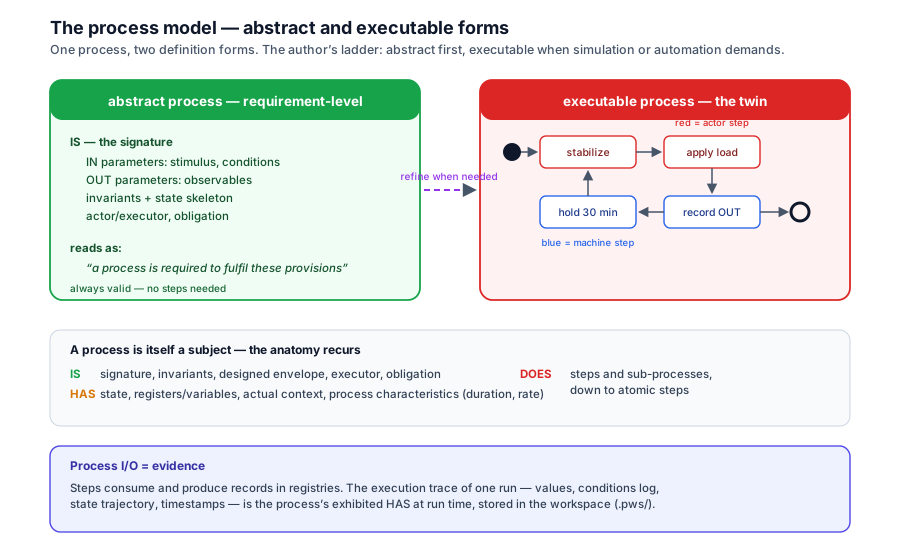
Every process is authored in one of two forms:
- Abstract process, the signature plus invariants, nothing more. It says what the process is and what must hold, not how it proceeds. In a reference model, an abstract process reads as “a process is required to fulfil these provisions”, it is requirement-level. An abstract process is always valid. Most processes in a standard need no more.
- Executable process, the signature plus concrete steps, transitions, and register operations: the executable digital twin of how the process actually proceeds. Required when the process must be simulated (R 91’s traffic-simulator tests), automated (workflow dispatch), or state-gated (warm-up enforcement).
The ladder rule: author abstract; refine to executable only when simulation or automation demands it. Executable steps are additive , an abstract process refined later is an extension, not a modification (OCP). The two forms live within one model; do not confuse this form axis with the model-kind axis of chapter 5 (reference vs implementation , related by mapping, never by refinement).
4.3 The classification facets: activity_kind and segregation:
Section titled “4.3 The classification facets: activity_kind and segregation:”Two optional facets enrich an abstract process beyond its signature. Both are classification, never inheritance: the process holds a reference into a register (or to its sibling processes), checked at link time, silent when the register is not in scope.
activity_kind: [<kind-id>, …], what kind of activity is this?
Conformity-assessment vocabularies (ISO/IEC 17000:2020’s functional
approach is the canonical case) classify every activity under functions
like selection, determination, review, decision, attestation. When such
a vocabulary is modelled as an activity-archetype register (chapter 8
, a package of classifiable kinds, each clause-anchored), an abstract
process may tag itself with one or more kind ids. Multi-kind is
deliberate: the vocabulary itself defines composite kinds (ISO/IEC
17065 3.3’s evaluation = selection + determination), and forcing a
single tag would falsify it. The register records a kind’s parent
only where the source standard states a type-of relationship, a
grouping title is not a taxonomy. Resolution: every tag must resolve
against a register composed into the same tree (linker-checked; an
unknown kind is an error); with no register in scope the facet is
inert documentation. Volume IV, chapter 2 shows the OIML-CS process
model tagged end to end, application as [selection], testing as
[testing], issue as [certification].
segregation: [{ id, kind, clause, pair?, … }], whose hands must
stay off this case? Certification standards carry non-involvement
norms: the reviewer shall not have been involved in the evaluation
(ISO/IEC 17065 7.5.1), nor the decider (7.6.2); complaint resolution
shall be independent of the case (7.13.5); consultancy creates a barred
relation, temporal where the standard fixes a period (7.13.6). These
are cross-process relations over personnel sets, relative to one
case, and they are first-class structured declarations, not
invariants: strings, for three disqualifying reasons: invariant
strings are never parsed by the toolchain (a rule that cannot fail is
not a rule); the constraint quantifies over several processes’
personnel, not one process’s own signature records; and the members
cannot be roles, a scheme may legitimately bind one role to
evaluation, review and decision (the OIML-CS binds issuing_authority
to all three), so the norms quantify over process involvement. Pair
members are therefore abstract-process ids; the reserved token
case_personnel names the case-relative personnel set. Two kinds cover
the shapes: case_personnel_disjoint (exactly two distinct pair
members) and consultancy_bar (barred relations, period only where
the standard fixes one). Declaration well-formedness is linker-checked;
per-assignment enforcement is the runtime’s (Volume IV, chapter 5).
source { doc "…" clause "…" }, which clause demands this process?
A third facet sits beside the classification pair, provenance rather than
classification (● primmel-ts 490bacc): the same source shape
requirement, table and calculation carry (chapter 9), now on processes.
One block names a doc + clause (plus an optional fragment); repeated
blocks collect into sourceRefs, with the scalar source keeping the
first entry (first-wins), so single-source processes read unchanged.
A process of a reference model can thereby answer “R 60-2, 2.10.1” the
way a requirement answers “R 60-1, 5.2”, clause-URN provenance for the
DOES, not just the IS.
4.4 The step vocabulary
Section titled “4.4 The step vocabulary”Eight step kinds cover the standard’s process content:
| Step kind | Meaning | Executor |
|---|---|---|
| action | do work: apply, record, compute, notify | machine or actor |
| approval | a role signs off; binds an approver role + an approval registry | actor |
| gateway | conditional branch; conditions on outgoing edges, in OCL | machine |
| parallel gateway | unordered conjunction, all branches required, no order | machine |
| start event | the one entry point of a process | , |
| end event | terminates a path; required on an empty gateway path to say “no requirement here” | , |
| timer event | a period or deadline; with a self-loop = recurrence (re-verification every N months) | machine |
| signal event | an external trigger starts/resumes the process | , |
Connection semantics, three rules only:
- Serial,
A → B: do A, then B. - Parallel, two unconditioned paths: both, in any order.
- Self-loop + timer, repeat with a period.
Gateway semantics: if edges carry OCL conditions, the satisfied path is taken (first match in document order; an explicit default edge catches the rest). If no edge is conditioned, the gateway is fulfilled when any outgoing path is fulfilled (the “implement at least one option” reading).
4.5 Executors
Section titled “4.5 Executors”Every step declares its executor as an IS-level property:
- machine, the engine runs it: OCL evaluation, gateway resolution, calculations, applicability expansion, state transitions, verdict re-execution.
- actor, a role performs it: the lab technician applies the load, the IA reviewer signs. Actor steps are recorded, not run: their outputs are captured through forms into evidence.
Executor typing is what makes “an executable suite of workflow programs” precise rather than rhetorical: the engine executes machine steps directly, drives actor steps by presenting their input forms, and treats the process as blocked until the actor’s record lands in the registry.
4.6 State and registers
Section titled “4.6 State and registers”A process’s HAS is where its memory lives:
-
state, the process’s state machine: named states and guarded transitions. Instrument-side example:
off → warming → ready → measuring → fault. Workflow-side example:draft → submitted → under_review → dispatched → …. Transitions are fired by steps and by cascades (a transition in one machine may set states in another, withwhereguards andcreateeffects). -
registers, typed variables the process reads and writes: measurement variables with source typing (chapter 6). A step’s I/O is declared in terms of registers. A register may also declare an initial value, its starting content, set at definition (● primmel-ts 490bacc; proof: the kernel’s
process-register-initialssuite):registers { capacity : mass = 50 kg remark : string = "unloaded" }The literal contract is the instance-value contract of chapter 6: one value token plus an optional unit (quote multi-word values, so the unit position stays unambiguous), or the
{ value … unit … }QuantityValue block form for the full structure. Initials are a registers facet only, signature parameters and call bindings take their values at the call, and an=there is a hard parse error, not a silently mis-parsed parameter. -
context, the actual conditions under which the process executes, logged per run.
Preconditions are OCL guards on entry: a violated run-validity
precondition voids the run as a run (its verdicts become invalid,
never fail), the state gate that keeps an unwarmed instrument from
producing misleading evidence.
4.7 Composition signature checks, typed transition boundaries (task 38) ●
Section titled “4.7 Composition signature checks, typed transition boundaries (task 38) ”An executable process composes steps over typed registers: one step
writes, the next reads, a calls step binds a sub-process’s signature.
That composition is sound only if every transition boundary
type-checks, and “sound” is a computed fact, not a review opinion.
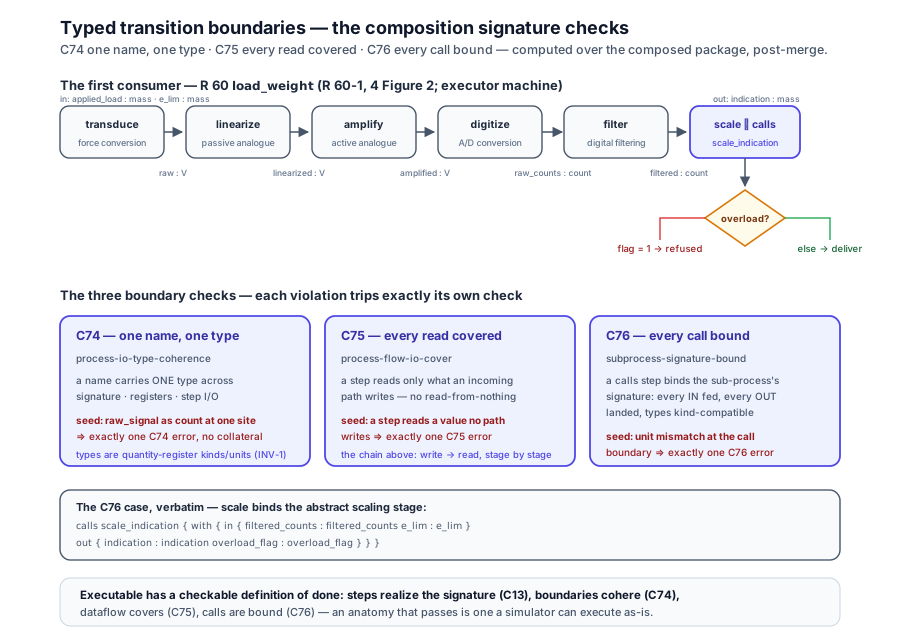
Three kernel checks (● primmel-ts, TODO.roadmap/38; chapter 11’s
C-catalog) police the boundaries over the composed package post-merge:
- C74 process-io-type-coherence, one name, one type. A name
declared at several sites (signature parameters, registers, step I/O)
carries ONE type across all of them;
raw_signal : voltagein the registers andraw_signal : countat a step boundary is an incoherent declaration, not a style deviation. - C75 process-flow-io-cover, every read has a writer. The step-chain dataflow covers every read: a step may read only what some incoming path writes. A read with no upstream producer is a gap in the chain, the step would execute against nothing.
- C76 subprocess-signature-bound, every call bound. A
callsstep binds the sub-process’s signature completely and kind-compatibly (with { in … out … }): every IN parameter fed, every OUT parameter landed, and the bound types compatible, a unit mismatch at the call boundary is an error at the boundary, not a surprise inside the callee.
The checks are surgical: each seeded boundary violation (one name
with two kind-incompatible declaration sites; a read no path writes; a
unit-mismatched call binding) trips exactly its own check with no
collateral findings, pinned in prl-check-all.test.ts over the
shipped packages.
The first real consumer is R 60’s load_weight (task 50, the
executable anatomy of the behavior with the same id, R30’s id-equality
link). The instrument’s own signal chain, calibrated against R 60-1, 4
Figure 2: transduce → linearize → amplify → digitize → filter → scale, then the overload_check gateway against e_lim (R 60-1,
3.5.16), executor machine throughout: the instrument runs its own
measurement, the first machine-executed process in the packages
(distinct from the actor-typed workflow processes of chapter 8 in
Volume II). Its signature (in { applied_load : mass, e_lim : mass },
out { indication, last_indication : mass, load_count : count }),
registers with honest initials (raw_signal : voltage = 0 V, the
ENGINEERING-DEFAULT pattern where the Recommendation gives no value),
and the scale step’s calls scale_indication { with { in { filtered_counts … } out { indication … overload_flag … } } } binding
the abstract, signature-only scaling stage, C76’s live case. Type
tokens come from the package’s quantity register (mass / voltage /
count / dimensionless), so INV-1 holds across the chain: no bare
numbers at any boundary.
The authoring consequence: refining an abstract process to executable (§4.2) now has a checkable definition of done, the steps realize the signature (C13), the boundaries cohere (C74), the dataflow covers (C75), and every call is bound (C76). An anatomy that passes is one a simulator can execute as-is (the platform annex’s simulated instruments interpret exactly this anatomy).
4.8 Process I/O = evidence
Section titled “4.8 Process I/O = evidence”Steps consume and produce records in registries (chapter 6): a test step reads the subject’s parameters, enforces conditions, and writes measurements; a workflow step reads an application and writes a dispatch.
The execution trace of one run, the filled registers, the
conditions log, the state trajectory, timestamps, the operator, is the
process’s exhibited HAS at run time. That trace is exactly what the
Evidence model stores, and it lives in the workspace (.pws/): one
record per filled slot, typed by the process output it satisfies. Facts
only: no verdicts in a trace (the firewall, chapter 1).
4.9 Repetition and instances
Section titled “4.9 Repetition and instances”Two parameterizations keep one process definition serving many runs:
- per-classification instances, the process declares instance
parameters keyed by a subject dimension (R 60:
n_runs= 5 for accuracy classes A/B, 3 for C/D). The applicability engine expands the concrete run plan per subject at execution time. - timer-driven recurrence, the process re-fires on a period (initial verification, then re-verification at legislated intervals; a tyre change on an ego meter re-triggers out of cycle via a signal event).
The continuous limit case: the monitor ●. Recurrence taken to its
limit is a process that never ends: the monitor, triggered by
schedule, signal, or a watched value’s change, looping fetch → freshness
→ evaluate → verdict → evidence (the loop is chapter 14, §14.5; the
runtime shipped, task 34).
Monitors evaluate against served instances, and the same endpoint
machinery makes a subject’s own processes remotely callable: an invoke
operation triggers a behavior over the wire (chapter 14, §14.4).
4.10 Processes across model kinds
Section titled “4.10 Processes across model kinds”The same process concept, three voices:
- in a reference model: “a process is required” (abstract form) , R 60-2’s creep test method is a requirement for a process, specified to step level but still normative, not actual;
- in an implementation model: “this is how we actually do it” (usually executable), the lab’s SOP, the platform’s dispatch workflow, mapped to the reference process (chapter 5);
- in the workspace: “this is what happened”, the execution traces.
4.11 Grammar sketch (illustrative v3 syntax)
Section titled “4.11 Grammar sketch (illustrative v3 syntax)”process creep_test { is { signature { in applied_load : mass, duration : time out indication_series : mass[] } preconditions { ocl{ self.state = #ready and self.warmed_up } } executor lab activity_kind [testing] # classification, not inheritance source { doc "urn:oiml:pub:r:60-2:2021" clause "2.10.1" } } has { registers { applied_load : mass = 50 kg stabilized : string = "pending" } } does { start_event s action stabilize { executor actor write conditions_log } action apply_load { executor actor set applied_load } action hold { executor machine wait duration } action record { executor machine capture indication_series } end_event e flow { s -> stabilize -> apply_load -> hold -> record -> e } }}
process review { is { activity_kind [review] } segregation [{ kind case_personnel_disjoint # cross-process, per case, pair [review, evaluation] # members are process ids clause "iso-iec-17065:7.5.1" # — never roles, never prose }]}4.12 Validation rules
Section titled “4.12 Validation rules”- exactly one start event per process; end events on every terminal path (mandatory on empty gateway branches);
- every gateway edge’s condition is OCL over declared registers;
- every step’s I/O names declared registers; every register is written by exactly one step kind (no competing writers);
- every precondition is an OCL Boolean over signature and state;
- an executable process’s steps realize its own signature (the OUT parameters are written; the IN parameters are read);
- the transition boundaries compose: one name carries one type across
signature/register/step-I/O sites (C74), every step read is covered by
an upstream write (C75), and every
callsbinding is complete and kind-compatible (C76); - a timer event’s period is a time primitive; a self-loop contains a timer (no unguarded infinite loops);
- every
activity_kindid resolves against an activity-archetype register composed into the same tree (silent when none is in scope); - every
segregation:entry is well-formed: a known kind, exactly two distinct pair members forcase_personnel_disjoint, pair members resolving to abstract-process ids,periodonly where the source standard fixes one; - an initial value appears only on a register, in the literal contract
(one value token + optional unit, or the
{…}QuantityValue block) , an=in a signature parameter or call binding is a parse error; - every
sourceblock names doc + clause; repeated blocks collect intosourceRefs, the scalarsourceholding the first.
4.13 Summary
Section titled “4.13 Summary”- A process is a subject: IS the signature, HAS the state and registers, DOES the steps.
- Abstract is always valid; executable is added when simulation or automation demands it.
activity_kindclassifies a process against a register (multi-kind deliberate);segregation:declares cross-process non-involvement over personnel sets, both classification, never inheritance;sourcecarries requirement-shape clause provenance.- Eight step kinds, three connection rules, two executor kinds.
- The composition signature checks (● task 38) make an executable
anatomy’s soundness computed: C74 one-name-one-type, C75
every-read-covered, C76 every-call-bound, the R 60
load_weightsignal chain is their first consumer. - Registers may declare initial values, a registers-only literal
contract; signature parameters and call bindings reject
=outright. - Preconditions void runs, never instruments; traces are facts, never verdicts.
- Per-classification instances and timer recurrence let one definition serve every run.
Next: Chapter 5, Mappings: reference and implementation models, and the coverage calculus.