
Chapter 9, Provenance and Documents
Chapter 9, Provenance and Documents
Section titled “Chapter 9, Provenance and Documents”In this chapter: the two-level provenance system, clause references and fragment addresses, both shipped, the
.prddocument artifact, model↔document maps, and the reconstruction loop that proves a model still says what its source says.
9.1 Why provenance is cross-cutting
Section titled “9.1 Why provenance is cross-cutting”Every element of a Primmel model is an interpretation of something a standards body published. That claim is only as strong as the ability to answer, for any element, instantly and mechanically: which clause of which document does this come from? Provenance therefore lives on the cross-cutting tier, it is a property of every element on every tier, not an aspect of any one model (chapter 2’s IS catalog lists it as an identity aspect of the subject precisely because a model of the wrong source is a different model).
Provenance serves three consumers:
- the author, who must defend every modelling decision against the text during review;
- the auditor, who must trace a verdict back through requirement, test, and evidence to the clause that demands it;
- the machine, which checks coverage (chapter 11) and reconstructs the document (§9.5), both are graph operations over provenance edges.
The running system already enforces the discipline: the OIML R 60
package declares its source collection in data/r60/standard.yaml
(source: { collection: sources/r060/collection.yml, primmel: primmel-packages/oiml-r60 }), and every requirement carries its clause
reference. The second, finer level, fragment provenance, shipped with
v3 (task 24, ● smart 83be1e6).
9.2 Level 1, clause provenance (● today)
Section titled “9.2 Level 1, clause provenance ( today)”The coarse level is a clause URN on every content element. The R 60 package’s canonical example, the requirement quoted in chapter 1:
- name: Maximum load of the measuring range identifier_fragment: measuring-range-max reference: "urn:oiml:pub:r:60-1:2021#clause-5.2" statement: | The value of the largest load applied to a load cell during test which is expressed in units of mass shall not be greater than E_max. binds_to: [sample.test_context.d_max, model.parameters.e_max](from data/r60/specification/requirements/metrological.yaml). The URN
pattern is urn:oiml:pub:{doctype}:{number}:{part}:{year}#clause-{n} ,
one string that names the document, the edition, and the exact clause.
Three supporting constructs make clause provenance first-class rather than decorative:
- The references registry (●
data/r60/references.yaml), every clause the package depends on is declared once (id: r60-1-5.2,document: "OIML R 60-1:2021",clause: "5.2",title: "Measuring range"). Elements cite clause ids; the linker (chapter 11) rejects a reference that resolves to no declared clause. - Source-discrepancy records (●), when the source contradicts
itself, the model says so instead of silently picking a side. R 60
records that the R 60-3 form criterion for the max-load humidity
effect (
C_Hmax ≤ MPE,urn:oiml:pub:r:60-3:2021#clause-2.1.7) contradicts the R 60-1 requirement text (C_Hmax ≤ 1 v,urn:oiml:pub:r:60-1:2021#clause-5.6.3.1), with an explicitresolution:field. The linker’ssource-discrepancyrule keeps the record honest. - Corpus-level discrepancy records (● primmel-ts 0dbcfd5, smart
8651182), the same conflict, one level up: some disagreements attach
to documents, not to any model node (PD-02, 11.1’s four-year expert
review vs OD-01, 13.4’s 3-yearly cycle, no requirement owns that).
The top-level
discrepancy_recordconstruct reuses the facet’s fields verbatim (summary/sources/resolution/rationale) and addsstatus: open | resolvedplusgoverning(the followed source, one ofsources). The discipline is mechanical (linker rule R33): a resolved record carries resolution + rationale;follows_clause_xrequiresgoverning;annotated_onlynever takes one, the conflict is recorded, no side picked; and anopenrecord prints at audit level instead of hiding in a comment. The record is the corpus’s errata memory: a coverage gap never re-litigates a settled disagreement. Volume IV, chapter 3 walks the three live records of the OIML-CS corpus. - The source collection (●
sources/r060/), the authoritative text itself, as a metanorma collection (collection.yml, parts1 2 3 a), with the compiled presentation of each part underdata/r60/documents/. The package manifest pins the model to this collection; nothing provenance-related is allowed to float free of it.
Clause provenance is necessary and insufficient. It tells you which clause, not which sentence, and it cannot support reconstruction, because a clause is not addressable at the granularity a model element actually interprets.
9.3 Level 2, fragments and the .prd artifact (●, shipped, task 24)
Section titled “9.3 Level 2, fragments and the .prd artifact (, shipped, task 24)”The fine level decomposes each source document into addressable
fragments, published as a .prd file, the Primmel Document, the
formal successor of the Demo .sdc seed. The R 60 package ships one
extract per part (data/r60/sources-prd/r60-{1,2,3}.prd.yaml, schema
data/schemas/prd.yaml, regenerable from sources/r060/, never
hand-edited). A fragment is:
- addressable, it has a stable address composed from the document
URN plus a fragment path:
urn:oiml:pub:r:60-1:2021#clause-5.2/s2names the second sentence of clause 5.2; - typed, provision, definition, table, figure, note, example, front-matter (the typed-supplement taxonomy of §9.6);
- normativity-marked, normative or informative, so coverage metrics know what must be modelled and what may be skipped;
- text-bearing, it carries the source text verbatim, because text identity is what the congruence check compares.
Model elements then bind fragment addresses, not just clause URNs ,
the map form source: { doc, clause, fragment? } on provisions,
attributes and requirements, beside the URN-string forms. The clause
URN remains as the coarse, human-legible citation; the fragment address
is the machine-checkable one, and linker rule R27
fragment-references resolves every binding against the cited
document’s .prd extract (bindings citing documents with no loaded
extract, external vocabularies, are skipped). A requirement’s
provenance answers “R 60-1, 5.2, second sentence”, and a reviewer no
longer has to guess which of the clause’s five sentences the limit
expression interprets. The twin direction reuses the machinery one
level over: the passport’s unique identifier is the same kind of
address, the public, fragment-level identity of the product, the one
a buyer or a DPP registry resolves (●, chapter 14, §14.6).
9.4 Model↔document maps
Section titled “9.4 Model↔document maps”The relation between a model and its source document is recorded as a
.prm map (chapter 5), the same artifact kind that maps
implementation models to reference models, applied to a second purpose.
Where a compliance mapping reads “fulfilling A fulfils B”, a provenance
mapping reads “element A realizes fragment B”. Each pair carries the
same two fields:
- description, how the element realizes the fragment (“the
measuring-range upper bound, expressed as a constraint on
sample.test_context.d_maxagainstmodel.parameters.e_max”); - justification, why the interpretation is faithful (“E_max is a
design parameter of the Model; the test load is exhibited per Sample;
the clause’s ‘shall not be greater’ is the
<=limit”).
Keeping this in a .prm rather than inline has the same payoff as in
chapter 5: the map is versioned independently of both endpoints, so an
edition change of the source document (chapter 13) invalidates the map
without touching the model.
9.5 Document reconstruction and the congruence check
Section titled “9.5 Document reconstruction and the congruence check”Provenance is complete only when it runs in both directions. The forward direction is authoring (text → model). The backward direction is reconstruction: the model emits an ordered fragment stream , each element renders its statement in canonical order, carrying its fragment address, and a congruence check compares that stream against the authoritative source on three axes:
| Axis | Question | Failure means |
|---|---|---|
| coverage | does every normative fragment appear in the stream? | the model silently dropped a clause |
| order | is the stream’s fragment sequence the source’s sequence? | the model reordered the logic of the document |
| text identity | does the fragment text in the model match the source verbatim (up to normalization)? | the model paraphrased and the paraphrase drifted |
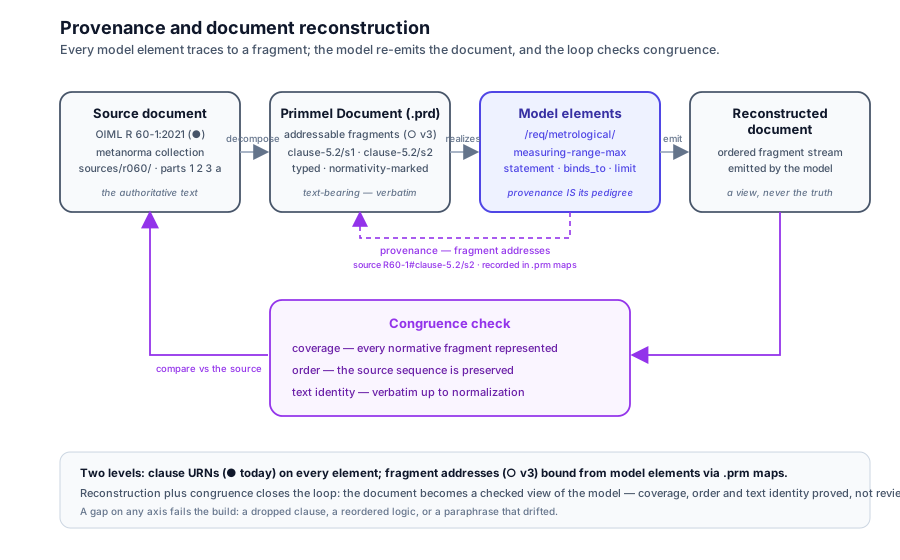
A package that reconstructs its source with full congruence has a remarkable property: the document is a view of the model, and the view is provably complete. This is the precise sense in which “the model is the source of truth” (design principle 1) stops being a slogan, the published document can be regenerated, and the regeneration is checked.
Reconstruction is shipped and gated (● smart 83be1e6, task 24). The
congruence gate (browser/build/prd-congruence.ts, validate §1g) runs
the three axes over the real corpus on every build, and its census is
test-pinned (prd-congruence.test.ts):
| Document | Normative fragments | Bound | Documented named gaps |
|---|---|---|---|
| R 60-1:2021 | 139 | 132 | 7 |
| R 60-2:2021 | 151 | 142 | 9 |
| R 60-3:2021 | 291 | 275 | 16 |
Every normative fragment is bound by ≥1 model element or carries a
documented named gap; the unbound-model-text axis is live and empty ,
every requirement carries a provenance binding. The gate is
mutation-proven: seeded coverage gaps, order inversions, text
mismatches, and stale named gaps each fail it in the test kit. The
sentence layer on the same extracts (task 26, ● smart d08e614) refines
the census: 274/293 normative sentences bound (93.5 %), 19
discharged by sentence-pinned allowance, 0 unresolved duplicates, and a
gated ratio of 100 % per part (R 60-1 150/154 covered + 4 allowed,
R 60-2 111/118 + 7, R 60-3 13/21 + 8, the release evidence block is
analysis/release-coverage-summary.txt). Chapter 11’s text-coverage
metric is the linter’s consolidation of the same discipline.
9.6 References, links, notes, figures
Section titled “9.6 References, links, notes, figures”Four document-machinery constructs round out the picture:
- References (●), the normative-references registry of §9.2; first-class, id-keyed, linker-checked.
- Links (●), cross-references between elements (a form referencing its test, a gateway referencing a state). The rule is chapter 1’s closed under reference: every identifier resolves, and the linker is the enforcement. A link that resolves to nothing is a build error, not a dead hyperlink.
- Notes and examples (●), typed supplements, declared in
data/r60/notes.yamlwithtype: NOTE | EXAMPLE | WARNING | INFO(R 60 uses onlyNOTE) and linker-checked attachment points (note_runs_ab_vs_cd: “Classes A and B require 5 identical load applications per test point…”). This is the running form of the IEC-ISOProvisionSupplementtaxonomy. - Figures (◐/○), figures live with the source parts today
(
sources/r060/1/images/) and ride along in the compiled presentation; v3 makes them typed fragments so a figure, like a table, is addressable and covered. Tables are modelled as data (chapter 6), never as text, so “the table” and “the requirement citing the table” have separate, checkable provenance.
9.7 Grammar sketch (illustrative v3 syntax)
Section titled “9.7 Grammar sketch (illustrative v3 syntax)”document R60-1 { urn "urn:oiml:pub:r:60-1:2021" extract of "sources/r060/1"
fragment clause-5.2 { kind provision normative true title "Measuring range" sentence s1 "The value of the smallest load applied to a load cell during test … shall not be less than E_min." sentence s2 "The value of the largest load applied to a load cell during test … shall not be greater than E_max." }}
requirement /req/metrological/measuring-range-max { statement text/… # chapter 10 content set provenance { source R60-1#clause-5.2/s2 } # fragment address binds_to [sample.test_context.d_max, model.parameters.e_max] limit ocl{ sample.test_context.d_max <= model.parameters.e_max }}
map r60-model-to-r60-1 (provenance) { mapping { from /req/metrological/measuring-range-max to R60-1#clause-5.2/s2 description "Upper bound of the measuring range as a constraint on exhibited test load vs design capacity." justification "E_max is design-fixed on the Model; d_max is exhibited per Sample; 'shall not be greater' is <=." }}
reconstruct R60-1 from oiml-r60 { order by fragment address check { coverage, order, text_identity }}
discrepancy_record pd-02-vs-od-01-expert-review-cycle { status resolved summary "PD-02, 11.1 prescribes a four-year expert-review cycle 'as outlined in OD-01, 13.4', which prescribes a 3-yearly cycle" sources { "urn:oiml:pub:cs:pd-02:2022#clause-11.1" "urn:oiml:pub:cs:od-01:2022#clause-13.4" } resolution annotated_only # follows_clause_x ⇒ governing required rationale "Both official texts verified verbatim … a CID-01 clarification candidate."}9.8 Validation rules
Section titled “9.8 Validation rules”- every content element carries a clause reference; every clause reference resolves against the references registry (● linker);
- every fragment address resolves to a declared fragment in the cited
.prddocument (● linker rule R27fragment-references); fragment addresses are unique per document; - a
.prmprovenance map’s endpoints both resolve, the model element and the fragment, and its direction is model → document, never the reverse; - the reconstruction stream covers every normative fragment of the
source; a coverage gap, an order inversion, or a text mismatch fails
the congruence check (● validate §1g, mutation-proven in
prd-congruence.test.ts); - a
source_discrepancyrecord names at least two conflicting sources and an explicit resolution; the linker’ssource-discrepancyrule verifies both citations resolve; - a corpus-level
discrepancy_recordadds the corpus wrapper’s laws (R33): every URN insourcesresolves;status: resolvedrequires resolution + rationale;follows_clause_xrequiresgoverningnaming one of the sources;annotated_onlyforbids it;openprints at audit level.
9.9 Summary
Section titled “9.9 Summary”- Provenance is cross-cutting: every element answers “which clause of which document”, for author, auditor, and machine alike.
- Level 1 (● today): clause URNs on every element, a references
registry, source-discrepancy records on nodes and
discrepancy_recordat the corpus level, a pinned source collection. - Level 2 (● task 24):
.prdfragments, addressable, typed, normativity-marked, text-bearing, bound from model elements and resolved by linker rule R27. - Model↔document relations are
.prmmaps: description + justification, versioned independently of both endpoints. - Reconstruction emits the ordered fragment stream; congruence = coverage + order + text identity, shipped and gated (● validate §1g): R 60’s 581 normative fragments all bound or named-gap, 274/293 normative sentences bound (93.5 %, 19 allowances, 0 unresolved duplicates), gated ratio 100 % per part. A congruent package regenerates its document as a checked view.
Next: Chapter 10, Multilinguality: ISO 24229 spelling codes on every human-readable string.